Part 2: The Girl Left a $100 Tip for a Pregnant Diner Waitress — 10 Years Later, She Recognized the Woman Across the Interview Table
At first, Elena Ruiz thought the note was meant for someone else.
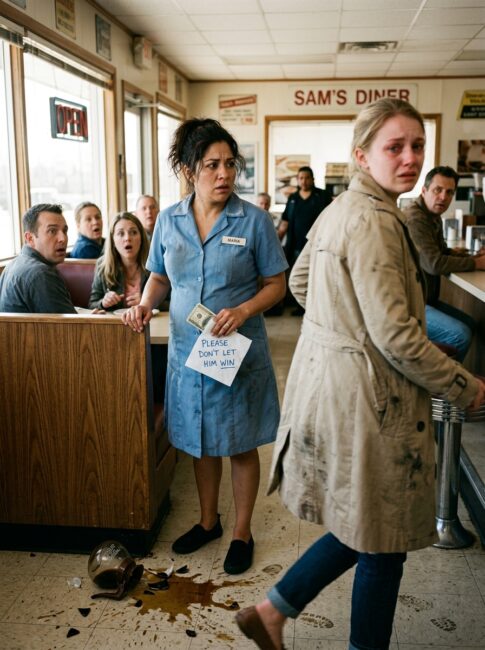
She stood beside booth seven, one palm on the curve of her belly, the other holding that damp napkin as if it might disappear. The diner noise returned slowly. Forks tapped plates again. Coffee poured. Someone laughed too loudly near the window, trying to cover the awkwardness.
But Elena could still feel everyone looking at her.
The owner, Mr. Hanley, came out from behind the register with the check in his hand.
“Did she pay?” he asked.
Elena looked at the untouched pancakes, then at the hundred-dollar bill.
“She left this.”
His eyebrows rose.
“For a seven-dollar breakfast?”
Elena did not answer.
She had seen plenty of strange things in Bluebird Diner. Lonely men ordered birthday cake alone. Mothers counted coins before buying their children grilled cheese. Couples broke up in booths and left lipstick on coffee mugs.
But she had never seen a young woman run from generosity like it was a crime.
Mr. Hanley reached for the money.
Elena pulled it back.
“I’ll cover the meal from this,” she said.
“That’s not how tips work.”
“I know.”
He stared at her for a second, then shrugged. “Your call.”
Elena tucked the bill into her apron pocket, but the napkin stayed in her hand. Five words. No name. No explanation.
Please don’t let him win.
The strange part was not the money.
The strange part was that Madison had looked terrified.
Not guilty. Not proud. Terrified.
By noon, the rain had turned the parking lot into a dull mirror. Elena’s shift should have ended at two, but another waitress called in sick. She stayed until five, refilling coffee for people who never noticed how often she winced.
At six, when she finally removed her apron, the diner phone rang.
Mr. Hanley answered, listened, and frowned.
“Elena,” he said quietly. “Someone’s asking for you.”
She walked over.
“Hello?”
There was only breathing at first.
Then Madison’s voice came through, thin and unsteady. “Did you get it?”
Elena glanced at Mr. Hanley, then turned her back.
“The money?”
“The note.”
Elena swallowed. “Yes.”
A long pause followed.
“I’m sorry I left like that,” Madison whispered. “I couldn’t stay.”
“Are you in trouble?”
Another pause.
Then Madison laughed once, but it sounded broken. “People keep asking me that like trouble is a place you can walk out of.”
Elena pressed the receiver closer.
Outside, headlights slid past the wet windows.
“Where are you?” Elena asked.
“I shouldn’t have called.”
“Madison, right? That was the name on your card?”
The line went quiet.
Elena realized too late that the young woman had paid with cash for the coffee refill earlier, not a card. She had guessed. Maybe badly.
But Madison said, “Yes.”
Elena heard a door close on the other end.
“I saw the bruise,” Madison said.
Elena’s fingers tightened around the cord.
“What?”
“On your wrist. When you poured my coffee.”
Elena looked down. Her sleeve had slipped earlier. She remembered pulling it back quickly, hoping no one had noticed the dark crescent near her thumb.
Nobody ever noticed.
Or maybe they did and chose not to.
“That’s none of your business,” Elena said, but her voice lacked anger.
“I know,” Madison said. “Mine wasn’t anyone’s business either. Until it almost killed my mother.”
Elena closed her eyes.
There it was.
A crack in the wall.
“You left me a hundred dollars because you saw a bruise?”
“No,” Madison said. “I left it because I recognized your smile.”
Elena did not understand.
Madison continued, her voice dropping lower. “My mom smiled like that when she served dinner with a split lip. Like if she smiled hard enough, nobody would ask why she was bleeding.”
The diner around Elena blurred at the edges.
Mr. Hanley was counting the register. A child was dragging a straw wrapper through ketchup. The pie case hummed softly.
Everything looked normal.
That was the worst part.
“Why would you write that note?” Elena asked.
“Because someone wrote it for my mother once.”
A car horn sounded on Madison’s end. She inhaled sharply.
“I have to go.”
“Wait,” Elena said.
But Madison kept talking fast, like she had only borrowed courage and had to return it soon.
“There’s a women’s shelter two towns over. Gray building behind the library. Ask for Ruth. Don’t call from home. Don’t pack anything that makes noise. Don’t tell him you’re leaving.”
Elena’s knees weakened.
Him.
Madison knew enough to say him.
“I didn’t ask for help,” Elena said.
“I know.”
“I don’t even know you.”
“I know.”
“Then why are you doing this?”
For a moment, all Elena heard was rain.
Then Madison said, “Because a stranger did it for us, and my mother waited too long to believe her.”
The line clicked dead.
Elena stood with the receiver in her hand until Mr. Hanley said her name twice.
That night, she went home to a narrow apartment above a pawn shop. Her husband, Victor, was sitting in the dark watching television with the sound low. He did not ask why she was late. He asked how much she made.
Elena lied.
“Thirty-two dollars.”
Victor held out his hand.
She gave him twenty.
He stared at her.
“Where’s the rest?”
“Lunch.”
His eyes moved slowly over her face, searching for the place where fear began.
Elena placed one hand over her belly.
The baby kicked.
Victor smiled.
Not warmly.
“You’re getting forgetful,” he said. “Must be the baby.”
Later, while he slept, Elena sat on the bathroom floor with the fan running to cover the sound of paper unfolding.
The hundred-dollar bill was under the bath mat.
The napkin was in her bra.
Please don’t let him win.
She read the words until they no longer looked like a stranger’s message.
They looked like a door.
Elena did not leave the next morning.
That was the part no one understood when the story was told years later.
People liked clean bravery. They liked a woman grabbing a suitcase, walking into sunrise, and never looking back. They liked courage that made sense from the outside.
Elena’s courage was quieter than that.
It hid in the freezer behind a bag of peas, where she taped twenty-dollar bills after every shift. It hid in the way she started taking longer routes home, memorizing street names. It hid in the small backpack she packed and unpacked every night, because even the sound of a zipper could wake Victor.
For three weeks, Madison’s hundred-dollar bill remained untouched.
Elena could not spend it.
It felt like proof someone had seen her.
And seeing was dangerous.
Victor grew suspicious anyway. Men like him often felt change before they saw it. He noticed when Elena stopped flinching at every raised voice. He noticed when she asked Mr. Hanley for extra hours. He noticed when she began sleeping with her shoes beside the bed.
One evening, he found the shelter address written inside a matchbook.
He did not hit her that night.
That would have been easier to understand.
Instead, he cried.
He sat at the kitchen table with his head in his hands and said he was scared. He said he had been under pressure. He said his father had taught him no better. He said a baby needed two parents.
Then he reached for Elena’s hand and kissed the bruise he had made.
“I’ll change,” he whispered.
Elena wanted to believe him so badly it hurt.
That was the cruelty of love after fear. It did not vanish all at once. It lingered in corners. It remembered the first good days. It asked whether leaving meant giving up.
The next morning, Victor brought her flowers from the gas station.
The morning after that, he smashed her phone because she did not answer quickly enough.
Elena left three days later.
Not during a fight.
Not with sirens.
Not dramatically.
She left while Victor was at work and the rain was falling just hard enough to blur the windows of the bus. She wore an oversized coat, carried one backpack, and had eighty-six dollars in her shoe.
The hundred-dollar bill from Madison was tucked inside the baby book she had bought from a thrift store.
At the shelter, Ruth was older than Elena expected. She had silver hair, square glasses, and a voice that did not rush.
“Do you have somewhere safe tonight?” Ruth asked.
Elena shook her head.
“Does he know you’re here?”
Another shake.
“Are you ready for how hard this may become?”
Elena looked down at her belly.
The baby turned under her palm.
“No,” she said honestly.
Ruth nodded. “That’s all right. Ready is not always required. Sometimes present is enough.”
Elena slept that night in a room with three other women and a radiator that clanked like an old train. She woke every hour expecting Victor’s key in the lock.
Instead, she heard a toddler coughing, a woman crying into a pillow, and the rain moving down the glass.
Her son was born eighteen days later.
She named him Mateo.
In the hospital, a nurse asked if there was anyone to call.
Elena thought of her mother in Arizona, who had stopped answering after Victor called her a liar. She thought of Mr. Hanley, who had given her last paycheck in cash and pretended not to see her shaking hands.
Then she thought of Madison.
But she had no phone number. No last name she could prove. No way to say, “Your note reached me before I drowned.”
So Elena wrote a letter she could not send.
Dear young woman from booth seven,
You do not know me, but I am alive.
She folded it and placed it behind Madison’s bill in the baby book.
Years passed with the slow violence of ordinary survival.
Elena cleaned offices at night and took community college classes online while Mateo slept beside her textbooks. She learned accounting because numbers did not shout. Numbers did not slam doors. Numbers stayed where they were placed.
By the time Mateo entered kindergarten, Elena had become a payroll assistant at a nonprofit that helped women rebuild their lives after crisis. She was not wealthy. She still counted grocery totals in her head. She still parked under streetlights.
But she had keys no one could take.
She had a lease in her own name.
She had a son who believed footsteps in a hallway meant someone was coming home, not someone was coming to hurt them.
One afternoon, when Mateo was seven, he found the old baby book in a closet.
“Mom,” he called. “Why is there money in here?”
Elena came into the room and saw him holding the faded hundred-dollar bill like a museum artifact.
Her breath caught.
“That,” she said, sitting beside him, “was the first brick in the road that brought us here.”
Mateo frowned.
“A brick?”
She smiled. “A very expensive brick.”
He turned it over and found the folded letter behind it.
“Who’s Madison?”
Elena went still.
She had written the name years earlier, after finally finding it on an old diner schedule. Mr. Hanley had remembered the young woman because she returned once, a week after Elena left, and asked if the pregnant waitress was all right.
When Mr. Hanley said Elena had quit, Madison cried.
Then she left another hundred dollars and told him to give it to Elena if she ever came back.
Elena never did.
Mr. Hanley mailed it to the shelter months later.
That was twist number one Elena carried in silence: Madison had not disappeared after the note. She had returned.
There was another twist too.
Madison had not been rich.
The silver watch on her wrist that morning had belonged to her mother. The polished coat had come from a church donation rack. The hundred dollars had been nearly all she had left after buying a bus ticket to another city.
Elena learned this only because Ruth knew Madison’s mother.
The stranger who had saved Elena was not a wealthy girl performing kindness from a comfortable distance. She was a frightened daughter spending survival money on someone else’s escape.
For years, Elena tried to find her.
She searched social media. She asked Ruth. She called old shelters. Nothing. Madison Vale became a name that lived in Elena’s prayers but not in her contact list.
Time carried them forward anyway.
Madison built her life in fragments too.
After that morning at Bluebird Diner, she moved three states away, finished college at night, and worked in human resources for companies that talked a lot about culture and very little about mercy.
She became good at reading people in interviews.
Too good, sometimes.
She could spot the candidate who had slept in a car. The woman who apologized before answering. The man who wore confidence like borrowed clothes.
Madison never told anyone about the diner. Not even close friends. It had become one of those private memories that shaped her without asking permission.
By thirty-two, she had a résumé that looked stronger than she felt. Then the company she worked for downsized, replacing half its staff with software and cheerful emails about efficiency.
For the first time in years, Madison was unemployed.
She sent applications into silence.
She borrowed rent from a friend.
She almost pawned her mother’s watch.
Then she got an interview at a growing nonprofit called Second Harbor Family Services.
The position was Director of People Operations.
The salary was better than anything she had earned before. The mission made her chest tighten. The office was in a renovated brick building with plants in the lobby and children’s drawings framed along the hall.
Madison arrived twenty minutes early.
She wore the same silver watch.
It had a scratch across the face now.
In the waiting room, a little boy about ten sat at a table drawing a lighthouse. He looked up and said, “Are you here to help people too?”
Madison smiled. “I’m here to try.”
“That’s what my mom says all the time.”
Before she could ask more, a woman stepped into the lobby with a folder in her hands.
“Elena Ruiz?” the receptionist said.
The woman nodded.
Madison did not recognize her at first.
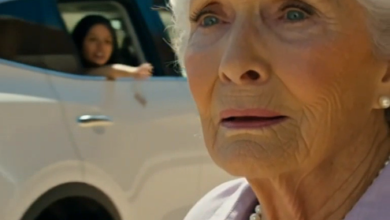
Ten years had changed Elena. Her face was fuller, calmer. Her hair was shorter. Her posture had become something solid. She wore a navy blazer and flat shoes, and her left hand held the folder without trembling.
But then Elena turned.
Their eyes met.
The room seemed to lose sound.
Madison saw booth seven. Rain on glass. A swollen belly. A bruised wrist. A napkin under a cup.
Elena saw a young woman with red eyes, a silver watch, and fear dressed as politeness.
The folder slipped slightly in Elena’s hand.
Madison stood too quickly.
Neither woman spoke.
The receptionist glanced between them. “Ms. Vale, Ms. Ruiz will be leading your interview.”
Madison’s mouth went dry.
Of all the rooms in all the years, she had walked into this one.
Elena looked at the résumé in her folder, then back at Madison.
Her professional smile appeared, but it did not hold.
“Ms. Vale,” she said softly. “Please come in.”
The interview room had a round table, two glasses of water, and a window overlooking a small playground. Madison sat across from Elena and tried not to stare at the woman she had wondered about for a decade.
Elena opened the folder.
Her eyes landed on the name again, as if confirming it was real.
“Before we begin,” Elena said, “I need to ask you something that is not on your résumé.”
Madison nodded.
Elena reached into her folder and removed a folded napkin sealed inside a plastic sleeve.
The handwriting was faded.
Please don’t let him win.
Madison covered her mouth.
Elena’s eyes filled, but she did not cry yet.
“Was this you?”
Madison looked at the napkin, then at Elena.
“Yes,” she whispered.
Elena placed beside it an old hundred-dollar bill, flattened and preserved.
“I never spent it,” she said.
Madison shook her head, confused. “You should have. That was the point.”
“I know. But by the time I understood that, it had already become something else.”
The playground outside was empty, swings moving slightly in the wind.
Madison’s voice broke. “Did you get out?”
Elena smiled through tears.
“My son is in the lobby drawing lighthouses.”
That was when Madison cried.
Not delicately. Not professionally. She cried like someone who had been holding her breath for ten years and had only just been told the person inside the burning house had survived.
Elena reached across the table and took her hand.
For a moment, there was no interview.
No title.
No salary.
Only two women on opposite sides of the same old storm, recognizing the weather in each other.
Elena did not hire Madison because of the hundred-dollar bill.
That would have made the story too simple.
She still asked the questions. She asked about conflict, leadership, hiring practices, policy, retention, and how Madison handled people who came to work carrying invisible emergencies.
Madison answered carefully at first.
Then honestly.
She spoke about workplaces that punished people for being human. She spoke about managers who mistook fear for attitude and exhaustion for laziness. She spoke about building systems that left room for the kind of crisis people rarely named out loud.
Elena listened without interrupting.
Near the end, she asked, “Why do you want to work here?”
Madison looked toward the window.
Outside, Mateo had come into the playground with a staff member. He was testing the swings, his coat too big at the shoulders.
Madison watched him push off the ground, laughing as if the world had never been dangerous.
“Because someone helped my mother once,” she said. “And I spent a long time thinking kindness was only a moment. I think I’m old enough now to understand it can be a structure.”
Elena closed the folder.
“That is the best answer I’ve heard all week.”
Madison gave a small, embarrassed laugh.
“I practiced something much more polished in the car.”
“I’m glad you forgot it.”
They sat quietly.
There was one more thing Elena had not told her.
She stood, walked to a small shelf behind her desk, and took down a framed photograph. In it, a younger Elena stood outside a small apartment building with Mateo on her hip. He was maybe two years old, wearing one sock and holding a toy truck.
Taped inside the frame, just visible at the bottom, was a corner of the original hundred-dollar bill.
“I kept it there during college,” Elena said. “Every time I wanted to quit, I looked at it and remembered somebody had bet on me before I could bet on myself.”
Madison touched the frame lightly.
Her mother had died three years earlier. For months after the funeral, Madison had felt that all the old pain had gone nowhere. It had only changed rooms.
Now, sitting across from Elena, she felt something inside that grief loosen.
“My mom would have loved knowing this,” Madison said.
“What was her name?”
“Caroline.”
Elena repeated it gently. “Then Caroline is part of this place too.”
Two weeks later, Madison began work at Second Harbor.
On her first day, she found a small envelope on her desk. Inside was not the hundred-dollar bill. Elena had kept that, and Madison was glad.
Inside was a new hundred-dollar bill and a note in Elena’s handwriting.
For the next person you recognize before they can explain.
Madison laughed, then cried, then placed the bill inside her top drawer.
She did spend it eventually.
Not all at once.
Twenty dollars for a rideshare when a new employee needed to leave a bad situation quickly. Fifteen for lunch when a caseworker forgot her wallet after a night shift. Thirty for a grocery card nobody asked for directly. The rest for a pair of shoes a woman wore to court.
Each time, Madison wrote nothing dramatic.
No speeches.
No grand declarations.
Just small notes when they were needed.
Take the long way home tonight.
You are not a burden.
Call Ruth before you call him.
Years later, when Mateo graduated high school, he invited Madison to sit with the family. Elena cried before his name was even called. Madison brought flowers and wore the silver watch, still scratched, still ticking.
After the ceremony, Mateo hugged her with the careless strength of a boy who had been loved well.
“My mom says you helped us before I was born,” he said.
Madison looked over his shoulder at Elena, who was wiping her eyes with the corner of the program.
“I only left a tip,” Madison said.
Mateo shook his head. “No. You left a door open.”
Madison had no answer for that.
As the crowd moved around them, Elena slipped the old preserved napkin into Madison’s hand. For a second, Madison thought she was giving it back.
But Elena folded Madison’s fingers around it and smiled.
“Keep it today,” she said. “I don’t need the reminder anymore.”
Madison looked down at the faded words.
Please don’t let him win.
Then she looked at Elena standing in the sunlight, at Mateo laughing with his friends, at the ordinary afternoon that had taken ten years to arrive.
She finally understood.
He hadn’t.
And if this story stayed with you, follow the page for more heartfelt stories about the quiet moments that change a life.