Part 2: The Girl Mocked for Not Having the New iPhone — Until the Crisis Came and She Saved Everyone
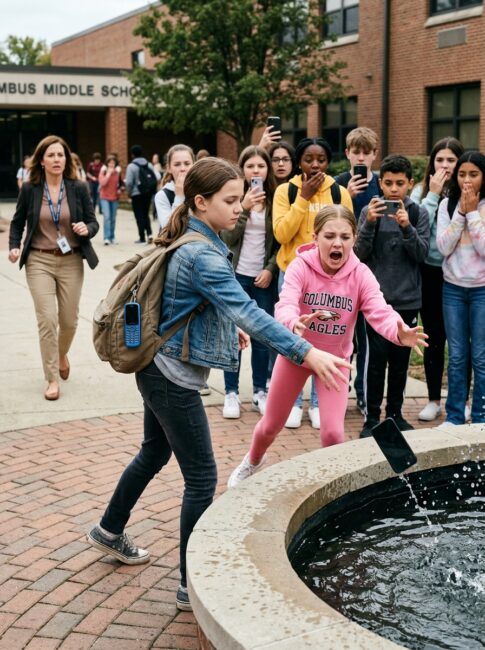
By noon, Lily Parker was sitting outside Principal Meredith Grant’s office with wet shoes, a detention slip, and twenty-seven unread messages she had no way of seeing.
Not because she was ignoring them.
Because her phone could not receive group chats, videos, or the cruel little memes already spreading through the seventh grade.
Inside the office, Madison Vale was crying hard enough to make her mother’s mascara run. Her father, a tall man in a gray suit, stood beside her with one hand on his hip and the other pointing through the glass window.
“That phone cost more than some people’s rent,” he said loudly enough for Lily to hear.
Lily looked down at her sneakers.
They were clean but old, the white rubber cracked near the toes. Her backpack had a hand-stitched patch over one corner, not decorative, just practical. Everything about her looked like someone was trying very hard to make worn things last.
Mrs. Grant opened the door and called her in.
Lily entered slowly.
Madison sat in the chair closest to the desk, wrapped in her pink hoodie like a victim in a courtroom drama. Her mother rubbed her shoulders. Her father did not even look at Lily like she was a child.
He looked at her like she was a problem.
“Do you understand what you did?” Mrs. Grant asked.
Lily nodded.
“Then explain it.”
Lily opened her mouth, but no words came out.
It was not defiance. Mrs. Grant had seen defiance before. Defiant kids crossed their arms, rolled their eyes, smirked at the floor.
Lily only stared at the principal’s desk, at a little gold paperweight shaped like an apple, while her fingers twisted around the strap of her backpack.
“She did it because she’s jealous,” Madison said. “She’s always weird about people having nice things.”
Lily’s eyes lifted for one second.
Something moved across her face, not anger exactly. More like pain trying not to become sound.
Mrs. Grant noticed.
So did nobody else.
“Lily,” the principal said more gently, “why did you throw Madison’s phone into the fountain?”
Lily swallowed.
“It was hot.”
Madison’s father laughed once, sharp and ugly.
“Hot? That’s your excuse?”
Lily flinched.
Mrs. Grant held up a hand. “Let her finish.”
Lily looked at Madison’s mother, then at the floor again.
“The back was puffed out,” she whispered. “A little. Near the side. And it smelled like pennies.”
No one spoke.
Madison frowned. “What does that even mean?”
Lily shook her head. “I don’t know. I just thought…”
“You thought you could steal my phone and throw it in water?” Madison snapped.
“I didn’t steal it.”
“You grabbed it.”
“It buzzed weird.”
“Phones buzz.”
“Not like that.”
Madison’s father stepped forward. “This is ridiculous. She destroyed private property. We expect the school to handle this properly.”
Mrs. Grant looked at Lily again.
There was something in the girl’s hands now. They were shaking, but not with guilt. With memory.
“Lily,” the principal said, “how would you know what a damaged phone smells like?”
Lily pressed her lips together.
For a moment, it seemed like she might answer.
Then the office phone rang.
Mrs. Grant picked it up, listened, and her expression changed.
“Yes, we’re coming,” she said.
She hung up.
“The assembly is starting. We’ll continue this afterward.”
Madison’s father was not satisfied, but the principal had already stood.
It was the last hour before winter break, and Roosevelt Middle School was holding its annual community assembly in the gym. Parents had been invited. The student council was presenting a donation drive for a nearby family shelter. Local reporters were there too, filming a cheerful holiday segment about kindness and technology in schools.
The irony would not become clear until later.
Lily walked into the gym behind Madison, her detention slip folded in her pocket like a sentence.
The gym smelled of floor polish, paper decorations, and the warm plastic scent of extension cords. A long table near the stage held donated tablets, chargers, laptops, and smartphones for a “technology access” display sponsored by Madison’s father’s company.
A banner stretched behind it.
Connecting Every Child.
Students filled the bleachers. Parents sat in folding chairs. Madison rejoined her friends and immediately whispered something that made three girls turn and stare at Lily’s flip phone clipped to her backpack.
“Maybe they’ll donate her a real phone,” one of them murmured.
Lily sat at the end of the second row, close to the aisle, close to the exit.
That was another thing Mrs. Grant noticed.
Lily always sat near exits.
Not because she was trying to leave.
Because she watched them.
On stage, Madison’s father adjusted the microphone and smiled like a man used to being admired. He spoke about opportunity, innovation, equal access, and the importance of every student keeping up with the modern world.
Lily listened with her head down.
Beside her, an older janitor named Mr. Alvarez paused while pushing a mop bucket along the wall. He had been at Roosevelt for nearly twenty years, long enough to know which kids were trouble and which kids carried trouble quietly.
He glanced at Lily’s face.
“You all right, mija?” he whispered.
Lily nodded too quickly.
Mr. Alvarez looked toward the technology table, then toward the outlet strip behind it. His brow tightened.
“Smell that?” Lily whispered.
He leaned closer.
For a second, he seemed confused.
Then his eyes sharpened.
A faint odor drifted under the music and applause. Metallic. Bitter. Hot.
Mr. Alvarez turned toward the outlet strip again.
Before he could move, the gym lights flickered once.
The microphone popped.
A few students laughed.
Madison’s father tapped the mic and joked, “Looks like even our building wants an upgrade.”
People chuckled.
Lily did not.
Her eyes had locked on a small charger brick near the technology table.
One corner of it had gone slightly brown.
The wire beside it trembled with a tiny, almost invisible thread of smoke.
Lily stood.
A teacher behind her hissed, “Sit down.”
But Lily was already moving.
The first sound was not an explosion.
It was smaller than that.
A hard crack.
Like a tree branch snapping under ice.
Then the lights went out.
For one breath, the gym stayed silent, held inside sudden darkness.
Then hundreds of children began to scream.
Emergency lights clicked on along the walls, but only two of them worked. The gym fell into a dim red haze. A fire alarm chirped, stuttered, and died halfway through its own warning.
Something under the technology table sparked blue.
Parents rose from their folding chairs. Students shoved against each other on the bleachers. Someone yelled that they smelled smoke. Someone else shouted for the exits.
The doors at the far side of the gym did not open.
Mr. Alvarez knew why immediately.
The school had installed new electronic safety locks after a security scare the previous fall. During a power failure, they were supposed to release.
But old buildings do not always obey new promises.
Mrs. Grant pushed through the crowd. “Everyone stay calm. Teachers, move students toward the main doors.”
The main doors were already jammed with bodies.
Madison was crying again, but this time no one was paying attention to her phone.
Lily was on the floor beneath the technology table.
At first, it looked like she had fallen.
A gym teacher grabbed her shoulder. “Lily, get out from there!”
She pulled away and reached behind the table leg.
The charger brick popped again.
The teacher stumbled back.
Lily yanked the heavy power strip from the wall, then kicked it away with the side of her sneaker. Sparks spat against the floor where the cord scraped.
“Don’t touch the metal legs,” she shouted.
Her voice cracked, but it carried.
That was the first time anyone in the gym heard Lily Parker sound older than twelve.
Mr. Alvarez came running with a fire extinguisher. Lily pointed, not at the smoke, but at the table skirt.
“Under there!”
He dropped to one knee, lifted the fabric, and saw the small lick of flame beginning to crawl up a cardboard donation box.
He sprayed it fast.
White powder burst across the stage.
The crowd recoiled.
The smoke thinned, but panic had already found its shape.
Madison’s father was near the microphone stand, shouting into a dead system. His polished confidence had vanished. His wife held Madison against her chest while searching for a signal on her phone.
No service.
Too many people were trying at once. The gym was half underground on the north side, and the storm outside had knocked down a cellular booster near the school roof.
Students waved expensive phones in the air like useless candles.
Lily reached into her backpack.
The blue flip phone came out.
A boy in the bleachers actually laughed.
Even then.
“What’s she gonna do, call 1998?”
Lily ignored him.
She flipped the phone open and pressed three buttons with her thumb.
Then she stopped.
Not because she forgot.
Because the screen blinked once and died.
The laughter came again from somewhere in the dark, nervous and mean.
Lily stared at the dead screen.
For half a second, her face fell.
Then she turned the phone over, slid off the back cover, and pulled out the battery.
Mrs. Grant watched from five feet away, confused.
Lily reached deeper into her backpack and took out a second battery wrapped in a piece of cloth.
Nobody laughed now.
She snapped it in, powered the phone on, and tried again.
This time, the call connected.
Her voice changed.
Calm. Flat. Precise.
“This is Roosevelt Middle School, 3147 West Broad Street. We have a small electrical fire contained, partial power loss, locked gym doors, and approximately three hundred people inside. There may be smoke exposure. We need fire and EMS.”
Mrs. Grant stared at her.
So did Madison’s father.
The dispatcher asked questions.
Lily answered every one.
No, the active flame was out.
Yes, there was smoke.
Yes, the exits were blocked.
No, no visible injuries yet.
Then a boy screamed from the bleachers.
A seventh grader named Owen had slipped while climbing over a row, twisting his ankle hard between the wooden seats. His mother tried to reach him but got pushed back by the crowd.
The panic surged again.
Lily turned to Mrs. Grant.
“Tell everybody to sit down.”
Mrs. Grant blinked.
“What?”
“They’re crushing each other because they’re standing. Tell them to sit down, then move by rows.”
For one terrible second, the principal hesitated.
Then she climbed onto the first row of bleachers and shouted with every bit of authority she had.
“Everybody sit down now!”
Teachers repeated it.
Mr. Alvarez repeated it in Spanish for two parents near the door.
Slowly, unevenly, the crowd sank.
The gym became less like a wave and more like a room again.
Lily stayed on the phone.
Then she did something no one expected.
She handed her flip phone to Madison.
Madison stared at it like Lily had handed her a snake.
“Hold this,” Lily said. “Don’t hang up. If they ask, tell them the fire is out but smoke is still inside.”
Madison’s mouth opened.
“I don’t—”
“Just hold it.”
Madison took it.
Her hands shook so badly the phone rattled.
Lily moved toward Owen.
She did not run wildly. She moved the way people move when they have practiced being afraid before. She stepped over backpacks, knelt beside him, and told his mother not to pull his leg.
“How do you know that?” Owen groaned.
Lily looked at his shoe, the angle of his foot, the swelling already rising near the ankle.
“My dad used to fall,” she said.
It was the first piece.
Not the whole story.
Just enough to make Mrs. Grant turn her head.
Outside, sirens began to approach.
But they could not get close.
The storm had dropped a thick tree limb across the main driveway, and parents’ cars were packed in front of the entrance from the assembly. Firefighters would have to come through the side gate, the one everyone forgot because it was chained during school hours.
Everyone except Lily.
She stood suddenly.
“Mr. Alvarez, the garden gate.”
His eyes widened.
“The old key?”
“In your cart.”
He looked at her like he had just remembered something important about the world.
Then he ran.
Mrs. Grant followed him with her gaze, then looked back at Lily.
“How did you know he had that?”
Lily did not answer.
Madison still held the phone. The dispatcher’s voice crackled through the tiny speaker, asking for an update.
Madison looked terrified.
Lily turned toward her.
“Tell them the side gate is opening.”
Madison repeated it.
Her voice was small, stripped of all the cruelty it had worn that morning.
Within minutes, firefighters entered through the garden side. They opened the jammed gym doors manually, checked the electrical panel, and moved people into the hallway row by row.
The crisis did not become a tragedy.
That was the kind of sentence people say afterward, when they are trying not to imagine the other version.
When the last students were out, Mrs. Grant found Lily standing alone near the empty bleachers, powder from the extinguisher dusting her jacket.
Her blue flip phone was still in Madison’s hands.
Madison walked over slowly.
She held it out.
“I’m sorry,” she whispered.
Lily took the phone, but she did not smile.
Madison’s father approached too. His suit jacket was stained with extinguisher powder. He looked at Lily, then toward the ruined technology table, then back at her.
“How did you know?” he asked.
This time, nobody interrupted.
Lily rubbed her thumb across the worn edge of the phone.
“My mom’s apartment caught fire two years ago,” she said.
The gym seemed to grow quieter around her.
“The battery in her phone swelled. She thought it was just broken. It got hot on the nightstand while she was sleeping.”
Madison’s mother covered her mouth.
Lily kept looking at the floor.
“My little brother was in the room. I woke up because it smelled like metal. I got him out, but my mom burned her hands trying to unplug everything.”
She swallowed.
“She can’t work much now.”
The sentence landed softly.
That made it worse.
Mrs. Grant’s eyes filled, but Lily kept going before anyone could turn her into a speech.
“The fireman told me swollen batteries can be dangerous. He showed me what to look for. Heat. Hissing. Sweet-metal smell. Puffed back. Weird buzzing.”
Madison’s father went pale.
His daughter’s expensive phone had not been destroyed because Lily was jealous.
It had been thrown into water because a poor girl recognized danger faster than every adult in the courtyard.
Mrs. Grant sat down on the edge of a bleacher.
“Why didn’t you tell us earlier?”
Lily looked at Madison.
Then at Madison’s parents.
Then toward the empty place where the crowd had been.
“Because nobody was listening.”
No accusation.
No drama.
Just truth, said by a child who had learned not to expect room for her voice.
The smaller twist came a few minutes later.
Mr. Alvarez returned with the garden gate key still in his hand, breathing hard, his face wet from the rain outside.
He heard the last part and shook his head.
“She’s been helping me check outlets since October,” he said.
Mrs. Grant looked at him.
“What?”
Mr. Alvarez nodded toward Lily. “She stays after school some days until her aunt can pick her up. She noticed the old art room plug sparking. Then the library heater. She always notices.”
Lily’s shoulders tightened.
She did not want that said.
But Mr. Alvarez said it anyway.
“She never asked for credit. She just didn’t want anybody getting hurt.”
Madison stared at Lily like she was seeing a person where a punchline had been.
Then the final twist opened quietly.
Mrs. Grant remembered the donation drive.
The shelter.
The banner.
The phrase Connecting Every Child.
She looked at Lily’s old flip phone.
“Lily,” she asked carefully, “why do you carry backup batteries?”
Lily looked toward the hallway, where students were being reunited with parents under the red emergency lights.
“My mom’s hands don’t always work,” she said. “Sometimes she drops her phone, or it dies. If she needs me, I have to be reachable.”
Madison’s father looked down.
For the first time all day, he had nothing polished to say.
His company had donated tablets for publicity.
Lily had carried a dying flip phone like a lifeline.
By three o’clock, Roosevelt Middle School had become the kind of place that adults described in careful words.
Contained incident.
No serious injuries.
Emergency response successful.
Students safe.
The local reporter who had come to film a cheerful holiday segment now stood in the front hallway, speaking softly into a camera while firefighters packed equipment behind her.
No one mentioned the girl who had been mocked that morning unless someone else said her name first.
Lily sat on a bench outside the nurse’s office with a paper cup of water in both hands. Her aunt was on the way. Her mother could not drive anymore, not easily, not since the fire.
Madison stood across the hallway with her parents.
Her face was red from crying, but the tears were different now. They were not about a phone. They were the kind that come when a person realizes they have been cruel in front of their own reflection.
She walked over.
Lily looked up.
For a moment, neither girl spoke.
Then Madison reached into the pocket of her pink hoodie and pulled out a small plastic charm from her keychain. It was shaped like a white daisy, scuffed at the edges.
“I know this doesn’t fix anything,” Madison said.
Lily waited.
Madison’s voice broke.
“I liked when people laughed. I thought it meant I was winning.”
Lily looked at the charm, then back at her.
Madison held it out.
“It was on my backpack since third grade. You don’t have to take it. I just wanted to give you something that wasn’t… a performance.”
Lily did not take it right away.
Down the hall, Madison’s father was speaking with Mrs. Grant. His voice was lower than before. Not humble exactly, but cracked open around the edges.
“I want to replace the damaged equipment,” he said. “And I want an electrician here before school reopens.”
Mrs. Grant folded her arms.
“We needed that last year.”
He nodded.
“I know.”
Then he looked toward Lily.
“And I’d like to pay for Madison’s phone myself. Not the school. Not Lily’s family.”
Madison heard him.
So did Lily.
The hallway settled into a strange quiet, the kind that comes after a loud day has finally run out of noise.
Lily reached for the daisy charm.
“Thanks,” she said.
That was all.
But Madison cried harder.
A week later, when students returned from winter break, the courtyard fountain had been drained for cleaning. At the bottom, beneath coins and leaves and a soggy homework sheet, maintenance found Madison’s iPhone.
The back panel was warped.
The battery had swollen so badly that one side had split open under the glass.
The fire marshal’s report used plain words, as official reports always do.
Potential thermal runaway.
Possible ignition risk.
Immediate removal likely prevented injury.
Mrs. Grant read those lines twice.
Then she placed the report in a folder and sat alone in her office for a long time.
On Monday morning, there was a new rule at Roosevelt Middle School.
No charging stations without inspection.
No damaged devices in classrooms.
No public shaming over what a student did or did not own.
The last rule was not written on the wall.
It did not need to be.
People felt it when Lily walked into the cafeteria and the room grew quiet for the wrong reason, then slowly for the right one.
No one clapped.
That would have embarrassed her.
No one made a speech.
That would have ruined it.
But Owen moved his backpack from the chair beside him and said, “You can sit here.”
Lily paused.
Across the room, Madison touched the daisy charm now clipped to Lily’s backpack, then looked away quickly, as if asking forgiveness too loudly might make it about herself.
Lily sat.
Her blue flip phone rested on the lunch table beside her carton of milk. It looked just as old as before. Scratched. Heavy. Out of place in a room full of glowing screens.
But nobody laughed.
Later that afternoon, Mr. Alvarez found Lily near the courtyard fountain.
She was not staring at the place where Madison’s phone had sunk.
She was watching a younger boy struggle with his backpack zipper while two older kids whispered nearby.
Before they could turn the whisper into laughter, Lily walked over and knelt beside him.
“Here,” she said softly. “The fabric’s caught. Don’t pull too hard.”
The boy sniffed and nodded.
Mr. Alvarez watched from the doorway, his mop handle resting against his shoulder.
Lily fixed the zipper, stood, and clipped her old flip phone back onto her backpack.
Then she walked toward the school bus line under a pale winter sun, the little daisy charm tapping gently against the worn blue plastic with every step.
Follow the page for more emotional stories that stay with you long after the last line.