Part 2: The Girl Called Her Dad a Monster — Then 47 Harleys Stood at Her School
I had been teaching first grade for nineteen years by then, long enough to know children repeat what adults are afraid to say out loud.
That was why I noticed Emma before I understood Ray.
At the start of the year, she ran to him every afternoon like her legs couldn’t carry her fast enough. She would burst through the gate, backpack bouncing, and he would drop to one knee before she reached him, arms open, leather vest folding around her like a wall.
“Easy, bug,” he always said.
She never listened.
She crashed into him anyway.
He would lift her with both arms, careful despite his size, and she would press both hands against his cheeks, touching the tattoos that climbed toward his ear. Once, I heard her ask, “Did these hurt?”
Ray said, “Not as much as stepping on your Legos.”
She laughed so hard her backpack slid off one shoulder.
That was the first version of them.
The second version started in October.
A boy named Tanner said the thing at recess. I didn’t hear it myself. Children rarely hurt each other where adults are standing close enough to stop them. I found Emma behind the slide, rubbing dirt into the toe of one purple sneaker.
“What happened?” I asked.
She shrugged.
Six-year-olds think shrugging can hide a broken heart.
Later, another child told me.
Tanner had pointed toward the parking lot and said, “My dad says your dad’s a criminal because only criminals wear that patch.”
Emma had answered, “He’s not.”
Then Tanner said, “He looks like a monster.”
That word stuck.
Monster.
By the end of the week, Emma stopped drawing her family during art. She drew a house, a sun, a cat they did not own, and a tall man with no face standing outside the fence.
When Ray came for pickup that Friday, I walked Emma to the gate myself.
His Harley sat at the curb, engine cooling with those little metallic ticks that sound like a machine catching its breath. He smelled faintly of leather, gasoline, cold air, and gas station coffee. A silver chain clipped to his belt tapped softly against his jeans when he shifted his weight.
He saw Emma hiding behind my coat.
His face changed.
Not much.
Just enough.
“Bug?” he said.
She looked at the ground.
“Can you not come to the gate anymore?”
The parents around us pretended not to listen.
They listened anyway.
Ray’s hand twitched once at his side. Across his knuckles were the letters S T A Y on one hand and S O F T on the other, dark ink over scarred skin. I had noticed them before and thought they were strange words for a man like him.
Stay soft.
That was the seed I did not understand yet.
Ray crouched in front of Emma, making himself small in front of everyone.
“Did I scare somebody?” he asked.
She shook her head.
“Did somebody say something?”
Her chin trembled.
“I just want you to park by the diner.”
The old Route 66 diner sat half a block away, red sign flickering even during daylight. Parents used it for overflow parking when the school lot filled, but children could not see it from the playground.
Ray nodded once.
“Okay.”
No argument.
No lecture.
No wounded pride.
He kissed two fingers and tapped them gently against the butterfly patch on her backpack.
“I’ll be at the diner.”
Emma walked away with me, but she looked back.
Ray stayed on one knee until she was inside the building.
That afternoon, I saw three other bikers at the diner. One was a Black American man in his late fifties with a white beard and a limp. One was a Latina woman maybe forty-five, red bandana tied around her wrist. One was a younger white man with a prospect patch and nervous eyes.
They stood around Ray’s Harley, saying nothing.
Brotherhood has a sound when it is real.
Sometimes it is not loud engines.
Sometimes it is men giving one another room to hurt.
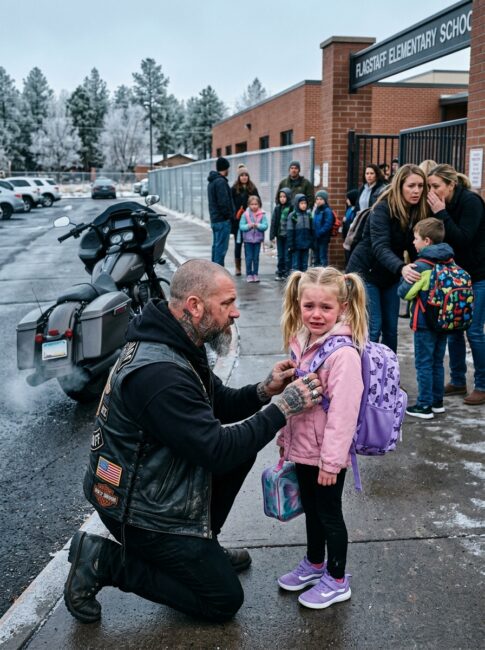
Tuesday was the morning everything went wrong.
The air was sharp enough to sting, the kind of Flagstaff cold that sneaks under sleeves before the sun clears the pines. Parents hurried children across the crosswalk, coffee cups in hand, phones tucked between cheeks and shoulders.
Ray parked at the diner like Emma asked.
I saw him from my classroom window.
He stood beside his Harley under the cracked neon sign, arms folded, watching the school gate from half a block away. He looked like trouble waiting for permission. But even from that distance, I could see he had tied a purple ribbon to his handlebar.
Emma’s ribbon.
She walked in alone.
Her shoulders were up around her ears.
At 9:15, during writing time, Tanner whispered something across the table. Emma’s pencil stopped moving. Her eyes filled, but she did not cry.
I crossed the room.
“What did you say?” I asked Tanner.
He stared at his paper.
Nothing.
Children know the power of nothing.
At recess, Emma stood by the fence instead of playing. I watched from the blacktop as Tanner and two others came near her. I started walking, but sound travels oddly on playgrounds. I heard only pieces.
“Gang.”
“Jail.”
“My mom saw online.”
Then Emma shouted, “He is not bad!”
The playground froze.
Tanner laughed, not because it was funny, but because children sometimes laugh when they realize they have found the softest spot.
“If he’s not bad, why are you scared of him coming here?”
Emma hit him.
Not hard.
A small open-handed slap from a six-year-old whose whole body was shaking.
But it was enough.
By lunch, the office had called Ray.
By 12:05, his Harley came into the lot.
Not from the diner.
Right to the front curb.
The engine cut off.
The front office went silent.
I was sitting beside Emma in Principal Morris’s office when Ray walked in. Principal Morris was a white American woman in her early fifties, kind but cautious, the sort of administrator who believed every problem had a form attached to it. She stood when he entered.
Ray did not sit until Emma looked at him.
His boots made a dull sound on the carpet. His leather creaked when he lowered himself into the small visitor chair. He held his helmet in both hands, and I noticed those hands trembling.
Not from fear.
From holding something back.
Principal Morris cleared her throat.
“Mr. Callahan, Emma struck another student today.”
Ray looked at Emma.
“Did you?”
Emma nodded, eyes fixed on her shoes.
“Why?”
Nobody spoke.
Emma’s lips pressed together until they went pale.
Ray leaned forward, elbows on his knees.
“Bug.”
She whispered, “He called you a monster.”
Ray closed his eyes.
For a second, the room changed. The biker was gone. The father was there, and he looked older than he had looked that morning.
Principal Morris said gently, “We’re handling the bullying as well.”
Ray opened his eyes.
“No.”
The word was quiet.
But it stopped the room.
“No?” Principal Morris asked.
Ray’s voice came out rough.
“You’re handling the slap. You missed the part that made her swing.”
That was the false climax.
At least, we thought it was.
A father confronting a school.
A biker fighting for his kid.
The kind of scene people record on phones and post with captions like “watch this dad go off.”
But Ray did not go off.
He looked at Emma, then at me, then at Principal Morris.
“I’ll keep parking at the diner,” he said.
Emma’s head snapped up.
“What?”
Ray swallowed hard.
“If me being here makes your day worse, I’ll stay out of sight.”
I wanted to stop him.
I did not know how.
Emma’s small face crumpled in confusion, because children can ask for distance without understanding the loneliness it creates.
Ray stood.
His chain clicked once.
His hands flexed around the helmet.
“Don’t hit again,” he told Emma.
She nodded, crying now.
He turned to leave, then stopped at the door.
“Call me if she needs me.”
He did not say, “if you need me.”
Only she.
When he walked out, Emma pressed both hands over her mouth to keep from sobbing too loudly.
Outside, the Harley started.
It sounded like a heart trying not to break.
The next morning, I arrived early.
Teachers always say we need quiet time before the children come in, but really, we need a few minutes to become steady enough for other people’s children. I had barely unlocked Room 12 when I heard the first engine.
Then the second.
Then more.
Not loud like a parade.
Low.
Measured.
A rolling thunder moving down Route 66 before the sun had fully warmed the pavement.
I stepped to the window.
Forty-seven Harleys came around the diner corner in a single line, headlights cutting through the blue morning. Touring bikes, cruisers, old softtails with faded paint, all ridden by men and women in leather cuts, denim, road-worn gloves, and quiet faces.
They did not rev.
They did not block traffic.
They did not shout.
They parked along the curb in perfect order and shut their engines off one by one.
The silence fell heavier than the sound.
Parents froze in the drop-off lane.
Some reached for phones.
Some pulled their children closer.
Ray arrived last.
Emma rode in a car with her grandmother, not on the bike. That mattered later.
She stepped out wearing the same butterfly backpack. Her face went white when she saw the riders lined before the school gate.
Ray walked toward her.
He did not touch her at first.
He crouched.
“Too much?” he asked.
Emma looked at the line of bikers.
The Black rider with the white beard removed his sunglasses and nodded once. The Latina rider held a little paper flower in one tattooed hand. The prospect stared at the pavement like he had been told not to scare anyone.
Nobody smiled too big.
Nobody made a show.
Emma whispered, “Why are they here?”
Ray looked down.
“Because I told them not to come.”
That was the twist we felt before we understood.
Brotherhood tested.
Ray had not asked for protection. He had asked for distance. He had told his club brothers to stay away from the school, to let him and Emma handle the shame quietly.
They came anyway.
Not to intimidate children.
Not to scare parents.
To stand where he had been told to disappear.
The white-bearded rider stepped forward. His name, I later learned, was Marcus “Preacher” Bell, and he had known Ray for seventeen years.
He stopped ten feet from Emma and crouched too.
“Little sister,” he said, voice gravelly from too many cold rides, “your daddy said he didn’t want us causing trouble.”
Emma blinked.
“Are you?”
“No, ma’am.”
The riders behind him stood still.
Preacher nodded toward the school doors.
“We’re just walking you in.”
Principal Morris appeared at the entrance, phone in hand, face tight with panic. A school resource officer moved beside her, one hand near his radio.
Ray saw them.
His jaw tightened.
He raised one hand, palm out, not to challenge, but to calm his own people.
“Line stays back,” he said.
Every biker obeyed.
Instantly.
That silence did more than shouting ever could.
Emma looked at her father.
“Are they bad?”
Ray’s face folded around the question.
“No, bug.”
“Then why does everyone say that?”
He had no fast answer.
No father does.
Finally, he said, “Because people see leather before they see skin.”
Emma reached for his hand.
This time, she did not let go.
And forty-seven bikers stood beside her while she walked through the school gate.
The story could have ended there and gone viral in the cheap way.
Scary bikers defend little girl.
Parents learn lesson.
Everyone claps.
But real stories have old roots, and this one reached back farther than the school gate.
That afternoon, after the phones had captured enough footage to make half the town argue online, Principal Morris called an emergency meeting. Not for the whole school. Just the families involved, a few staff, Ray, and two representatives from his club.
I was there because Emma was my student.
Tanner’s parents came too.
His father wore a fleece vest and the expression of a man annoyed by inconvenience. His mother looked embarrassed before anyone said a word.
Ray arrived without the club behind him.
Just Preacher and a woman named Rosa “Mags” Delgado, the Latina rider with the paper flower. Ray’s cut looked heavier indoors. The patch on the back seemed to fill the room even when he sat silently near the end of the table.
Tanner’s father spoke first.
“I don’t want my son threatened by motorcycle gangs.”
Ray did not answer.
Preacher did.
“Nobody threatened your son.”
“Forty-seven bikers at an elementary school feels like a threat.”
Mags leaned forward.
“They didn’t come for your boy.”
“Then why come?”
Mags looked at Ray.
Ray stared at his hands.
Across his knuckles, those strange words showed again.
STAY SOFT.
Principal Morris asked gently, “Mr. Callahan, why did they come?”
Ray breathed in through his nose.
When he spoke, he kept his eyes on the table.
“Because ten years ago, I didn’t show up.”
The room went quiet.
Ray rubbed one thumb across the opposite knuckles, over the ink.
“My first daughter’s name was Sophie.”
Emma knew that name. I saw it in the way her face changed. Tanner did not.
Ray continued.
“She was eight. Different school. Different town. Kids picked on her because of me too. I was new to the club then, angry at everything, trying to prove I wasn’t the guy I used to be by acting tougher than I needed to be.”
His voice stayed flat.
That made it worse.
“One day she asked me not to pick her up. Said kids called me a jailbird. Said they barked motorcycle noises when she walked by.”
Mags closed her eyes.
Preacher looked at the wall.
“I thought giving her space was love,” Ray said. “So I stayed away.”
His hands stopped moving.
“She stepped off the bus three blocks from home because she didn’t want kids seeing me waiting. A drunk driver jumped the curb.”
No one breathed.
Ray’s eyes were wet now, but he did not cry. Bikers like him learn early that tears are private things, like old letters and loaded guns. He swallowed them down until only the shine remained.
“She lived two days.”
Emma’s grandmother covered her mouth.
Tanner’s mother began to cry silently.
Ray touched the words on his knuckles.
“I got these after the funeral. Stay soft. Sophie said that to me once when I yelled at a mechanic who overcharged her mom. She was six. Looked me dead in the face and said, ‘Daddy, stay soft.’”
Now the seed made sense.
The careful hands.
The quiet voice.
The way he crouched before speaking to children.
The way he kept his distance when Emma asked, even though it gutted him.
He had already lost one daughter to the shame other people put on his back.
He was terrified of making the wrong choice again.
Mags put a small paper flower on the table.
Purple.
Folded from a diner napkin.
“Sophie used to make those,” she said.
Ray did not look at it.
Preacher finally spoke.
“Ray told us not to come because he didn’t want Emma punished for us. We came because last time we stayed away, our brother buried a child.”
Tanner’s father lowered his eyes.
For once, he had nothing polished to say.
Principal Morris looked at Emma.
“Sweetheart, did you feel scared this morning?”
Emma shook her head.
“Did you feel safe?”
She nodded.
Then she looked at Tanner.
“He can think my dad is scary,” she said. “But he can’t make me think it.”
Tanner stared at the table.
His mother whispered, “Tell her.”
The boy’s face tightened the way children’s faces do when shame is too big for their bodies.
“I’m sorry,” he said.
Emma did not forgive him instantly.
That would have been too clean.
She only nodded.
Ray saw that and looked proud, though barely.
A tiny lift at one corner of his mouth.
That was all.
The next morning, there were no forty-seven bikes. Just Ray at the gate, parked where Emma could see him. He stood beside the Harley with his hands folded in front of him, leather cut zipped against the cold.
When Tanner walked up with his parents, he stopped.
For a moment, everyone braced.
Tanner reached into his backpack and pulled out a folded paper.
He handed it to Emma.
It was a drawing.
A little girl, a big biker, and a line of motorcycles standing like a fence.
At the top, written in crooked first-grade letters, were the words:
Your dad is not a monster.
Emma studied it.
Then she tucked it into her butterfly backpack.
Ray looked away toward the highway.
His jaw worked once.
He kept the tears where he kept everything else.
Inside.
After that, the school mornings changed.
Not all at once.
People do not drop prejudice like a backpack at the door. They loosen one strap, then another, and sometimes pick it back up when they’re scared.
But Ray stopped parking at the diner.
Every morning, his Harley came to the curb at 7:42. The engine thudded low, then cut off before the children reached the crosswalk. He stood by the gate with Emma’s lunchbox in one hand and his helmet in the other.
Some parents still watched him.
But fewer pulled their children away.
The club never repeated the forty-seven-bike arrival. That was not the point. The point had been made once, quietly and hard.
Still, every Friday, one rider came with Ray.
Preacher one week.
Mags the next.
Sometimes the young prospect, who turned out to be named Caleb, stood awkwardly by the fence and helped kids unjam backpack zippers with the focus of a man defusing a bomb.
They called it Sophie’s Watch.
Nobody announced that name to the school. I learned it from Mags one morning while she drank coffee from a dented thermos near the curb.
“We don’t guard the kids,” she said. “That ain’t our place.”
“What do you do?”
She looked at the playground.
“We make sure nobody disappears alone.”
That sentence stayed with me.
Ray’s ritual became smaller than the morning people filmed.
Every Thursday evening, he rode to Sophie’s old school, now a community center off Milton Road. He parked under a cottonwood tree, killed the engine, and sat there until the sun dropped behind the pines. Sometimes Preacher joined him. Sometimes no one did.
On Sophie’s birthday, the club rode Route 66 out past the old diner and back through town without stopping. Forty-seven bikes the first year. Forty-six the next, after one brother passed. Forty-eight the year Caleb earned his full patch.
Emma rode in a car behind them with her grandmother until she was old enough to understand why her father touched two fingers to his knuckles at every red light.
Stay soft.
She wrote those words on a sticky note once and put it inside his helmet.
Ray never removed it.
Even when the glue gave out and the corners curled, he pressed it back in place.
Some things are not decoration.
They are instructions.
The last day of first grade came warm and windy.
Parents crowded the gate with flowers, cupcakes, and phones. Children came out carrying paper folders stuffed with drawings, math sheets, and the wreckage of a long school year.
Emma ran to Ray again.
Just like before.
No hiding.
No asking him to park around the corner.
She slammed into his chest, and he dropped to one knee fast enough to catch her, leather creaking, boots scraping the sidewalk. Her butterfly backpack bounced against his vest.
This time, nobody whispered monster.
Tanner walked past with his mother and lifted one hand.
Ray nodded.
Small.
Enough.
Emma dug through her folder and pulled out a drawing. She had made it in class that morning. It showed a school, a girl, one huge man in black, and a row of motorcycles under a yellow sun.
At the bottom she had written:
My dad waits where I can see him.
Ray stared at the paper for a long time.
Then he folded it carefully and tucked it inside his cut, against his chest, near a place I knew carried old grief.
The Harley started a minute later.
Low thunder.
Warm pavement.
Leather and gasoline in the air.
Emma climbed into her grandmother’s car, not on the bike, and Ray rode beside them out of the school lot toward Route 66.
At the corner, he touched two fingers to his knuckles.
The taillight turned red.
Then he was gone.
Stay soft.
Follow the page for more stories about the people we judge before we know what they carry.