Part 2: The Mother Pushing Her Son’s Wheelchair Under the Blazing Sun — A Biker Shut Off His Engine and Walked Beside Them
The first thing people saw was not kindness.
They saw a rough-looking biker stepping toward a tired mother with one hand inside his vest. They saw the mother tighten both hands around the wheelchair handles. They saw the boy shrink slightly in his seat, his shoulders curling inward as if he expected another loud voice, another impatient stranger, another adult deciding his body was an inconvenience.
A man pumping gas across the street muttered, “Here we go.”
The silver SUV honked again.
The biker stopped.
Not close enough to scare them.
Just close enough to speak.
His voice was lower than the traffic, rough around the edges, almost swallowed by the heat.
“Ma’am,” he said, “your front wheel’s about to come off.”
The mother blinked.
That was when people noticed the small thing nobody else had cared to see.
The front right wheel of the chair was wobbling badly, held together by a bent bolt and what looked like a strip of old duct tape. Each time the mother pushed forward, the wheel twisted sideways, scraping against the cracked pavement. It wasn’t just hard to push. It was dangerous.
The biker held up what he had taken from his vest.
A small folding wrench.
Not a weapon.
Not a phone.
Not a threat.
Just a battered little tool, scratched silver, the kind a man keeps because life has taught him that something always breaks when you least need it to.
The mother’s mouth opened, but no words came out.
“I can tighten it enough to get you off this road,” he said.
Behind him, a driver shouted, “You fixing a chair now? In traffic?”
The biker turned his head just slightly. He didn’t raise his voice. He didn’t have to.
“Yes,” he said.
That one word landed harder than a shout.
The mother looked down at her son. The boy lifted his eyes, and for a second the sun caught his face. He was maybe ten, maybe eleven, with pale skin flushed red from the heat and lips gone dry at the edges. His left hand twitched against his knee, not from fear exactly, but from a body working harder than anyone around him could understand.
The biker crouched beside the wheelchair.
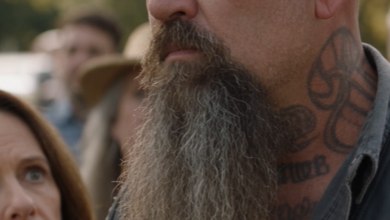
That made him look even bigger somehow, this tattooed man kneeling in the dust while cars waited and strangers stared. His leather vest creaked when he moved. On the back of it, stitched in white thread, were the words IRON SAINTS MOTOR CLUB, though nothing about him looked saintly to the people watching from air-conditioned seats.
“What’s his name?” he asked.
The mother hesitated.
“Eli,” she said.
The biker nodded once.
“Hey, Eli. I’m Mason.”
The boy did not answer with words. His fingers moved slightly, brushing against the armrest twice.
The mother noticed the biker watching.
“He understands,” she said quickly, like she had said it too many times to people who assumed otherwise. “He just doesn’t always speak when he’s tired.”
Mason did not look surprised.
He only lowered his eyes to the wheel and began working the wrench around the bolt with careful, steady hands.
The silence changed then.
Not completely.
There were still horns. Still heat. Still irritation rising from people who believed their errands mattered more than a child on a broken sidewalk. But something had shifted. A woman at the bus stop stopped fanning herself with a grocery receipt. The gas station cashier stepped outside. The angry delivery driver stopped yelling.
Mason tightened the bolt, tested the wheel, then frowned.
“This chair been doing this long?” he asked.
The mother looked away.
“A while.”
“How far you walking?”
She swallowed.
“Clinic to home.”
“That’s four miles.”
She said nothing.
That answer was worse than words.
Mason’s jaw flexed once beneath his beard. He glanced at the boy, then at the road ahead, where heat rolled off the asphalt in silver waves. The sun was merciless. There was no shade for at least half a mile.
“Bus?” he asked.
The mother gave a tiny laugh, the kind that wasn’t humor at all.
“Lift was broken. Driver said we could wait for the next one.”
“When?”
“Forty minutes.”
Mason looked at Eli’s cracked lips.
Then he looked back at the line of cars.
The silver SUV driver leaned out and snapped, “Some of us have places to be!”
Mason stood slowly.
For one second, it seemed like the old misunderstanding might come true after all. He looked like a man built for confrontation, with sunburned arms and tattoos curling down to his wrists, his shadow falling across the road like a warning.
But he didn’t walk toward the SUV.
He walked to his motorcycle.
He pulled a bottle of water from a saddlebag, unopened, sweating cold in the heat.
Then he handed it to the mother.
“Give it to him first,” he said.
That was when the mother’s hands began to shake.
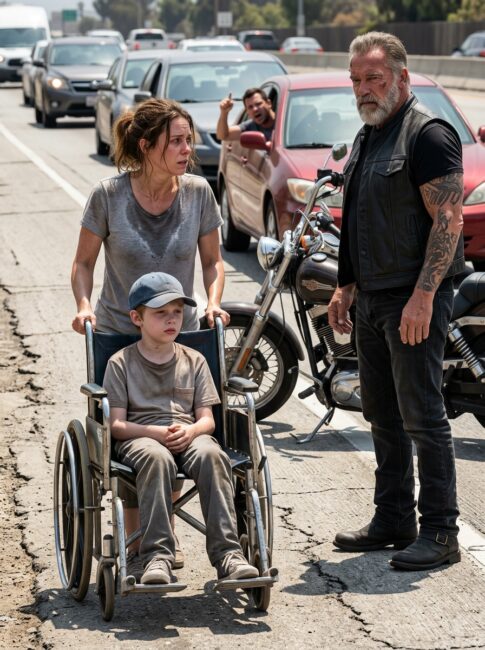
Her name was Rachel Moreno, though nobody on that road had asked.
To the cars passing by, she was just another woman slowing traffic down. To the woman in the SUV, she was a problem. To the man at the gas pump, she had been a scene waiting to become trouble. Even to Mason, at first glance, she had looked like someone about to break under the weight of the afternoon.
But Rachel had been walking since 11:40 that morning.
She had taken Eli to a specialist appointment across town because the clinic had rescheduled twice, and if she missed this one, the next opening would not come for three months. Her old sedan had died outside their apartment complex two weeks earlier. Her neighbor who usually helped had been working a double shift. The bus got them there late, the appointment ran long, and then the lift on the return bus jammed halfway down with that terrible mechanical buzz that made everyone stare at Eli like his wheelchair had personally ruined their afternoon.
The driver had apologized.
Sort of.
Rachel had heard those apologies before.
The kind that sounded like procedure.
The kind that ended with her stranded.
So she started walking.
She told Eli it would be an adventure, because mothers learn to lie gently when the truth is too heavy for a child. She told him they would stop for a soda when they got closer to home, though she only had three dollars and seventeen cents in her pocket. She told him the sun would be behind them soon, though it kept burning straight down as if the sky had no mercy left.
By the time Mason saw them, Rachel had already passed two fast-food restaurants, one pharmacy, and a shaded church parking lot where people coming out of a meeting looked at her, looked at the chair, and looked away.
Mason did not know any of that.
Not yet.
He only knew the wheel was loose, the boy was overheating, and every car behind him was angry at the wrong people.
“Drink slow,” Rachel whispered, holding the bottle to Eli’s mouth.
Eli took two small sips, then pushed it gently toward her.
“No, baby, you drink.”
He moved his fingers again.
Mason watched.
Rachel noticed.
“He says, ‘Mom too,’” she said.
Mason looked down for a moment, and something crossed his face that did not belong to strangers. Recognition, maybe. Or memory.
“You sign?” Rachel asked.
“A little,” he said.
That was another crack in the picture everyone had built of him.
Bikers like Mason were supposed to be loud. Intimidating. Men who lived on engines, bars, and trouble. But his fingers moved slowly, forming careful words as he looked at Eli.
Hot day.
Eli stared at him.
Then the boy signed back, with weak but deliberate hands.
Too hot.
Mason smiled once.
It was small.
It changed his whole face.
The SUV driver honked again, sharper this time, and that sound seemed to snap the street back into its ugliness.
Rachel flinched.
Mason saw it.
He turned, walked to his motorcycle, and pushed it by the handlebars toward the curb. The bike was heavy, but he handled it as if it were nothing. Then he parked it in front of the broken stretch of shoulder, angled slightly into the lane, making a barrier between the wheelchair and the traffic.
A police cruiser rolled up two minutes later.
Of course it did.
Someone had called.
A young officer stepped out, one hand near his belt, eyes moving from Mason’s tattoos to the motorcycle to the mother and child.
“Sir,” the officer said, “you can’t block a lane.”
Mason nodded.
“I know.”
“Then move the bike.”
Rachel’s face tightened. “Officer, please, he was just helping us.”
The officer glanced at her. Not unkindly, but not fully seeing her either. His attention stayed on Mason, because men like Mason made easy stories in people’s heads.
Mason reached into his vest again.
This time, the officer’s hand moved closer to his holster.
Several people stopped breathing.
Mason froze.
Slowly, with two fingers, he pulled out a folded card and held it forward.
“Retired county search and rescue,” he said. “Volunteer medical transport, too, before my back gave out.”
The officer took the card.
The words were faded at the edges. The photo was older, showing Mason with less gray in his beard and fewer lines around his eyes.
Rachel stared at him.
“You do medical transport?”
“Used to.”
His eyes drifted to Eli’s chair.
“My daughter needed one like that.”
The sentence was quiet enough that most of the crowd missed it.
Rachel did not.
Neither did Eli.
The boy’s fingers stilled.
Mason cleared his throat and looked away, as though he had accidentally opened a door he preferred to keep locked.
“She hated when people talked over her,” he said. “Hated when they called her brave just because she went outside.”
Rachel pressed her lips together.
The officer looked from the ID card to the wheelchair, then to the line of cars. His expression softened, but embarrassment moved behind his eyes too. He understood then that he had arrived ready to manage a nuisance and found a human emergency instead.
“How far are you going?” the officer asked Rachel.
“East Belle Terrace,” she said.
The officer exhaled. “That’s not close.”
“No,” Rachel said.
There was a pause.
Then Mason said, “I’ll walk them.”
The officer frowned. “In this heat?”
Mason shrugged. “Bike’s not built for three. Chair’s not built for that shoulder. Somebody’s walking.”
Rachel shook her head immediately. “No. You don’t have to do that.”
“I know.”
That was all he said.
Not “I want to be a hero.”
Not “I’m a good man.”
Not even “It’s the right thing.”
Just I know.
He pulled a bright orange bandana from his saddlebag and tied it to the back of the wheelchair so drivers could see it better. Then he took out a small towel, poured a little water on it, and handed it to Rachel for Eli’s neck. From another compartment, he found a granola bar, crushed but unopened.
People watched him unpack kindness from a motorcycle they had mistaken for menace.
The cashier from the gas station crossed the street with two more bottles of water.
The delivery driver stepped out and muttered, “I got an umbrella in the truck.”
The woman from the SUV did not move at first.
She sat behind her windshield, face tight, lips pressed thin, trapped inside the shame of her own impatience. Then her daughter said something from the back seat. The woman looked at the little girl in the mirror, looked at Rachel, and finally opened her door.
“I have sunscreen,” she said, not loudly.
Nobody applauded.
That would have ruined it.
The officer redirected traffic, and Mason began walking beside Rachel and Eli, one hand near the wheelchair but not touching it unless Rachel needed him. He let her remain the mother. He did not take over. That mattered.
They moved slowly down Union Avenue under the brutal sun, past storefront windows and dusty lots, with Mason’s black motorcycle left behind under the watch of the gas station cashier. For the first quarter mile, Rachel kept apologizing.
“I’m sorry this is taking so long.”
“Don’t be,” Mason said.
“I should’ve figured something out.”
“You did.”
“I mean something better.”
Mason looked at Eli, then back at the road.
“You got him there. You’re getting him home. That’s better than most people understand.”
Rachel’s eyes filled, but she blinked hard and kept walking.
Eli signed something.
Rachel glanced at him and gave a tired smile.
“He wants to know if your motorcycle is loud because it’s angry.”
Mason chuckled.
“No,” he signed slowly. “It’s loud because it’s old.”
Eli’s shoulders lifted with a silent laugh.
That laugh did something to Rachel.
It broke her open a little.
She had been holding herself together all day with the desperate strength of mothers who cannot afford to collapse. She had smiled through receptionists who spoke too quickly, through waiting room stares, through a bus full of people sighing when the lift failed, through the long sidewalk where every crack in the pavement felt like another person saying, “Not my problem.”
But when Eli laughed, even silently, Rachel bowed her head over the wheelchair handles and cried.
Not loudly.
Not dramatically.
Just one broken breath, then another.
Mason slowed his steps.
He did not tell her not to cry.
He did not say everything would be okay.
He simply walked on the traffic side, placing his large body between them and the road, as if that was the only promise he knew how to make.
A few blocks later, the officer’s cruiser returned. Behind it came a city maintenance truck with a portable ramp and a supervisor who looked uncomfortable in a clean polo shirt. The bus company had been called. So had someone from the clinic. So had someone from the county accessibility office.
It was amazing how many systems could move once a tattooed man blocked traffic long enough to make them look.
Rachel did not know whether to be grateful or furious.
Maybe both.
The supervisor apologized with a clipboard in his hand.
Rachel listened, one palm resting on Eli’s shoulder.
Mason stood a few feet away, silent.
The supervisor offered a ride.
Rachel hesitated.
After everything, accepting help felt almost as hard as needing it.
Mason seemed to understand.
He leaned closer and said, “Let the boy get cool.”
That was the sentence that made the decision for her.
Not the apology.
Not the clipboard.
Not the official tone.
Just Eli, whose face was still too red beneath the little blue cap.
Rachel nodded.
The ride home took twelve minutes.
It should never have taken three hours.
Rachel sat in the back of the maintenance vehicle beside Eli, holding the wheelchair steady while cool air moved through the vents and made her realize how hot her own skin had become. Mason followed behind them on his motorcycle, not roaring this time, just keeping distance like a quiet escort.
At the apartment complex on East Belle Terrace, the grass was mostly brown and the laundry room door hung crooked on one hinge. A few neighbors looked out from balconies as the truck pulled in, curious in the way people get when help arrives too visibly.
Rachel thanked the driver.
She thanked the officer.
She thanked the supervisor, though the words came out tired.
Then she turned to Mason.
For the first time all afternoon, she really looked at him.
Not at the tattoos.
Not at the leather vest.
Not at the size of him or the hard lines of his face.
She looked at the man who had shut off his engine when everybody else wanted to keep moving.
“I don’t know how to repay you,” she said.
Mason shook his head.
“You already did.”
Rachel frowned slightly.
He looked at Eli.
The boy raised one hand.
His fingers moved slowly, carefully.
Thank you, motorcycle man.
Mason’s face changed again, but this time he could not hide it fast enough. The grief came through first, then warmth, then the ache of memory he had carried longer than anyone on that street could have guessed.
He signed back.
You’re welcome, strong man.
Eli smiled.
Not big.
Not for show.
Just enough.
Rachel’s hand rose to her mouth, and she looked away because some moments feel too private even when they happen in the open.
Mason reached into his saddlebag one last time and pulled out a small strip of reflective tape.
“For the chair,” he said. “So cars see him better.”
Rachel accepted it with both hands as if it weighed more than it did.
The old wheelchair sat in the shade now, its crooked wheel tightened just enough, the orange bandana still tied to the back like a tiny flag that had survived a battle nobody planned to fight.
Before Mason left, the woman from the silver SUV pulled into the apartment lot.
Rachel stiffened.
The woman stepped out holding a paper pharmacy bag and a small pack of cooling towels. Her daughter stood beside her, clutching the sunscreen bottle against her chest.
“I was rude,” the woman said.
Her voice trembled, not from fear of Mason, but from the harder thing.
Owning herself.
Rachel did not rescue her from the silence.
Mason did not either.
The woman looked at Eli. “I’m sorry.”
Eli watched her for a long moment.
Then he signed something to his mother.
Rachel translated softly.
“He says the horn hurt his ears.”
The woman closed her eyes.
“I’m sorry for that too.”
No one hugged.
No music swelled.
Life rarely fixes itself that neatly.
But the woman left the bag on the step, and her daughter gave Eli a shy little wave before they drove away much slower than they had arrived.
That evening, after the sun finally dropped behind the low roofs and the sidewalks stopped glowing, Rachel taped the reflective strip onto the wheelchair. Eli supervised from the couch with serious eyes, pointing once when she placed it crooked.
Mason had already gone.
He had not asked for a photo. He had not stayed for praise. He had not given Rachel a speech about strength or faith or how people should treat one another. He simply kicked his motorcycle to life, lifted two fingers in a small goodbye, and rode back toward the street where everyone had first misunderstood him.
But something remained.
The orange bandana.
The tightened wheel.
The memory of a huge, tattooed man walking slowly in the heat so a mother would not have to walk alone.
Three days later, a package arrived at Rachel’s apartment with no return name.
Inside was a new wheelchair wheel, two bottles of sunscreen, a small cooling vest for Eli, and a note written in blocky handwriting.
For hot days. — M
Rachel stood in the doorway holding the note, and Eli rolled closer, touching the paper with one careful finger.
Outside, traffic moved along Belle Terrace like it always did, busy and impatient and certain of where it needed to go.
Rachel tied the orange bandana to the new wheel anyway.
And if this story stayed with you, follow the page for more emotional stories about the strangers who quietly change everything.