They Refused to Seat the Biker at the Door — Then the Waitress Called Him Dad
The hostess looked at the man in the leather vest and saw trouble.
I looked at him and saw my father.
That was the first lie of the night, and it was mine.
He came through the front doors of Bellmore House just after 7:10 p.m., bringing cold February air, road dust, and the deep, familiar smell of leather, motor oil, and black coffee into a dining room that charged thirty-eight dollars for sea bass and called mashed potatoes “potato purée” like that made them noble.
Every head turned.
Of course they did.
My father—Jack “Rook” Mercer—was the kind of man a room notices before he speaks. Fifty-eight. White. Tall enough to seem larger in doorways than he really was. Broad shoulders under a weather-beaten black leather cut. Gray in the beard, old scar through the brow, knuckles thick and marked from years of wrenching engines and making bad decisions before he started making better ones. The chain on his wallet hit his thigh with every step. His boots made the polished floor sound too honest for a place like Bellmore.
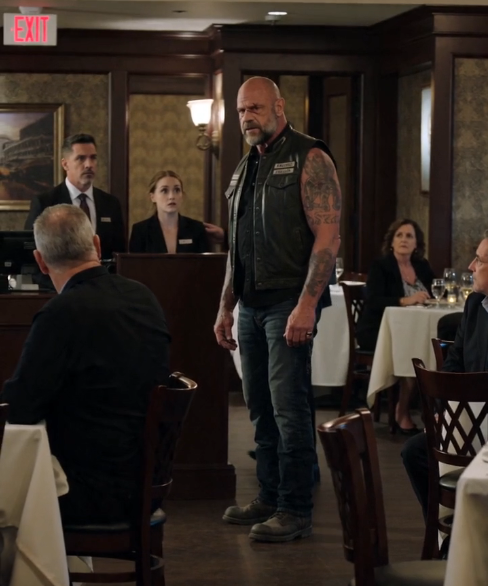
He looked like exactly the kind of man the staff had been trained to manage before trouble began.
The maître d’ saw the vest.
The hostess saw the tattoos.
The bartender saw the boots.
I saw his hands.
Rough hands. Clean nails.
That detail always got me. My father looked like a fistfight and washed his hands like a nurse.
“Sir,” the hostess said, already smiling the way rich restaurants smile when they mean no, “we do require jackets and reservations.”
He glanced down at his leather cut and then back up at her. “I’m covered on both.”
A couple at table nine laughed.
The hostess didn’t.
She tightened her smile and repeated the second part. “And reservations.”
“I’m meeting someone.”
Now my pulse was in my throat.
Because I knew why he was there.
He had called me twice that week. I let both calls go to voicemail. The third time, he didn’t leave a message. Instead, he sent one text so short it felt heavier than a speech:
You said Saturday. I’m outside of Saturday.
I had told him not to come to Bellmore.
Not because he’d embarrass me, exactly.
Not only that.
I was twenty-six, two years into serving at the nicest restaurant in St. Louis, and I had built a whole fragile life out of not explaining where I came from. Not the trailer outside Rolla. Not the biker clubhouse with the patched men who brought casseroles when my mother died. Not the father who rode a Harley and talked like gravel and had once done county time before getting sober and learning how to stay. In Bellmore House, I was Emma Mercer, efficient, polished, forgettable in all the right ways.
Not Jack Mercer’s daughter.
Definitely not that.
The floor manager moved toward the front when he saw the situation. He was already wearing his “de-escalation” face, the one management trains in mirrors. Calm. Firm. Public.
“Sir, I’m going to ask you to step back from the stand.”
My father didn’t raise his voice.
That made it worse somehow.
“I’m not here to cause a scene.”
That line made everyone think he was.
Three women at the bar turned to watch. The older man at table four lowered his menu just enough to enjoy it. The kitchen doors pushed open behind me and my tray suddenly felt too light, too loud, too obvious in my hands.
Then the hostess made the mistake that turned the whole thing mean.
She looked at me and said, “Emma, do you know this gentleman?”
I should have said yes.
I didn’t.
I said, “No. I don’t think so.”
If you’ve never watched your own father get smaller without moving, I don’t recommend it.
He didn’t flinch.
Didn’t blink.
Didn’t call me out.
He just looked at me for one second too long, then back at the manager, and nodded like somebody who had been denied in worse places than a dining room.
“Fine,” he said. “I’ll wait outside.”
That should have been the end of it.
The misunderstood biker turned away from the expensive room. The daughter protected her polished life. The restaurant returned to candlelight and overpriced wine.
But ten minutes later, a man at table twelve fell sideways in his chair with a piece of steak caught in his throat.
And the person who moved first was the same biker I had just let them throw out.
What he did after that forced me to tell the truth about who I was, where I came from, and why the roughest man outside the door turned out to be the only one inside the room who knew how to save a life.
Read the rest in the comments, because what my father did on that dining-room floor changed the way every person in Bellmore House looked at him—and at me—forever.
My father had always been the kind of man polite people judge in the first three seconds and revise only if life makes them.
Most of them never stayed long enough for revision.
He rode a Harley-Davidson Road Glide black as old coffee, with one saddlebag lid slightly scratched from a gas station spill in Kansas and a V-twin sound you could feel in your chest before you saw the bike turn the corner. He wore the same cut in every season unless it was funeral weather. He had a road name—Rook—earned years before I was born because, as one of his club brothers once told me, “He looked like bad luck till you learned how strategic he was.”
That part was true.
He had a complicated past, like the best biker stories always do and the real ones often don’t survive cleanly enough to tell. Army at nineteen. Home by twenty-four. Divorce by thirty. Jail by thirty-two. Sober by thirty-three. Mechanic after that. Then sponsor. Then road captain for a midsize Missouri club that spent as much time raising funeral money and escorting abused women to court as it did riding.
He never advertised any of it.
That was another thing about him. He hated sentimental explanation. If somebody asked too many questions about the club’s charity work, he’d shrug and say, “Road goes both ways.”
My mother used to laugh at that.
She worked nights at a nursing home and called him “my loudest good decision.” She died of ovarian cancer when I was nineteen, and after that, it was just the two of us in a little rented place that smelled like detergent, coffee, and occasionally gasoline when his jacket hung too long in the kitchen. He packed my lunches. Burned toast. Learned which conditioner I liked by memorizing the bottle color because he couldn’t remember the name. Showed up to my high school awards banquet in a pressed black shirt that still couldn’t hide the tattoos on his forearms, then sat in the back because he didn’t want to scare my friends’ parents.
He scared them anyway.
He scared me sometimes too, if I’m honest—not because he was unsafe, but because he was unhideable. My whole twenties, I wanted a life that moved smoother than the one I came from. Softer edges. Cleaner introductions. A name that didn’t come with a motorcycle outside and a father everybody noticed before I finished saying, “This is my dad.”
So when I got the Bellmore job, I split myself in two.
There was Emma at work—tight bun, pressed apron, soft voice, wine notes memorized, never late, never personal.
And there was Emma on Sundays in Rolla with her father, where the garage radio played old Skynyrd, the coffee was too strong, and men called me “kid” even though I was twenty-six and paying my own rent.
He knew I was splitting.
He just didn’t say it outright.
Instead, he did what he always did when I was ashamed of something that had his fingerprints on it: he gave me space so wide it hurt more than being confronted. If I didn’t mention Bellmore for three weeks, he let three weeks pass. If I changed the subject when club rides came up, he changed it too. He never asked to visit. Never pressured. Never showed up uninvited.
Until that Saturday.
What he didn’t know—or maybe what he did know, deep down—was that Bellmore House had become bigger in my head than a restaurant had any right to become. It wasn’t only work. It was my proof. Proof I could exist in a room full of lawyers, surgeons, old-money wives, and anniversary reservations without anybody smelling motorcycle oil in my bloodline.
The irony, of course, is that Bellmore’s guests were not finer than him.
Just better dressed.
That night the room was full of polished people saying polished things. A hedge fund guy from Clayton sending back perfectly good Bordeaux because it had “opened too aggressively.” A blonde woman on a first date saying “trauma-informed” three times while snapping at a busboy. A man at table twelve wearing a navy cashmere jacket and a watch worth more than my car, laughing with his wife like they had always been the kind of couple who knew how to order oysters correctly.
My father stood outside in the cold because I let them think he didn’t belong.
Then came the crisis.
Table twelve.
The steak.
The chair tipping.
At first it didn’t even look real. The man just stopped talking. He reached one hand to his throat and one to the edge of the tablecloth. His wife smiled awkwardly at him for one terrible second, like this might be a joke rich men do over expensive meat. Then his face changed color.
Everything after that happened in fragments.
A fork hit the floor.
A glass tipped.
Someone shouted, “Call 911!”
The bartender froze with the phone in his hand but did not move yet.
Our manager said, “Sir? Sir?” like repetition could replace oxygen.
Nobody in that room knew what to do.
Not quickly.
Not with their hands.
And then the front door slammed open.
My father came back inside before anybody invited him.
That, from a distance, probably looked exactly like the threat they had feared ten minutes earlier. A biker denied entry now forcing his way back in during panic. Boots on polished floor. Leather creak. Big shoulders moving through candlelight and white tablecloths like the room had finally produced the excuse it wanted to dislike him for.
But he wasn’t looking at management.
He was looking at the man turning purple in the chair.
“Move,” he said.
Nobody did at first.
He said it again, louder this time, and people scattered because sometimes competence sounds rude right up until it saves you. He reached table twelve in three long steps, pulled the man’s chair back with one hand, got him up with the other, and locked both arms around his upper abdomen so fast I realized two things at once:
My father had done this before.
And every single person in Bellmore House had misjudged the only prepared man in the room.
He gave one hard upward thrust.
Nothing.
Second thrust.
A wet choking sound, then still nothing.
His face didn’t change. Not panic. Not drama. Just focus. Old, disciplined, medic focus. The kind I had seen only twice before—once when a drunk clipped a rider on Route 44 during a memorial run, and once when my mother collapsed in the kitchen and he got on the floor before grief was allowed to arrive.
“Call the damn ambulance now,” he barked.
That got the bartender moving.
Third thrust.
A piece of steak hit the table. Then the floor.
The man folded forward like a tent cut loose from one corner and sucked in air so harsh it sounded like an animal tearing through underbrush. His wife began sobbing instantly. Somebody at the bar started clapping because some people don’t know what else to do with relief. My father hated that kind of clapping. I could tell because his whole body stiffened.
“It’s okay,” he said to the man. “Easy. Small breaths.”
Then he looked straight at me.
Not accusing.
Not triumphant.
Just tired.
That was the false climax.
The biker thrown out of the fine restaurant comes back in and saves a choking customer. The room is forced to see him differently. Daughter ashamed of father is publicly proven wrong. Emotional correction. Moral done.
That would have been enough for most stories.
It wasn’t enough for this one.
Because Twist Two was standing right there under the candles and noise and ambulance lights beginning to flash outside the windows: the man everyone now wanted to thank had not come to Bellmore to prove anything.
He had come to see me.
And when the husband at table twelve finally got enough air to speak, he said the sentence that cracked the entire restaurant open wider:
“You Army?” he croaked.
My father wiped his hands on his jeans without looking up. “Medic. Long time ago.”
The man nodded weakly, eyes watering, still trying to breathe around survival. “I knew it.”
That landed in the room differently than the rescue itself.
Because now he wasn’t just some biker who happened to know the Heimlich. Now there was a hidden identity under the leather. Military. Trained. A whole private life nobody in Bellmore had bothered to imagine because they had already settled on the lazy version of him.
Our manager stepped forward wearing gratitude like borrowed clothing.
“Sir, I—I owe you an apology.”
My father shrugged him off with a look. “You owe your staff training.”
That line silenced half the room harder than the rescue had.
The man’s wife stood and reached for my father’s hand with both of hers. He let her hold it for three seconds, maybe four, then gently pulled away because biker culture does not know what to do with public praise when adrenaline is still draining.
And then the hostess—the same one who turned him away—looked at me and asked the question I had been dodging for two years.
“Emma… how do you know him?”
The whole restaurant seemed to lean.
I could have lied again.
I could have said family friend.
Old customer.
Neighbor.
Anything smoother than truth.
But there are moments when lying costs more than shame. Watching him stand there breathing hard in his old leather cut, after saving a stranger in the room that had sneered at him, I understood that the next sentence would tell me what kind of daughter I had been trying to become.
So I said it.
“He’s my father.”
No music.
No cinematic hush.
Just one real second where every face in that room changed.
The hostess went white.
The manager looked away.
The bartender mouthed, “Oh.”
My father didn’t rescue me from that moment either. He never had. He believed if you were old enough to choose your silence, you were old enough to stand in it when it broke.
Which is exactly what I had to do.
The biggest twist was not that he saved a customer.
It was why he had come at all.
Not to embarrass me.
Not to test me.
Not even to surprise me.
He had come because that morning had been the anniversary of my mother’s death, and for the first time since she passed, I had not answered his call.
That was what finally forced him to Bellmore.
He told me later, outside by the ambulance loading zone while the staff pretended not to watch us through the glass, “Your mother used to say the two worst sounds in this world were a phone that rings too long and a child who won’t come home.”
He looked down at his gloves in his hands, turning them once by the fingertips.
“When you didn’t answer all day,” he said, “I figured I’d rather get thrown out of your restaurant than sit in the garage imagining the worst.”
That broke me worse than the rescue.
Because it meant he had risked my anger only after spending the whole day afraid for me.
That was Twist One folded into Twist Two: the daughter had hidden the father, while the father had come out of love, not ego.
Twist Three came from Bellmore itself.
The man my father saved was Judge Alan Whitmore, one of the city’s most connected private-club regulars and the kind of customer management practically bowed around. His wife knew the restaurant owners personally. They comped his desserts at Christmas. They knew his wine preferences before he sat down.
After the paramedics cleared him and the room began breathing like a room again, Whitmore refused to leave without speaking to the general manager, who had just arrived in a sport coat and apology mode.
In front of half the dining room, he pointed at my father and said, in a voice still raw from almost dying, “That man stays anywhere he wants in this building.”
Then he looked at me.
“And if you were ashamed to say he was your father before tonight, don’t waste the rest of your life on that.”
It was a brutal sentence.
Worse because it was deserved.
My father grimaced like he’d bitten a nail. He hated public moralizing. Hated being turned into anybody’s lesson. But he didn’t interrupt because, for once, the truth had to land without being softened for me.
Then came the smallest twist, the one that stayed with me longest.
The hostess who turned him away approached with his old leather gloves she’d picked up from the host stand. She looked about nineteen now, not composed, just young and shaken. “I’m sorry,” she whispered.
My father took the gloves and said, “For what?”
“For assuming.”
He nodded once. “Yeah.”
Then he added, because this was who he was when he wasn’t trying to be anything for anyone: “Do better faster next time.”
Not cruel.
Not warm.
Just exact.
That was him all over.
No speech.
No self-forgiveness tour.
No fake grace for optics.
Just the truth delivered at working-man weight.
When the dining room finally settled and the police took a brief statement for the incident report, the details everyone had missed about my father came back one by one and rearranged themselves into an entirely different man.
The clean nails I always noticed despite the grease.
Because medics wash like memory lives in skin.
The way he moved toward the choking man without ever scanning the room for permission.
Because he had spent years in places where hesitation killed more than bad luck did.
The low, almost rude calm in his voice.
Because panic wastes oxygen.
The leather cut that made the hostess think bar fight.
The Army tattoo beneath it that would have told another story if she had looked long enough.
The old scar under his jaw that came not from prison, as I once assumed, but from shrapnel in Mosul when he was twenty-one and too stubborn to stay down.
Even the reason he ordered nothing when he came in finally made sense.
He wasn’t there to eat.
He was there to make sure I was alive on the hardest day of our shared calendar, and if I chose to send him away, he’d go. That had been his whole plan. To see me. To know. To leave.
Suddenly every “dangerous” thing about him looked different under full light.
His silence wasn’t menace.
It was discipline.
His size wasn’t threat.
It was weight he had learned not to throw around carelessly.
His leather wasn’t rebellion for theater.
It was the chosen uniform of a man who had built a second life among others too complicated for polite rooms.
Bellmore’s staff gathered the way people do after adrenaline empties out and shame takes its seat. The bartender asked him where he learned emergency response. My father said, “Army. Then life.” The busboy wanted to know what he rode. “Road Glide.” The line cook from the back, who had tattoos under his whites and recognized the club patch, asked quietly which chapter. My father told him and then asked his name right back, because that’s another thing I had forgotten about him—he always answered status questions with human ones.
And me?
I had to stand inside the truth I’d avoided.
I told the general manager my father’s name again, this time without flinching. I told the hostess the road name, Rook, and watched her realize how silly fear can sound once a person becomes specific. I told the bartender my mother had died and that my father still called on the hard date every year even though I sometimes made him feel like I wished he wouldn’t.
Nobody shamed me directly after that.
They didn’t need to.
The revelation was already doing the work.
The roughest man in the room had behaved with more dignity than the polished one—meaning me.
Later, while I waited outside the staff entrance during my break, I found my father standing by the bike under the alley light. He had one hand on the handlebar, not ready to go yet, just touching the machine the way bikers sometimes do when they need something solid under their palm before speaking.
“I’m sorry,” I said.
He looked at the wet pavement. “I know.”
That should have frustrated me. It didn’t.
Because he wasn’t making me earn absolution through pain. He was telling the truth. He already knew I was sorry before I had the courage to say it.
“I should’ve said you were my dad.”
He nodded once. “Probably.”
Again, not cruel.
Just exact.
Then he gave me the deepest revelation of the whole night.
“You know why I didn’t call you out in there?” he asked.
I shook my head.
He looked at the restaurant window, where soft people were returning to soft meals under expensive lighting. “Because shame hardens if you hit it too fast. Sometimes you gotta let a person hear themselves first.”
That line hit me harder than anything Whitmore or my boss had said.
Because he was right.
He had let me hear my own silence. Then my own truth. Then my own apology. He didn’t force it. He understood pressure better than I did. Too hard and a thing breaks. Too light and it falls apart.
That was the lesson he had been teaching his whole life, whether I noticed or not.
After that night, a small ritual formed without anyone announcing it.
Every year, on the anniversary of my mother’s death, my father rode to wherever I was.
Not to make a scene.
Not always to come inside.
Sometimes he just parked the Harley across the street where I could see it from the window. Sometimes he waited by the curb with black coffee in two paper cups and left before I came out if the place looked too busy. Sometimes he texted only three words:
Outside. No pressure.
And every year after Bellmore, I went out.
Sometimes in my apron.
Sometimes in my work shoes.
Once in tears.
Once laughing because he had brought the wrong kind of muffins and pretended my mother would’ve approved.
Same bike.
Same gloves.
Same rough face softening by half a degree when he saw I came out the door willingly this time.
At Bellmore, they stopped blinking when he showed up.
The hostess from that night learned his coffee order and would send it out sometimes before he asked. The manager quietly added emergency response training for the front-of-house staff. Judge Whitmore tipped obscene amounts every anniversary dinner after that and always nodded toward my father’s booth first if he saw him there.
Yes, his booth.
Because one year later, I invited him in myself.
He sat in the same dining room where they once turned him away and wore his old black shirt, the leather cut hung over the back of the chair, boots still too honest for the floor, and when the sommelier came over to recommend a cabernet, my father said, “Brother, I drink coffee or beer. Surprise me.”
The sommelier laughed.
So did I.
It sounded like healing.
The last time I saw him at Bellmore, he was standing by the coat rack waiting for me after close, one hand on his gloves, the other resting against the old leather cut they once thought meant trouble.
Outside, the Harley idled low in the alley. Inside, the candles were half burnt down and the dining room smelled like red wine and polish and all the things I once thought made a life respectable.
He looked at me and said, “You riding home behind me or what?”
I grabbed my coat.
Through the window, his taillight cut one red line into the St. Louis dark, and for the first time in my adult life, I didn’t feel like I had to choose between the room I worked in and the road that made me.
Some things sound rough before they sound like love.
Follow the page for more biker stories that stay with you.