The Homeless Man Who Grabbed a Biker in the Middle of a Crowded Street — And the Police Thought He Was Starting Trouble
The homeless man wrapped both arms around the biker’s chest in the middle of a screaming crosswalk, and for one breathless second it looked less like a hug than an attack nobody saw coming.
It happened during the worst rush of the evening in downtown Portland, with horns blaring, phones rising, and two officers already stepping off the curb—so why did the biker not fight back?
I was ten feet away, standing behind the open window of the coffee cart where I worked evenings on Southwest Broadway, and I still remember the exact sound the city made when it saw the two men collide.
Not a shout first.
A silence.
A sharp, unnatural drop in noise, as if the whole block had inhaled at once.
Then everything hit at the same time. A woman in a camel coat gasped, “Oh my God.” Someone near the bus stop yelled, “Get him off!” A delivery cyclist swerved so hard he nearly clipped a taxi mirror. And the biker—big shoulders, black leather vest, dark beard, the kind of face people judge before he ever opens his mouth—staggered under the force of the older man clinging to him.
The homeless man looked wild at first glance. Gray beard, cracked lips, layers of thrift-store coats even though the day was mild. One sleeve was tied off with string. And hanging from his pocket, swinging with every desperate movement, was a single blue knit glove so dirty it looked almost black.
That glove is important.
I didn’t know it then.
What I knew was this: the old man wasn’t shouting nonsense. He was saying something directly into the biker’s chest, again and again, like he was trying to stop a catastrophe none of us could see.
“Don’t lock your knees.”
The biker blinked hard.
His face changed.
Not angry. Not threatened.
Wrong.
Then one of the officers put a hand on his radio, moved in fast, and the homeless man suddenly looked straight past the biker—right at me—with eyes so terrified and certain that the hair rose on my arms.
And then the biker’s helmet slipped from his fingers and hit the pavement.
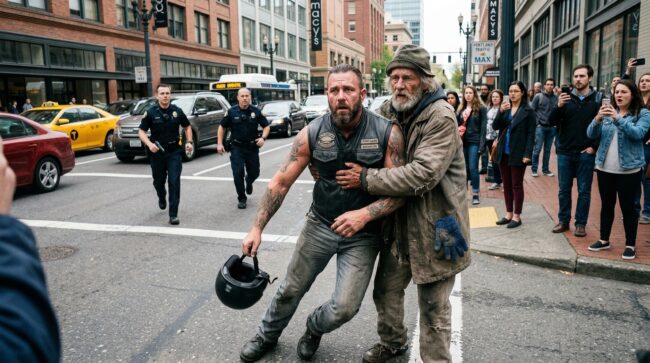
The biker’s name was Luke Mercer, though most people on our block just called him the guy with the matte-black Harley.
He came by my cart three or four nights a week, usually around six fifteen, always parking in the loading zone like he owned the city and then apologizing for it with the same tired half-smile. He was in his early forties, broad through the shoulders, the kind of man strangers read as dangerous because he had ink on both forearms, a scar near his eyebrow, and a silence that seemed harder than it really was. But he tipped too much, drank his coffee black, and once spent fifteen minutes fixing the loose hinge on our cart window because he got tired of watching me fight it.
He never stayed long.
That was the first thing I noticed about him.
The second was that he was always running on empty.
Not dramatically. Not in a way that begged attention. Just little things. The slight shake in his hand when he reached for change. The way he sometimes stood too still, as if holding himself upright took concentration. The faint grayness under his skin. Once, on a rainy Thursday, I asked if he was all right, and he gave me that same half-smile and said, “Just need sleep.”
But he didn’t look like a man who merely needed sleep.
He looked like someone spending himself faster than he could replace it.
And then there was the older man.
He’d been around the block all winter, sleeping in the recessed doorway of a boarded-up travel agency two buildings down from us. Some people called him Frank, others said his name was Eddie, and a few claimed he answered to neither. He rarely begged. Mostly he watched. Watched buses unload, watched office workers pass, watched pigeons fight over pastry crumbs. He had the kind of stillness that made people uneasy because it suggested he saw more than he should.
And always, from the torn pocket of his coat, hung that single blue knit glove.
Kids pointed at it.
Drunk men joked about it.
Once I saw a tourist hand him a new pair of wool gloves from a shopping bag. He thanked her politely, tucked them away, and kept the old blue one exactly where it was, hanging like some small private warning.
That should have meant nothing.
Instead, it kept drawing my eyes.
The first time I noticed Luke looking at the old man, really looking, was four nights before the scene in the crosswalk. Luke had come for coffee later than usual. He looked bad—worse than bad, honestly. Pale. Sweating through the collar of his gray T-shirt though the air was cold. I handed him his cup, and before I could say a word, the old man rose from his doorway and crossed the sidewalk with an urgency I had never seen in him.
People stiffened immediately.
A woman pulled her purse close.
The old man stopped three feet from Luke and said, very quietly, “You’re doing it again.”
Luke’s fingers tightened around the cup. “Go back inside, Frank.”
“You don’t have enough left.”
Luke’s expression changed so fast it unsettled me. Not fear exactly. Recognition. Irritation. Maybe even shame.
“I said go back.”
The old man’s eyes dropped to the bike, then to Luke’s boots, then up to his face as if checking symptoms only he understood. And then he reached into his pocket, touched the hanging blue glove, and stepped away without another word.
Luke never drank the coffee. He set it on the cart ledge, untouched, climbed on the Harley, and rode off so abruptly the rear tire spit water from the gutter.
I watched the untouched cup steam itself empty.
Later that night, when I closed up, I found the cup still there and the name I’d written on it—LUKE—blurred by drizzle into a dark stain that looked almost like a bruise.
After that, I started noticing things I hadn’t before.
Luke came by less regularly, but when he did, the old man seemed to know before anyone else. He would lift his head from half a block away. Turn. Wait. Once I saw him step off the curb just as Luke pulled up, as if drawn by something invisible between them. They never had long conversations. Mostly fragments.
“Did you eat?”
“Not your business.”
“Your hands are numb.”
“I’m fine.”
“Liar.”
It would have been almost funny if Luke hadn’t looked so exhausted every time.
Then came the first thing that truly made my stomach tighten.
Two nights before the crosswalk scene, I was dumping coffee grounds into the alley bin when I heard voices behind the cart. Luke and the old man again. Low. Tense. Hidden from the street.
I shouldn’t have listened.
I did anyway.
Luke said, “If you keep following me, somebody’s gonna call the cops.”
The old man answered, “Better that than scraping you off the pavement.”
I froze with the bin lid in my hand.
There was a pause. Then Luke said something I still hear when the city gets too quiet.
“Why do you still have that glove?”
The old man’s reply came softer. Rawer. “Because you told me to keep one hand covered.”
I leaned just enough to see around the corner—
and both of them stopped talking at the exact same moment.
By then, I should have let it go.
Normal people let things go.
They tell themselves a stranger’s life is none of their business, that weirdness in a city is just background noise, that if something truly dangerous is happening, someone more qualified will handle it.
But the problem with repeated strangeness is that it stops feeling random. It begins to feel arranged.
The next afternoon, Marisol, who ran the flower stand across from my cart, asked me if I knew the biker. I said not really. She lowered her voice and told me she’d seen the older man standing beside Luke’s bike before dawn, not touching it, just staring at the gas tank while holding that blue glove like a person holds a photograph at a funeral.
That image stayed with me all day.
Because Marisol wasn’t dramatic. She noticed practical things—weather shifts, counterfeit bills, which regulars were about to get evicted before they said it out loud. If she sounded unsettled, I paid attention.
“Did Luke see him?” I asked.
She nodded. “And he didn’t yell.”
That was the wrong part.
A man protective of his bike, especially a man who looked like Luke, should have yelled. Should have told him to back off. Should have drawn a line.
Instead, according to Marisol, Luke had just stood there in the weak morning light, breathing hard, one hand on the seat as if steadying himself, while the older man said, “You promised me spring.”
Then Luke looked over his shoulder as though somebody might be listening and answered, “Not here.”
Not here.
The words sat in me like a splinter.
That night the block felt off from the start. Wind pushed paper cups along the sidewalk. Sirens kept rising and fading three streets over. A man in a business suit argued into an earpiece while waiting for his rideshare, and even the pigeons seemed restless, hopping too fast under the benches. Around six, Luke appeared from the west end of Broadway on foot instead of on the Harley, carrying his helmet by the strap.
That alone was strange.
What was stranger was the way he moved.
He wasn’t drunk. I’ve seen drunk. He wasn’t high. I’ve seen that too. This was something quieter and more dangerous—like his body was obeying commands a half-second late. His shoulders were rigid. His face was colorless. Sweat clung to his temples though the air had turned cold enough for jackets.
“Luke,” I called before I could stop myself. “You okay?”
He looked at me, and for a second I got the terrible feeling he had to search for my face like it was buried under static.
“Yeah,” he said.
A lie.
A clean one. Practiced.
Then the older man stood up from the doorway across the street so suddenly a couple walking by flinched. He did not wave. Did not shout. He just started crossing against the light, straight toward Luke, that blue glove swinging from his pocket like a signal flag from another world.
A car horn blared.
Someone cursed.
Luke turned, saw him coming, and I watched something like dread move through his whole body.
Not fear of the man.
Fear of being seen with him.
The old man reached him at the curb and caught his sleeve.
“You sat down?” he asked.
Luke pulled free. “Not now.”
“You ate salt?”
“Jesus, Frank.”
“You’re white as paper.”
That got attention. Heads turned. Office workers slowed. One college kid took out his phone as if bad public moments were collectible now. Luke lowered his voice, but the old man didn’t. He kept talking with urgent, humiliating intimacy, the way family talks when they’ve forgotten other people exist.
“Your fingers tingled, didn’t they?”
“Stop.”
“Your hearing went thin.”
“Frank—”
“And now your chest is doing that skipping thing.”
I felt my own pulse jump.
Luke took one step back. Then another. Not aggressive. Unsteady.
Marisol stared from her flower buckets.
The business-suit man muttered, “What is this?”
And then the old man did the worst possible thing a person could do in a nervous crowd: he grabbed Luke with both hands.
Gasps. Phones raised. A woman backed into my cart hard enough to rattle the sugar canisters. Across the intersection, two officers who’d been talking near a patrol SUV turned at the motion and started moving in.
Everything after that happened fast.
Too fast.
Luke tried to say something, but his mouth didn’t seem to cooperate. The old man pulled him closer instead of letting go, one arm braced across his back as if holding up dead weight. To every watching eye, it looked like a disturbance, maybe a fight, maybe harassment, maybe the kind of street chaos people are trained to fear before they understand it.
Then I saw the old man’s face.
Not rage.
Not confusion.
Calculation.
He turned Luke slightly sideways, one hand pressing between his shoulder blades, the other reaching blindly into his own coat pocket until his fingers closed around the hanging blue glove.
For one insane second, I thought he was going to pull a weapon.
One of the officers shouted, “Sir, let him go!”
The old man didn’t even look up. He shoved the glove into Luke’s limp hand and said, with a voice so fierce it cut through traffic, through fear, through every wrong assumption on that block—
“Stay with me, Daniel.”
Daniel.
Not Luke.
And the moment that name hit the air, the biker’s eyes fluttered, the officers broke into a run, and I realized with sudden cold certainty that almost everything I thought I understood was wrong.
Everything in the intersection split into two realities at once.
In one, which the crowd believed, a disoriented homeless man had latched onto a biker and was now babbling the wrong name while police rushed in to break it up. In the other, which I only began to glimpse in flashes, the old man was trying with terrifying precision to keep Luke—or Daniel, or whoever he really was—from collapsing face-first into moving traffic.
The officers reached them in seconds.
“Sir, step back now!”
One officer went for the old man’s shoulder. The other reached for Luke, who was still standing only because Frank—if Frank was even his name—had one forearm locked across his back like a brace. Luke’s helmet lay in the street near the crosswalk stripe, and cars had stopped in a jagged row, horns blaring in useless panic.
“Don’t pull him forward,” the old man snapped.
It was the tone that shocked me.
Not wild. Not confused. Not drunken.
Commanding.
The younger officer ignored him and tried to guide Luke by the arm. Luke’s knees buckled instantly.
A woman screamed.
The officer swore and caught him under the elbow just before his face hit the hood of a stopped sedan. That changed everything for exactly three seconds. Long enough for people to realize this might not be what it looked like. Not long enough for them to understand it.
“What did you take?” the younger officer demanded, looking straight at Luke now.
Luke tried to answer. His lips moved. No sound came.
The old man was still gripping him with one hand, the other pressed to Luke’s wrist, counting under his breath. “Too fast,” he muttered. “Then too slow. Damn it.”
The older officer turned on him. “You know him?”
The old man looked up, and for the first time I saw how exhausted he was beneath the grime. The deep cracks in his lips. The raw red veins in his eyes. The way his jaw trembled after every sentence, as if his body had been living too long on cold air and adrenaline.
“I know what’s happening,” he said.
That was not the same answer.
An ambulance was called. Pedestrians crowded closer despite the officers pushing them back. Someone said overdose. Someone else said diabetic shock. A man in a navy pea coat insisted he’d seen the homeless guy stalking the biker for days. Marisol started to argue with him, then stopped when Luke’s head dropped forward and the old man caught it before it snapped against his own shoulder.
And that was when I saw it again.
The blue knit glove.
Luke’s fingers had closed around it without anyone noticing. Not tightly. Barely. But he was holding it now like a child gripping a rail in deep water.
The ambulance took eight minutes.
They felt like forty.
I should have stayed at my cart. I should have kept out of it. But when they finally loaded Luke in and one of the paramedics asked if there was family, nobody answered. The officers were focused on Frank. The crowd was focused on the spectacle. And the old man, who had just prevented the collapse everyone thought he caused, was being edged toward the patrol SUV as if he were the problem after all.
He kept looking only at the ambulance.
“Tell them not to let him ride alone,” he said.
The older officer frowned. “You need to worry about yourself.”
“He passes out deeper if no one talks to him.”
“Who is he?”
The old man hesitated.
That hesitation did him no favors.
The younger officer took it as evasion. “Sir, we’ve had complaints about you following him. You want to explain that?”
The old man laughed once, without humor. “Following him?” His voice came out rougher now. “I’ve been keeping him alive.”
Nobody around us believed him.
Not really.
I’m ashamed to say I didn’t either. Not fully. Not yet.
Because if what he said was true, then why had Luke kept pushing him away? Why the secrecy? Why the wrong name? Why that strange, intimate checklist in the street—salt, knees, hearing, fingers, chest—like he knew Luke’s body better than Luke wanted anyone to know?
And why, when the ambulance doors shut, did Luke’s limp hand rise once against the glass—just enough for me to see the blue glove pressed there from the inside?
A second later, the younger officer asked the old man for ID.
The old man went still.
Then he said, “You’re not going to find me under Frank.”
And the officer’s hand moved toward his cuffs.
That night should have ended it.
A medical emergency. A detained homeless man. A biker taken to the hospital. A strange scene folded back into the city’s endless appetite for oddness.
Instead, it widened.
By nine o’clock, the whole block had its own version. Luke was an addict. Luke was an undercover cop. Frank was a war vet. Frank was a scam artist. The police had found warrants. The biker had a heart condition. The old man had saved him. The old man had poisoned him. Nobody knew anything, and somehow that made everyone louder.
I closed the cart late and walked the twelve minutes to St. Vincent’s because I couldn’t shake the look on Luke’s face before his knees gave out. Not fear. Not even pain, exactly. It was something worse—recognition mixed with defeat, as if whatever caught him in that intersection had been catching up for a long time.
The ER waiting room was bright in the cruel, sleepless way hospitals always are. Vending machines hummed. A child cried behind a curtain. A janitor mopped around shoes without anyone noticing him. I asked at the desk about Luke Mercer, and the nurse gave me the practiced look people save for strangers too emotionally involved to be casual.
“Family?”
“No.”
She nodded once. End of discussion.
I was turning to leave when I saw the older officer from the intersection step out of a side hallway carrying a paper cup and a manila envelope. He recognized me from the cart.
“You were there,” he said.
I nodded.
He studied me for a second, then said, “You know either of them?”
“Just enough to know none of that looked normal.”
He almost smiled at that. “It wasn’t.”
“What happened to the old man?”
“Being checked out. Not charged. Yet.”
The yet landed hard.
Before I could ask more, a woman in navy scrubs pushed through the double doors holding a clear plastic property bag. Inside were Luke’s wallet, keys, phone, and a few folded papers damp with sweat. On top of all that, jarring in its softness, lay the blue knit glove.
The officer noticed where I was looking.
“You know anything about that?”
“No.”
But something in my voice must have betrayed me, because he held my gaze a beat too long and then said, “The guy wouldn’t stop asking for it. Said it had to stay with him.”
“With Luke?”
“With Daniel.”
The hallway seemed to tilt.
“Who’s Daniel?” I asked.
The officer tapped the manila envelope against his palm. “That,” he said, “is exactly the problem.”
He went into a consultation room and shut the door.
I should have gone home.
I didn’t.
Instead I sat in the waiting room pretending to check messages until, twenty minutes later, a volunteer in a pink vest asked if I was all right. I lied and said yes. Then I saw a security guard wheel the old man—cleaner now, wrapped in a hospital blanket—past the end of the corridor toward Radiology. Without the street dirt and bundled coats, he looked smaller. Older. One cheekbone bruised purple. White stubble rough against hollow skin.
He saw me. Slowed. Lifted two fingers.
I got up and followed at a distance until they parked him in an alcove near imaging.
“I know you from the cart,” he said before I could speak.
His voice was weaker, but the sharpness in it remained.
“What’s your name?” I asked.
He gave me a dry little smile. “Which one are you asking for?”
I didn’t know how to answer that.
So I asked the question that had been pressing against my ribs since the intersection. “Who’s Daniel?”
He looked toward the corridor to make sure no one was close enough to hear. Then he said, “The man everybody calls Luke.”
“Why would he use another name?”
He ignored that. “Did they let him keep the glove?”
“No. It’s in his stuff.”
The old man shut his eyes, and for a second he looked almost frightened. “He needs it when he wakes.”
“It’s just a glove.”
“No,” he said, opening his eyes again. “It’s proof.”
That word changed the air.
“Proof of what?”
Before he could answer, footsteps approached. He turned his head fast. Too fast for a frail man. Instinctive. Defensive. The older officer appeared at the end of the alcove holding the same envelope.
“There you are,” he said to the old man. “Name check came back on one of your aliases.”
The old man’s jaw tightened.
Alias.
The officer glanced at me, then at him. “You want to explain why you told patrol your name was Frank Heller, but the shelter records have you as Elias Voss?”
The old man said nothing.
The officer continued, “And why Mr. Mercer’s old emergency contact—never updated, apparently—is also an Elias Voss?”
I stopped breathing for a moment.
The officer opened the envelope and pulled out one of the folded papers from Luke’s pocket. It was worn thin from being carried. He looked at it, then at the old man.
“This says,” he said carefully, “‘If found unconscious, please call Elias before transport if possible. He knows the signs.’”
I stared at the old man.
He stared back.
And then, with the terrible slowness of a lock turning, he said, “I told you. I’ve been keeping him alive.”
The officer stepped closer. “Then start at the beginning.”
Elias looked past him at me, not the cop, not the nurse passing by, just me—as if deciding whether I could bear the next piece.
When he spoke, his voice dropped low enough that I had to lean in.
“I was the one in the snow,” he said. “Not him.”
I frowned. “What snow?”
He swallowed. Hard. “Last winter. Under the Burnside Bridge. I was already halfway gone.”
A stretcher rattled loudly down the hall, drowning the last few words.
Elias waited until it passed, then looked at the envelope in the officer’s hand and went pale.
“What else was in his pocket?” he asked.
The officer hesitated.
Then he pulled out a small silver object on a ring.
Not keys.
A medical tag.
Elias saw it and swore under his breath.
The officer turned it over and read aloud, “Daniel Mercer. Addison’s disease. Adrenal crisis risk. Emergency steroid dependent.”
Every hair on my arms rose at once.
Because suddenly the checklist in the street made sense.
Not all of it.
But enough.
And then the officer read the final engraved line, and the old man lurched upright in the wheelchair like a man struck through the chest.
“Saved one life in the snow. Owe him mine.”
Silence can have weight.
Not the peaceful kind. The kind that settles over a room when a story has just changed shape and no one yet knows how to stand inside the new version of it.
The officer lowered the tag slowly.
I looked at Elias—not Frank, not some nameless man everyone on Broadway had filed under nuisance or threat—and saw the whole pattern rearranging itself piece by piece.
The watching.
The following.
The urgent questions about food, salt, numb fingers, hearing.
The fury when Luke tried to brush him off.
The glove.
Especially the glove.
Elias rubbed a hand over his mouth. When he spoke again, the roughness in his voice wasn’t from anger anymore. It was from memory.
“Last January was the coldest week I can remember,” he said. “The shelters were full. I’d been outside too long already. Wet socks. No heat packs. No dry place to stand. People passed me all day like I was part of the concrete.” He looked down at his blanket-wrapped knees. “By night I couldn’t feel my feet. Then my hands. Then not much of anything.”
The officer said nothing.
Neither did I.
Elias went on. “I lay down under the bridge because I was so tired I couldn’t think straight. That’s what freezing does. Makes dying feel like rest. I remember the river sound. I remember thinking I’d stop shivering soon.” He closed his eyes. “And then I remember a biker kneeling in dirty snow, slapping my face and swearing at me to stay angry.”
I saw it as he spoke: the bridge, the dark water, the stinging wind, Luke—Daniel—half frozen himself, crouched beside a man everyone else had stepped around.
“He took off one glove,” Elias said. “Blue knit. Cheap thing. Gave it to me because my left hand was white as wax and he said I needed to keep one hand covered while he got the fire crew to the right side of the embankment.” His mouth twisted faintly. “He kept shouting weird practical things so I wouldn’t drift. ‘Don’t lock your knees.’ ‘Keep breathing through your nose.’ ‘Tell me what month it is.’ ‘Swear at me if you can hear me.’”
I felt dizzy.
Those same phrases.
The same rhythm.
What I thought was harassment in the street had been memory turned into instruction. Elias had been repeating Daniel’s own words back to him, using the only script he knew had once pulled a body back from the edge.
“He saved you,” I said quietly.
Elias gave a tiny nod. “More than that. He came to the hospital after. Smuggled me decent socks. Sat through discharge because I had nowhere to go. Slipped me cash I tried not to take.” A bitter smile touched his face. “I took it.”
“Then why would he hide from you?” the officer asked.
Elias took a long breath before answering. “Pride. Shame. Stupidity. Pick one.”
He looked toward the ER doors, toward the part of the hospital where Daniel lay behind machines and curtains and professional voices.
“He found me again a month later,” Elias said. “I was doing better. Not good. Better. He was the one looking rough then. Dizzy. Skin too tan for winter but somehow gray under it. Cramping in his hands. He almost blacked out standing up. I knew those signs because my sister had Addison’s. Lost her at twenty-nine when she couldn’t get treatment in time.” He paused there, and the pause hurt. “I told him to go to a doctor. He laughed. Told me he already had doctors, plural. Told me meds cost money, insurance fights, appointments move, and he’d been stretching doses because rent doesn’t care what your glands do.”
The officer’s face hardened—not at Elias, but at the bleak, ordinary cruelty of that sentence.
“So you watched him,” I said.
“I watched him because he was getting worse.” Elias’s eyes flashed. “He’d skip meals. Work too long. Ride in freezing rain. He’d come by that cart trembling and act like coffee was enough. He kept saying he had it handled.” Elias shook his head. “People like him always say that right before they hit the ground.”
The officer looked at the medical tag again. “Why use a different name?”
Elias answered after a beat. “Because Daniel didn’t want anybody in the neighborhood knowing he was sick. Said people already looked at him and saw a stereotype. Didn’t want them seeing weakness on top of it. ‘Luke’ was easier. Cleaner. A name he used when he wanted distance.”
That landed in me harder than I expected.
All this time I had mistaken his reserve for toughness, his silence for mystery, his exhaustion for some vague private trouble that belonged to someone else. Really it had been management—minute by minute, symptom by symptom, dose by dose—while trying to keep the world from smelling vulnerability on him.
“And the glove?” I asked.
Elias looked at me then, directly.
“He told me that night under the bridge that if I lived, I should keep it until spring. Proof I’d made it through winter.” His voice softened. “Spring came. I kept it anyway. Then when I started seeing him fade the same way—different danger, same edge—it became something else. A reminder. A promise. He laughed at me for carrying it. But every time he saw it, he knew someone on that block was watching whether he was steady or not.”
The officer exhaled slowly. “So in the intersection—”
“He was crashing,” Elias said. “Maybe because he missed a dose. Maybe stress. Maybe no food, too much caffeine, bad luck. But I saw it before he did. The color drop. The far-away hearing. The locked knees. Once that wave starts, he gets stubborn, then confused. I grabbed him because if he fell hard, his head would’ve hit the curb.”
No one spoke for several seconds.
A nurse came for the officer with an update, but he held up one finger without looking away from Elias.
The whole story had turned inside out.
The dangerous biker had been the rescuer.
The troublesome homeless man had been the witness, the guardian, the unpaid lookout with no authority and no clean clothes and more useful knowledge than anyone around him.
And the object I had attached all my unease to—that filthy blue glove—was not a threat, not a sign of instability, not some strange prop from a drifter’s life.
It was gratitude made visible.
A relic.
A warning.
A debt.
The nurse stepped closer. “The patient’s awake,” she said to the officer. “Disoriented, but asking for someone named Elias.”
Elias looked down at his trembling hands.
For the first time all night, nobody hurried him.
I did not go into the room with them.
That felt earned by other people.
So I stayed just outside the half-closed curtain while the officer wheeled Elias in and then quietly stepped back out. Through the narrow gap, I could see only fragments: the corner of the hospital bed, the line of Daniel’s shoulder under the blanket, one socked foot, the monitor climbing and falling in bright green strokes.
His voice, when it came, was weaker than I had ever heard it.
“You caused a whole scene.”
Elias answered without apology. “You’re welcome.”
A pause.
Then, so softly I almost missed it, Daniel said, “You still had it?”
The blue glove was no longer in property. At some point, someone had finally understood enough to place it in Elias’s lap. Through the curtain gap, I watched him lift it with both hands like something fragile and absurdly important.
“Told you,” Elias said. “Till spring.”
Daniel gave the smallest laugh. It broke in the middle. “It’s been over a year.”
“Then maybe you needed more spring.”
Something in my chest tightened so suddenly it hurt.
Because there it was—the thing nobody in the crosswalk could have guessed, the truth hidden under all the worst assumptions. Not a disturbance. Not an attack. Not a scam. Just one worn-down man refusing to let another worn-down man disappear in public after once being pulled back himself.
I stepped away before they saw me watching.
The officer came out a minute later and leaned against the wall beside me. He looked older than he had in the street.
“We almost cuffed the one guy who knew what was wrong,” he said.
I nodded.
He stared at the floor. “Happens more than you’d think.”
That answer stayed with me even after I left the hospital.
Over the next few weeks, Daniel was around less, then more. Recovery seemed to come in uneven pieces. He still looked tired, but no longer hollowed out. He started carrying a small pouch clipped inside his vest. He ate at my cart sometimes instead of just buying coffee. Real food. Salted eggs. Soup in paper cups. Once, catching me watch him, he raised an eyebrow and said, “Happy?”
“More than you know,” I said.
Elias vanished for three days after discharge, and I worried he’d drifted somewhere unreachable. Then one cold morning he appeared near the doorway of the old travel agency in a donated peacoat two sizes too big, holding a cup Daniel must have bought him because it had come from a place neither of them could afford.
The blue glove still hung from his pocket.
Only now it no longer looked sinister.
Just stubborn.
Marisol started setting aside unsold flowers for him to take to the church basement shelter. The pea-coat man from the intersection—who had been loudest about “public safety”—pretended not to recognize him at first, then one afternoon quietly handed him a wrapped sandwich and walked away before Elias could answer. The city did not become kind overnight. Cities rarely do. But a few people on our block learned to look twice before deciding what they were seeing.
Daniel and Elias still argued, of course.
That never changed.
“Did you eat?”
“Mind your business.”
“Your hands are shaking.”
“They do that.”
“Liar.”
But now, when they stood outside my cart exchanging those rough little sentences, I heard what had always been hiding inside them.
Not annoyance.
Not dependence exactly.
Something harder to name and more human because of it.
A bond forged in the least romantic places possible: under a freezing bridge, in a noisy crosswalk, beside a hospital curtain, in the humiliating public work of keeping another person from slipping out of the world.
One evening in early April, when the air finally softened and the wet bite of winter was gone for good, Daniel came by on the Harley just before sunset. Elias was already there, sitting on an overturned milk crate with one knee wrapped in an elastic brace. They looked like they had been waiting for something neither wanted to mention.
Daniel set his coffee on the cart ledge and held out a small paper bag.
Elias frowned. “What’s that?”
“Open it.”
Inside was a pair of new knit gloves. Blue. Better quality than the old one, but the same impossible color.
Elias stared at them for a long time.
Then he looked up. “What about this one?”
He touched the old glove hanging from his pocket.
Daniel’s expression changed in that quiet way his face did when he was trying not to show too much. “Keep it,” he said. “That one did its job.”
Elias laughed once, then covered his eyes with the heel of his hand as if the sky had suddenly gone too bright.
I looked away because some moments grow smaller when watched directly.
When I looked back, Daniel had already put on his helmet. Elias had tucked the new gloves into his coat but left the old one where it always was, swinging gently against his leg.
A relic, yes.
But also a witness.
A reminder that the world’s ugliest first impression can be miles away from the truth. That sometimes the person people move to remove from the scene is the only one holding the scene together. That rescue does not always look heroic when it happens in real life. Sometimes it looks dirty, embarrassing, badly timed, and public. Sometimes it looks exactly like trouble.
Daniel kicked the bike to life. The engine rolled through the evening air.
Elias stepped back from the curb and lifted one hand—the gloved one, the old one—in a motion so small most people would have missed it.
Daniel saw.
He tapped two fingers once against his chest, right over the place where Elias had held him up in the street, and rode into traffic.
The old glove swung in the sunset long after the sound of the motorcycle was gone.
And I stood there understanding, too late and all at once, that the most dangerous thing in that crosswalk had never been the man everyone feared.
It was how quickly the rest of us were willing to be wrong.
Follow for more stories that begin with misunderstanding—and end where the heart finally catches up.