Part 2: The Little Girl Asked to Speak for the Whole Class — Her Final Words Made the Entire School Stand and Applaud
For one long second, the gym seemed to forget how to make noise.
The Spring Recognition Assembly at Lincoln Elementary was supposed to be safe. It was all paper certificates, plastic trophies, bright banners, and the smell of floor wax under warm lights.
Children were praised for perfect attendance, highest reading points, best handwriting, fastest mile, most improved math score. Parents clapped for names they recognized and politely for names they did not.
Nobody expected trouble from a ten-year-old in a faded yellow dress.
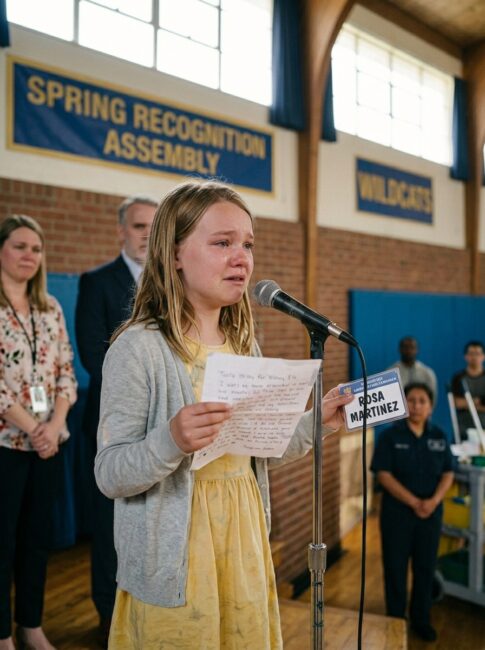
Nora stood at the microphone, her shoulders lifted toward her ears.
Mrs. Blake remained halfway between the front row and the stage, one hand still raised, not touching Nora but close enough to show the room she wanted to.
Principal Harris stepped nearer with that careful school smile adults use when something is going wrong in public.
“Who is leaving, Nora?” he asked.
Nora looked down at the folded note.
Her thumb rubbed one corner until the paper softened.
“She is,” Nora said.
She pointed toward the left side of the gym.
Everyone turned.
At the end of the teachers’ row sat Ms. Rosa Martinez, the school custodian.
She was in her early sixties, a short Hispanic American woman with silver streaks in her dark hair and a navy work shirt with her name stitched over the pocket. Her cleaning cart stood near the hallway door because she had come in during the assembly to replace a leaking trash bag.
She had not expected to be seen.
The moment everyone looked at her, she lowered her eyes.
A few students whispered.
One parent asked, “Why is the janitor part of this?”
Nora heard it.
Her face tightened.
Mrs. Blake looked suddenly pale.
Principal Harris said gently, “Nora, Ms. Martinez is not leaving today. Please hand me the microphone.”
Nora shook her head.
“She is leaving next Friday,” Nora said. “Because the district said they don’t need her full time anymore.”
A murmur spread across the gym.
Principal Harris closed his eyes for half a second.
That was the first crack.
Most children did not know district staffing decisions. Most children did not know what “part-time reassignment” meant. Most children did not know enough to sound that certain.
Nora unfolded the note.
Her hands trembled so badly the paper shook near the microphone.
“I wrote this with Room 12,” she said.
Mrs. Blake whispered, “Nora, please.”
Nora glanced at her teacher.
There was no defiance in her eyes. Only fear wrapped around purpose.
“She told us not to,” Nora said.
The sentence hit the room strangely.
“She told you not to what?” Principal Harris asked.
Nora looked at Ms. Martinez.
“To say thank you in public.”
Ms. Martinez’s hand went to her mouth.
The chosen class representative, a boy named Owen, stood from the front row.
“That’s true,” he said.
His voice cracked.
Mrs. Blake turned to him, startled.
Owen looked embarrassed, then lifted his chin.
“We all signed the note,” he said.
Another girl in Room 12 stood.
“So did I.”
Then another.
In less than ten seconds, nearly every child in Mrs. Blake’s class was on their feet.
Parents began lowering their phones.
This was no longer a little girl interrupting an assembly.
It was something else.
Nora smoothed the note against the podium.
“The first thing Ms. Rosa did was give Marcus her gloves,” she read.
A boy near the back row flinched.
Marcus Hill was known for his temper. He was eleven, Black American, tall for his age, and already carrying the exhausted look of a child adults called difficult too often.
Nora continued, “It was January. He came to school with no gloves. He told everyone he didn’t care, but his hands were red.”
Marcus looked at the floor.
“Ms. Rosa said she had an extra pair,” Nora read. “But she walked around with her hands in her pockets for the rest of the week.”
Ms. Martinez wiped her cheek quickly.
A teacher in the second row stared at her own hands.
Nora turned the page.
“The second thing she did was clean up the milk without telling anyone who spilled it.”
Mrs. Blake’s face changed.
She knew that story.
Everyone in Room 12 knew that story.
A carton of chocolate milk had exploded across the classroom rug in February. Mrs. Blake had been in the hallway speaking with a parent. When she returned, the mess was gone and the class was silent.
She had assumed the students finally learned responsibility.
She never knew why they had been silent.
Nora looked at a red-haired white American girl named Sophie in the front row.
Sophie’s eyes filled.
“I spilled it,” Sophie whispered.
Nora nodded.
“She spilled it because she was shaking,” Nora read. “She had forgotten her lunch money again, and she thought Mrs. Blake would call home.”
Mrs. Blake took one step back.
Sophie covered her face.
“Ms. Rosa cleaned it and said, ‘Some accidents don’t need an audience.’”
The gym was very quiet now.
Quiet enough to hear Ms. Martinez crying.
Nora took a breath and kept reading.
The note was not neat. It had different handwriting on every line. Some words were spelled wrong. Some sentences leaned upward as if the children who wrote them had pressed too hard with their pencils.
But the room listened as if it were the most important document ever read in that gym.
“The third thing,” Nora said, “was the blue backpack.”
A small boy in the front row stiffened.
His name was Tyler Evans. He was white, nine years old, and had spent most of the school year trying not to be noticed. His father had lost his job in November. By March, Tyler’s backpack had torn so badly the bottom sagged open.
The other kids had noticed.
Children notice everything.
Some had laughed when his pencils fell out during recess.
Nora’s voice softened.
“Tyler found a blue backpack on his chair the next morning. No tag. No note. Just a backpack.”
Tyler looked toward Ms. Martinez.
She shook her head slightly, as if begging him not to say anything.
But Tyler stood.
“It was hers,” he said. “I saw the receipt in the pocket.”
Ms. Martinez closed her eyes.
“I was going to give it back,” he added, voice trembling. “But she told me it looked better on me.”
A sound moved through the parents now.
Not applause.
Something gentler and more painful.
Nora looked at Mrs. Blake, and the teacher seemed to shrink under the weight of what her class had been carrying quietly.
“The fourth thing,” Nora said, “was the bathroom mirror.”
Several girls in Room 12 began crying.
In April, someone had written an ugly word about a girl named Hailey on the girls’ bathroom mirror. The school never found who did it. Hailey, an Asian American girl with thick glasses and a soft voice, had missed two days afterward.
Teachers called it bullying.
Students called it drama.
Ms. Martinez called it something else.
Nora read, “Ms. Rosa cleaned the mirror before first bell, but she didn’t stop there. She wrote on a sticky note and stuck it on Hailey’s desk.”
Hailey stood slowly.
Her voice was almost too small.
“It said, ‘Mirrors are not allowed to tell lies about you.’”
Mrs. Blake began to cry.
Hailey looked at her teacher.
“I kept it in my pencil box.”
Principal Harris stared at Ms. Martinez, then at the rows of children who had known more about each other’s pain than the adults had allowed themselves to see.
Nora’s grip on the paper tightened.
“The fifth thing was about me,” she said.
Her voice changed.
The room leaned closer.
“I didn’t want to write this part,” Nora admitted. “But Owen said if I got to speak, I had to tell the truth too.”
Owen nodded from the front row.
Nora swallowed.
“Last month, I hid in the supply closet during recess.”
Mrs. Blake’s eyebrows drew together.
“I thought you were in the library,” she said.
Nora shook her head.
“I was crying because everyone was talking about the father-daughter breakfast.”
The gym grew still.
Nora’s father had died three years earlier in a construction accident. Most people knew that in the distant way schools know sad facts. They remembered it during registration forms and forgot it during theme days.
“I didn’t want anyone to feel sorry for me,” Nora said. “But I didn’t want to sit at a table with an empty chair either.”
Her mother, seated near the back, pressed both hands to her mouth.
Nora looked toward Ms. Martinez.
“Ms. Rosa found me.”
Ms. Martinez shook her head again, tears falling freely.
“She sat on a bucket outside the closet door,” Nora said. “She didn’t tell me to come out. She just said her father died when she was twelve, and sometimes empty chairs are louder than full rooms.”
Several adults wiped their eyes.
“She gave me a napkin from her lunch bag,” Nora continued. “Then she said, ‘You can miss him without disappearing.’”
Nora stopped reading.
For a moment, she was not speaking for the whole class.
She was only a little girl trying to breathe through a memory.
Mrs. Blake climbed the stage steps slowly.
This time, she was not trying to stop her.
She stood beside Nora and looked out at the gym.
“I didn’t know,” she said.
Her voice broke on the last word.
Nora turned toward her.
“That’s why we wrote it down,” she said.
Those simple words undid the teacher.
Mrs. Blake covered her face.
The room watched a good teacher face a hard truth. She had loved her students. She had decorated bulletin boards, stayed late grading, bought tissues with her own money, and remembered allergies during class parties.
But she had missed things.
Not because she did not care.
Because care can become busy. Because systems reward visible success. Because small pain often hides beneath quiet behavior.
Ms. Martinez had seen what fell between the lines.
She saw the red hands, the torn backpack, the lowered eyes, the child in the closet.
She saw the parts that were not on report cards.
Principal Harris walked to the microphone.
“Nora,” he said, his voice thick, “may I say something?”
Nora hesitated.
Then she nodded and stepped aside.
Principal Harris faced Ms. Martinez.
“Rosa,” he said, “I knew about the district decision. I did not know about this.”
Ms. Martinez stood quickly, embarrassed.
“Please,” she said, “I was just doing my job.”
Marcus spoke from the back.
“No,” he said. “You were doing more than that.”
His voice carried across the gym.
For the first time all year, nobody corrected his tone.
Principal Harris looked at the school board representative sitting near the exit. The man adjusted his tie and stared at his program.
The principal turned back to the microphone.
“I can’t undo every decision from this stage,” he said. “But I can say this in front of everyone. Lincoln Elementary has misunderstood what kind of person we were about to lose.”
Ms. Martinez shook her head.
But the children were already standing.
One by one, Room 12 rose first. Then the fourth graders. Then the second graders who barely understood but felt the room shift. Parents stood next, slower and more ashamed.
Nora lifted the note again.
“I still have one last line,” she said.
Everyone waited.
Nora looked at Ms. Martinez, then at her classmates, then at the adults who had spent all morning handing out awards for things they could count.
Her voice trembled.
“We don’t want a trophy for being the best class,” she said. “We want to be the class that learned how to notice.”
The gym erupted.
Not all at once.
It began with Owen clapping through tears. Then Sophie. Then Marcus. Then Mrs. Blake, who clapped like an apology. Soon the whole school was on its feet.
Ms. Martinez stood near her cleaning cart with one hand over her heart, crying as if the applause belonged to someone else.
Nora looked down at the note.
For the first time that morning, she smiled.
After the assembly, nobody returned to class right away.
The gym filled with the strange, tender chaos that comes after people realize the day has become something they will remember. Parents hugged children tighter than usual. Teachers spoke quietly in corners. Students from other classes walked past Ms. Martinez with shy smiles and mumbled thank-yous.
She tried to return to work.
Of course she did.
She reached for the trash bag near the bleachers, but Principal Harris gently took it from her hand.
“Rosa,” he said, “not today.”
She looked uncomfortable with that much attention.
“I don’t know what to do if I’m not cleaning something,” she said.
Nora, still holding the wrinkled class note, stepped beside her.
“You can sit with us,” she said.
Ms. Martinez laughed softly through tears.
“That sounds harder.”
In Room 12, Mrs. Blake did something she had never done before.
She erased the day’s math lesson from the whiteboard.
Then she wrote one question.
“What did you notice today?”
The children did not answer right away.
They looked around at one another as if seeing the room differently. Marcus noticed Tyler’s new backpack had a loose strap. Sophie noticed Hailey kept touching the pencil box where the sticky note was hidden. Owen noticed Nora’s hands were still shaking.
Mrs. Blake noticed all of that.
This time, she did not rush to the next subject.
She sat on the edge of her desk and let the room breathe.
Later that afternoon, the school board representative called the district office. There were budgets and rules and schedules, the kinds of words adults use when they want kindness to wait its turn.
But something had already changed.
By Monday, Ms. Martinez’s hours had been restored temporarily.
By June, parents had raised enough money for a student care closet in the old storage room.
By September, the room had shelves of gloves, backpacks, snacks, clean socks, and quiet notes written by students.
Nobody named it after Ms. Martinez because she refused.
So the children named it “The Notice Room.”
On the last day of school, Nora found Ms. Martinez in the hallway near the gym. The cleaning cart was beside her, as always. A new pair of gloves rested on top, wrapped in blue ribbon.
Nora handed her a folded copy of the class note.
“You should keep the real one,” Nora said.
Ms. Martinez touched the paper like it might break.
“I don’t need thanks for being kind,” she said.
Nora looked up at her.
“I know,” she replied. “That’s why it matters.”
Ms. Martinez had no answer for that.
She only bent down and hugged the little girl carefully, as if holding both the child Nora was and the bravery she had somehow found.
From the classroom doorway, Mrs. Blake watched them.
She did not interrupt.
On her desk sat a new stack of recognition certificates for the end of the year. This time, between “Best Reader” and “Most Improved,” she had added one more category.
“Most Likely to Notice Someone Who Needs Help.”
Nora’s name was written there.
But when the certificate was handed out, she asked if the whole class could sign it instead.
Mrs. Blake said yes.
Years later, people at Lincoln Elementary would still talk about the assembly where a little girl took a microphone she was not supposed to touch and gave the school back a person it nearly overlooked.
But the image that stayed with Nora was smaller.
A navy cleaning cart.
A folded note.
A woman with tired hands standing beneath gym lights while children rose around her.
And one sentence that made the room feel less like a school and more like a promise.
“We want to be the class that learned how to notice.”
If this story stayed with you, follow this page for more heartfelt stories about the quiet kindness people often miss.