Part 2: The Mother Who Pretended She Was Too Busy for Her Daughter’s Honor Ceremony — Until a Secret Video Played in the Auditorium
The video had no music at first.
Only the low buzz of fluorescent lights and the distant hum of a floor buffer echoing down an empty hallway.
On the screen, Marianne Cole looked nothing like the woman people had judged from the diner window. Her brown hair was tucked messily under a faded baseball cap, her diner uniform hidden beneath an oversized gray sweatshirt, and her hands were red from cold water and bleach.
Someone in the auditorium whispered, “Is that Ellie’s mom?”
Ellie sat frozen in the front row, the scholarship plaque balanced on her knees.
She had never seen this footage.
No one had.
The camera angle came from the school’s security system, high in the corner near the trophy case. The timestamp read 12:43 a.m., March 8.
Marianne pushed a mop slowly across the hallway outside the science wing. She stopped at Ellie’s locker, reached into her sweatshirt pocket, and pulled out a small envelope. She looked both ways, like someone doing something wrong, then slid the envelope through the vent at the top of the locker door.
A few girls in the audience turned toward Ellie.
Ellie’s face changed before she could hide it.
She knew those envelopes.
For three months, every Friday morning, she had found one tucked inside her locker. Five dollars for lunch when her account ran low. A note that said, “Keep going.” A granola bar when she had skipped breakfast.
Ellie had thought it was Mrs. Landry.
Everyone had.
The video cut.
Now the screen showed the school parking lot in the blue-gray hour before sunrise. Marianne was sitting in her old white Chevy, the one with the dented passenger door. Her forehead rested against the steering wheel. Snow gathered softly on the windshield.
The timestamp read 5:18 a.m., January 24.
Marianne lifted her head and pressed two fingers to her mouth, breathing through pain. Then she reached for a brown paper bag on the seat beside her. She had written Ellie’s name on it in black marker.
Inside the auditorium, Mrs. Landry covered her mouth.
That morning, Ellie had received breakfast from “the school pantry.” A blueberry muffin, a banana, and a carton of milk. She had been too proud to ask who sent it.
Another clip appeared.
This time, Marianne was inside a small laundromat with flickering lights and cracked tile floors. It was late. Her diner apron was still tied around her waist. She was folding a navy-blue blazer over the top of a washing machine, smoothing the sleeves with careful hands.
Ellie’s blazer.
The one she wore to debate regionals.
Onstage, Principal Howard stood to the side, his jaw tight. He had introduced hundreds of award videos over the years, but this was not the polished slideshow he expected. The student media club had promised a short tribute about Ellie’s volunteer work. None of them had said Marianne would be in it.
The screen showed Marianne holding the blazer up to the light. There was a tear near the pocket. She opened a sewing kit, threaded a needle, and began to mend it by hand.
A voice came from somewhere in the crowd, soft and ashamed.
“I saw her that night. I thought she was washing uniforms for cash.”
Marianne was still not in the auditorium.
At Daisy’s Diner, she stood behind the counter while the owner, Lou, leaned near the kitchen door and watched her with worried eyes. The ceremony was being livestreamed on his phone, propped against the register. Marianne pretended not to look at it.
But when the video showed the laundromat, her hand slipped on the coffee pot.
Hot coffee splashed across her wrist.
She did not cry out.
She only grabbed a towel and turned her face away.
Back at the school, the video cut again.
A phone recording this time, shaky and vertical, taken by someone sitting in a car. Rain streaked the windshield. Across the street, Marianne stood beneath the awning of the public library, arguing with a man in a dark coat.
No one recognized him at first.
Then Ellie did.
Her father.
Daniel Cole had left when she was nine. He sent birthday cards for two years, then silence. Ellie had spent the last eight years pretending his absence did not matter.
On the video, Daniel held out an envelope.
Marianne did not take it.
The camera zoomed clumsily, and the audio cracked, but the words were clear enough.
“She deserves to know I offered,” Daniel said.
Marianne’s shoulders rose and fell. “You don’t get to buy a chair in her life the night she becomes someone worth watching.”
A sound moved through the auditorium, not applause, not outrage, but something heavier.
Daniel stepped closer.
Marianne did not move back.
“She asked about me?” he said.
Marianne’s voice broke, but she kept it low. “She stopped asking because it hurt less.”
Ellie’s fingers tightened around the edge of her plaque.
She had never known he had come back.
She had never known her mother had stood in the rain between her and another disappointment.
The video faded to black for a second, and the room stayed silent enough to hear the heating system click on.
Then a new image appeared.
Marianne at the diner.
Not that night.
Months earlier.
She was sitting alone in a booth after closing, counting coins from a glass jar. Quarters, dimes, nickels. Her lips moved as she counted. Beside her was a printed page from Franklin High School.
Senior Honor Night Dinner Contribution: $42 per guest.
Marianne stared at the amount for a long time.
Then she opened her wallet.
There was almost nothing inside.
A waitress named Rosa appeared in the frame, wiping a table nearby. “You want me to cover it?”
Marianne shook her head.
“She’ll see the ticket,” Rosa said gently. “She’ll know you paid.”
Marianne folded the paper twice and slipped it into her purse. “Then don’t let her see it.”
“Why not?”
Marianne looked down at her hands.
“Because if Ellie knows how hard it is, she’ll stop letting herself want things.”
The auditorium seemed to shrink around Ellie.
People had known the Coles were not wealthy. Everyone in small towns knows these things, even when they pretend not to. They knew Marianne worked breakfast shifts, lunch shifts, weekend shifts, and sometimes cleaned houses for families whose daughters sat beside Ellie in honors classes.
What they had not known was how carefully she hid the cost of keeping a child’s hope alive.
Then came the first voiceover.
It was not Marianne’s.
It was a boy from the student media club named Sam Whitaker, nervous but steady.
“We were making a video about Ellie’s service hours,” he said. “But every time we looked at the footage, Mrs. Cole was there too. Not in the front. Not where anyone could thank her. Always outside the frame.”
Ellie lowered her head.
The video had begun to explain her life without asking permission.
And still, the worst part had not played yet.
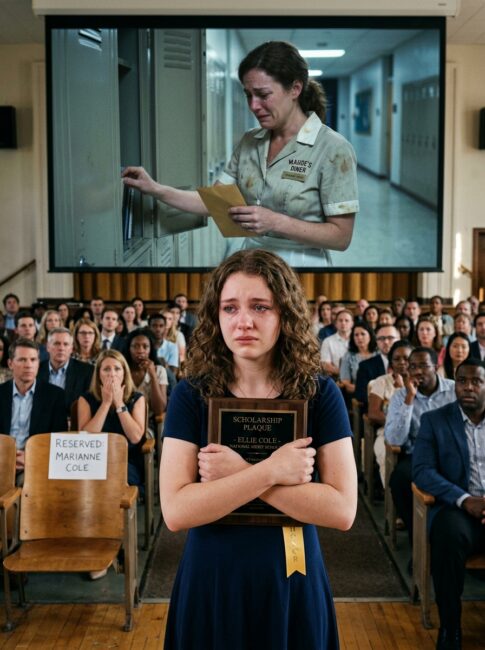
The screen shifted to a handheld video recorded inside the community center basement, where Ellie had spent Saturday mornings tutoring children from the trailer park outside town.
At first, it showed what everyone expected.
Ellie kneeling beside a little boy with a reading worksheet. Ellie tying a younger girl’s shoe. Ellie carrying boxes of canned food during the Thanksgiving drive.
Then the camera drifted toward the doorway.
Marianne stood there in her diner coat, holding a stack of winter jackets in both arms. She looked tired enough to fall asleep standing up, but when one of the children ran toward her, she smiled like she had been waiting all day for that one moment.
A woman in the back row murmured, “Those were donated by the church.”
Mrs. Landry shook her head slowly.
On the screen, Marianne handed the jackets to the center director and whispered, “Don’t say my name. Tell them they came from storage.”
The director frowned. “Marianne, you can’t keep doing this.”
“I can keep doing a little,” Marianne said. “A little is still something.”
The camera caught her hands.
They were wrapped in bandages.
Ellie turned toward Mrs. Landry, her eyes searching for an answer.
Mrs. Landry’s face crumpled.
The next clip answered before anyone else could.
Daisy’s Diner, kitchen entrance, 2:16 a.m.
Marianne was lifting a heavy tray from the industrial dishwasher when her right hand slipped. Steam burst upward. She jerked back, clutching her wrist against her chest.
Lou ran into the frame.
“Hospital,” he said.
“No.”
“Marianne.”
“No hospital.”
“You burned yourself.”
“I said no.”
He reached for the phone. “I’m calling Ellie.”
Marianne grabbed his arm with her uninjured hand, and for the first time in the entire video, she looked angry.
“You call my daughter, and she will miss her scholarship interview.”
Lou stared at her.
“She has to be at school by seven,” Marianne said, breathing hard. “She has to believe today is normal.”
“Your hand is blistering.”
“She has one shot, Lou.”
The video cut before anyone could see more.
In the auditorium, a woman began to cry quietly into a tissue. She was not close to Marianne. She had once told another parent that Marianne “used work as an excuse for everything.”
Ellie looked at the stage floor.
Her scholarship interview.
That morning, her mother had not come downstairs to make breakfast. Ellie had been angry. She remembered slamming the cabinet door, muttering that her mother cared more about diner tips than her future.
When Marianne came home later with her hand wrapped, she said she had spilled soup.
Ellie believed her.
No, not believed.
Accepted.
There is a difference.
The video moved on.
Sam’s voice returned.
“We asked the community center why Mrs. Cole was on their security footage so often. They told us she cleaned after events for free because Ellie volunteered there. Mrs. Cole said it was the only way she could serve beside her without embarrassing her.”
Now the auditorium saw Marianne mopping the basement floor after a holiday dinner. Chairs were stacked around her. Balloons sagged from the ceiling. She stopped beside a bulletin board where a photo of Ellie had been pinned under the words Youth Volunteer of the Month.
Marianne touched the edge of the photo with one finger.
She did not smile.
She looked proud and wounded at the same time, the way parents look when they realize their children are already walking toward a life that may not include them every day.
The next twist came from a voicemail.
The screen stayed black while Marianne’s voice played through the speakers.
“Hi, this is Marianne Cole. I know the final payment for Ellie’s cap and gown is due Friday. I’m short this week, but I can bring half tomorrow and half next Tuesday. Please don’t tell Ellie there’s a balance. She thinks everything is handled, and I need her to keep thinking that.”
The recording ended.
A few students turned to look at Ellie’s cap and gown hanging neatly on a rack beside the stage.
Ellie had complained about the color.
She had said the blue looked cheap.
Now her throat tightened so hard she could barely breathe.
The video showed another receipt.
Not for clothes.
Not for food.
For a bus ticket.
Franklin to Nashville.
One passenger: Marianne Cole.
Date: April 3.
Return: same day.
The camera cut to a bus station waiting area. Marianne sat beneath harsh lights with her purse on her knees and her burned hand wrapped in gauze. Across from her, Daniel Cole leaned against a vending machine, looking older than Ellie remembered and smaller than Marianne had allowed him to become in her imagination.
His voice was sharp.
“She’s my daughter too.”
Marianne’s was quiet. “Then act like it without making her bleed for it.”
“I got a new family now,” Daniel said. “I can’t just explain everything.”
“You don’t have to explain everything,” Marianne said. “You only have to stop promising what you won’t do.”
Daniel looked away.
He held an envelope again.
This time Marianne took it.
The room seemed to breathe with her.
Daniel said, “That should cover the ceremony dinner. And graduation.”
Marianne opened the envelope.
She looked inside.
Then she pulled out a folded note and read it.
Her expression changed.
Whatever money was in that envelope did not matter anymore.
Marianne’s voice dropped until the microphone barely caught it.
“You wrote her a goodbye letter?”
Daniel said nothing.
“You came back to leave again properly?” she asked.
He rubbed his forehead. “It’s better than disappearing.”
Marianne folded the note carefully and slid it back into the envelope.
“No,” she said. “It’s not.”
He reached for it, but she held it against her chest.
“She’s seventeen,” he said. “She can handle the truth.”
Marianne’s eyes filled, but she did not let the tears fall.
“She has handled enough truth from adults who didn’t stay.”
The footage stopped.
The auditorium was no longer judging an absent mother.
It was sitting inside the weight of what she had carried alone.
Principal Howard stepped forward, but the video continued before he could speak.
The final section had been filmed that afternoon.
A shaky phone camera showed Marianne in the back office of Daisy’s Diner, wearing the same uniform she had on right then. Her hair was pulled back. Her face looked pale. Lou stood beside her, arms crossed, looking furious in the protective way old friends do when they are tired of watching someone disappear.
Sam’s voice asked from behind the camera, “Mrs. Cole, why aren’t you going tonight?”
Marianne looked startled. “You shouldn’t be filming me.”
“We’re making a tribute video for Ellie,” Sam said. “We just wanted one sentence from you.”
Marianne shook her head. “No. Ellie doesn’t need me making a scene.”
“She saved the community center reading program,” Sam said. “She got the scholarship. She wants you there.”
Marianne’s mouth trembled.
For a moment, everyone in the auditorium believed she might say yes.
Then she looked down at her hands.
Her right hand was still healing. Her left thumb rubbed over the scar near her wrist, the one Ellie had seen for years without asking about anymore.
“I can’t,” Marianne said.
“Because of work?”
She smiled sadly.
“That’s easier for people to hate.”
Lou stepped forward. “Tell them the truth.”
Marianne’s eyes snapped toward him.
“No.”
“Marianne.”
“No.”
But Sam kept the camera steady.
The room listened.
Marianne sat slowly in the office chair, and all the strength seemed to leave her shoulders.
“I got a call this morning,” she said. “Daniel’s in town again.”
Ellie went still.
Marianne swallowed.
“He told me he was going to come tonight. Said he wanted to stand up when Ellie’s name was called. Said people should know he was her father.”
Lou muttered something under his breath.
Marianne continued, “He hasn’t earned that seat.”
Sam’s voice was gentle. “So why not come and stop him?”
“Because if I’m there,” Marianne said, “Ellie will watch me instead of receiving what she earned. She’ll see my face. She’ll know something is wrong. And if Daniel walks in, she’ll spend her big night wondering why he came back, why he left, why I didn’t tell her.”
Her voice cracked.
“She deserves one night where nobody abandons her, not even in memory.”
Lou said, “So you’re staying away?”
Marianne looked toward the diner window, where evening light was turning the street gold.
“I asked Principal Howard to keep an extra staff member near the door. I told him not to let Daniel near the stage. I told him if Ellie asks, say I got stuck at work.”
The camera shook slightly.
“You let her think you chose the diner over her?”
Marianne closed her eyes.
“Yes.”
The word landed in the auditorium like a stone dropped into water.
Then Marianne whispered, “It’s a small hurt I can give her tonight to keep a bigger one from walking through those doors.”
Ellie covered her mouth with both hands.
Every small twist now formed one larger truth.
The missed breakfasts.
The hidden envelopes.
The repaired blazer.
The burned hand.
The absent chair.
The mother who had looked careless was not careless at all.
She was standing between her daughter and pain so often that she had become invisible behind the shield.
The video returned to Sam in the hallway outside the auditorium just minutes before the ceremony. The camera pointed toward the main doors.
Daniel Cole appeared in a dark jacket, clean-shaven and nervous, holding a bouquet of gas station flowers.
Principal Howard met him quietly.
A staff member stood behind him.
Daniel tried to look past them into the auditorium.
“I’m her father,” he said.
Principal Howard’s voice was calm. “Not tonight.”
Daniel laughed once, bitterly. “Marianne did this?”
“No,” Principal Howard said. “Your choices did.”
The staff member guided him back toward the exit.
Daniel hesitated, then left the flowers on a bench.
The camera lingered on them.
Cheap white daisies wrapped in plastic.
Then Sam’s voice said, “Mrs. Cole asked us not to show any of this. But Ellie’s award is for service, courage, and quiet sacrifice. We thought the room should know where she learned it.”
The video ended.
No music.
No fade-out.
Just the school crest on the screen and the sound of an auditorium full of people realizing they had been wrong.
For several seconds, no one moved.
Then Ellie stood.
Her plaque slid from her lap and clattered onto the floor.
She did not pick it up.
She walked off the stage steps, down the center aisle, past the empty chair with her mother’s name on it, past the parents who had pitied her, past the teachers who had misunderstood her mother’s silence.
She pushed through the auditorium doors.
And for once, no one tried to stop her.
Daisy’s Diner was nearly empty when Ellie arrived.
The bell above the door gave a tired little ring, and Marianne looked up from the counter with a towel in her hands. For one second, mother and daughter stared at each other across the faded red booths and the smell of coffee, pie crust, and floor cleaner.
Marianne’s face changed first.
Not into surprise.
Into fear.
She looked past Ellie, as if expecting the whole auditorium to be behind her. But Ellie had come alone. Her curls had loosened around her face, her mascara had smudged at the corners, and the scholarship ribbon still hung around her neck.
Marianne set the towel down.
“You should be at the ceremony,” she said.
Ellie took one step forward.
“You should be too.”
The words were not angry.
That made them worse.
Marianne pressed her burned hand against her apron, hiding the bandage too late.
Ellie saw it.
Maybe for the first time, she really saw it.
Not as an inconvenience. Not as another sign that her mother was tired or distracted or late again. She saw the hand that folded notes into lockers, mended blazers, carried food, counted coins, and held back people who had no right to walk in when the lights were bright.
Lou stood near the kitchen and quietly disappeared through the swinging door.
Marianne’s voice dropped. “They played it?”
Ellie nodded.
Marianne closed her eyes.
“I told them not to.”
“I know.”
“I didn’t want you embarrassed.”
Ellie gave a small, broken laugh. “Mom, I thought you were embarrassed of me.”
That did it.
Marianne’s face folded in a way Ellie had never seen. Not dramatic. Not loud. Just the collapse of someone who had been strong so long she forgot strength has a cost.
“Oh, baby,” she whispered.
Ellie crossed the diner then, fast and clumsy, and threw her arms around her mother with such force that Marianne stumbled against the counter.
For a while, neither of them spoke.
The scholarship ribbon pressed between them. Marianne’s bandaged hand hovered in the air, afraid to touch, then settled gently against Ellie’s back.
“I was mad at you,” Ellie said into her shoulder.
“I know.”
“I said things.”
“I know.”
“I thought you didn’t care enough to come.”
Marianne held her tighter.
“I cared too much and got it wrong,” she said.
Outside the diner window, a few cars rolled slowly past, carrying families home from the ceremony. The town would talk. Small towns always do. But this time, the story would change as it traveled.
Not completely.
Stories never do.
Some people would say Marianne should have told Ellie everything sooner. Some would say she had no right to hide the truth about Daniel. Some would praise her as if praise could pay back years of quiet loneliness.
But inside the diner, none of that mattered yet.
Ellie pulled back and wiped her face with her sleeve.
“Dad came?”
Marianne nodded carefully. “He tried.”
“Did he want to see me?”
Marianne looked at her daughter for a long moment.
“He wanted to be seen seeing you.”
Ellie absorbed that with the stillness of someone old enough to understand and young enough to wish she didn’t.
Then she looked toward the counter, where Lou’s phone still showed the paused livestream. On the screen, the empty stage waited under soft gold lights.
“They’re probably wondering where I went,” Ellie said.
Marianne tried to smile. “You should go back.”
Ellie shook her head.
“No.”
“Ellie, that award—”
“I got the award.” She reached into her pocket and pulled out the medal she had taken off backstage. “But I didn’t get my picture.”
Marianne blinked.
Ellie held out the ribbon. “So take one with me.”
Marianne looked down at her diner uniform, at the coffee stain near her waist, at her shoes with the worn soles, at the bandage on her hand.
“I look awful.”
Ellie’s eyes filled again, but this time she smiled.
“You look like my mother.”
Lou came out from the kitchen then, pretending he had not been listening, holding an old instant camera he kept for birthday parties and retirement cakes.
“Stand by the pie case,” he said gruffly. “Light’s better there.”
So they did.
The great scholarship photo Ellie Cole would keep for the rest of her life was not taken beneath the school banner. It was not framed by roses or applause or polished wood.
It was taken beside a glass case of lemon meringue and pecan pie, with Marianne still in her apron, Ellie still in her honor ribbon, and both of them holding on like people who had almost lost each other in plain sight.
When the picture slid out, Lou shook it once and handed it to Ellie.
The image appeared slowly.
First the blur.
Then the outlines.
Then Marianne’s hand on Ellie’s shoulder.
Ellie looked at it for a long time.
On the bottom white border, she wrote the date. Then, after a pause, she added four words in small blue ink.
Mom was there first.
Years later, when Ellie moved into her college dorm, that photo was the first thing she taped beside her bed. Not the award certificate. Not the scholarship letter. The diner picture.
And whenever someone asked about the woman in the apron, Ellie never told the story quickly.
She would touch the corner of the photo and say, “That’s my mom. People missed her because she was always standing where the light didn’t reach.”
Then she would smile a little, the kind of smile that comes from old pain turning into something softer.
And if this story stayed with you, follow this page for more heartfelt stories about the quiet people we almost misunderstand.