Part 2: The Old Teacher Near Retirement Was Mocked by His Students One Last Time — Until the Whole Class Did Something He Never Expected
The envelope was thick, cream-colored, and sealed with a strip of red tape.
For a moment, Mr. Bennett simply stared at it, as if the paper weighed more than it should. His fingers hovered near the flap, but he did not open it.
Maddie Rhodes smiled from the front row.
Not a warm smile.
A careful one.
She had the kind of confidence that made teachers sigh before report cards came out. Straight-A student, debate captain, principal’s favorite when adults were watching, and impossible to reach when they were not.
“Open it,” said Caleb Torres from the back.
A few students laughed again.
Mr. Bennett looked up at them. His eyes moved slowly across the room, pausing on faces he had known since August but never fully understood. There was Caleb, who made jokes whenever class got quiet. There was Brianna, who wore earbuds even after he asked her not to. There was Ethan Kim, always sketching cars instead of taking notes. There was Jamal Price, who never turned in homework but read every book hidden under his desk.
Then Mr. Bennett opened the envelope.
Inside was a single sheet of paper.
At the top, in bold letters, someone had typed:
FINAL REPORT CARD FOR MR. BENNETT
The class erupted.
He read silently.
Mrs. Caldwell’s hand moved toward the door handle, ready to step in, but Mr. Bennett lifted one palm without looking at her.
A tiny gesture.
Please don’t.
His hand trembled again.
The first line said:
Punctuality: A+. Never missed a day, even when nobody wanted him there.
The room softened just enough for confusion to slip in.
Mr. Bennett blinked once.
The second line said:
Fashion: C-. Same brown jacket since the Civil War.
That got another laugh, but it was thinner now.
The third line said:
Voice volume: B. Quiet enough to ignore, strong enough to remember.
Mr. Bennett stopped reading.
His thumb pressed into the edge of the paper, leaving a crescent crease.
Maddie’s smile faded.
Caleb stopped rocking his chair.
Something was already wrong with the prank, though nobody could name it yet.
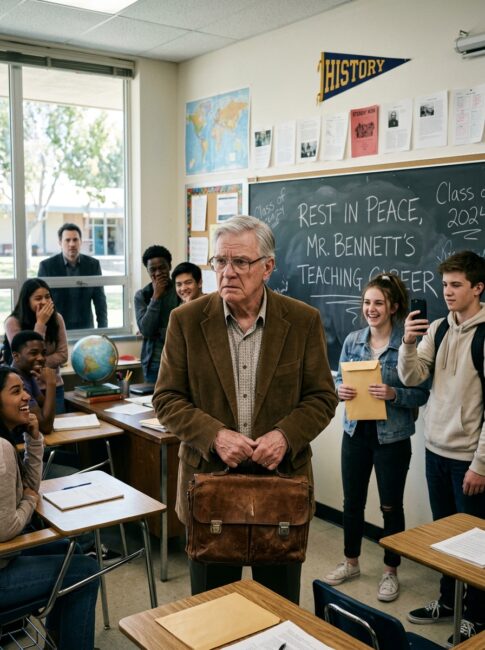
Mr. Bennett folded the paper once and placed it on his desk. Then he turned to the blackboard.
For the first time, everyone expected him to erase the joke.
Instead, he picked up a piece of chalk and wrote beneath the fake obituary:
Page 312. “The Road Not Taken.” Final discussion.
Groans rolled through the room.
“Seriously?” Caleb said. “It’s your last day.”
Mr. Bennett opened the poetry book with slow, practiced hands.
“That is why,” he said.
His voice was low, but it reached every corner.
He began reading. Not dramatically. Not like a performer. He read like someone placing an old photograph on a table and asking others to look closely.
Halfway through the poem, Brianna removed one earbud.
Ethan stopped sketching.
Jamal leaned back, arms crossed, but his eyes stayed on the page.
Mr. Bennett asked, “What does the speaker regret?”
Nobody answered.
He waited.
Teachers who fear silence usually fill it. Mr. Bennett never did. He let silence become uncomfortable enough to tell the truth.
Finally, Maddie said, “Maybe he regrets not knowing what the other life would’ve been.”
Mr. Bennett nodded. “Perhaps.”
Caleb muttered, “Or maybe he just picked a road and made a big deal about it later.”
A few students snickered.
Mr. Bennett looked at him.
“That is also possible.”
Caleb seemed surprised.
Most teachers corrected him before he finished.
Mr. Bennett turned back to the class. “Sometimes people call a choice brave because they cannot admit it was lonely.”
That sentence landed differently.
Mrs. Caldwell, still outside the door, looked down at her clipboard.
At the back of the room, Jamal shifted in his seat.
There was an old rumor about Mr. Bennett, one students repeated whenever they wanted to make him seem ridiculous. They said he had no family because he loved grammar more than people. They said his wife left him because he corrected her birthday cards. They said he kept teaching because he had nowhere else to go.
He never denied any of it.
And somehow that made the rumor feel true.
A knock came at the door.
A freshman office aide stepped in with a small cardboard box.
“For Mr. Bennett,” she said.
The class went quiet again.
Mr. Bennett’s face changed at the sight of the box. Not much, just a tightening around his mouth.
Mrs. Caldwell took one step into the room. “Harold, I can hold that until later.”
“No,” he said gently. “Thank you.”
The aide placed it on his desk.
The return label had been peeled off. Only one word remained, written in black marker.
BENNETT.
Caleb whispered, “Mystery box.”
Mr. Bennett did not open it.
He slid it into the lower drawer of his desk and continued teaching as if nothing had happened.
But Maddie had seen his hand shake.
Not the ordinary tremor.
This was different.
Fear.
At 8:34, the class phone on the wall rang.
Mr. Bennett answered it, listened for three seconds, and said, “No, please tell him not to come up.”
His voice was calm.
Too calm.
He hung up.
“Who was it?” Brianna asked before she could stop herself.
Mr. Bennett looked at the chalkboard.
“No one who belongs in this lesson.”
That answer should have ended things.
Instead, it made the room feel smaller.
Ten minutes later, a man appeared outside the classroom window.
He was in his early forties, broad-shouldered, wearing a black suit that did not fit quite right. His hair was dark, his eyes restless. He stared through the glass at Mr. Bennett with an expression no student could read.
Mr. Bennett did not turn around.
But he knew the man was there.
Every student watched him pretend not to.
Mrs. Caldwell guided the man away.
Maddie’s face had gone pale.
She looked down at the fake report card she had written, and for the first time that morning, the joke felt like something she had thrown before knowing where it would land.
Then Mr. Bennett reached into his satchel and pulled out twenty-six envelopes.
Each one had a student’s name handwritten across the front.
The laughter disappeared.
He placed them in a neat stack beside the chalk.
“Before the assembly,” he said, “I have one last assignment.”
Caleb raised an eyebrow. “Homework on your retirement day?”
Mr. Bennett smiled faintly.
“No. Something I owed you.”
He began with Brianna.
She took her envelope like it might explode.
“Do we open these now?” she asked.
“If you choose,” Mr. Bennett said.
That was always how he phrased things. Not orders. Choices. The kind that made teenagers roll their eyes because choices came with responsibility.
Brianna opened hers first.
The paper inside was covered in Mr. Bennett’s small, careful handwriting.
She read the first line and stopped breathing normally.
Brianna, you pretend music is a wall, but I have watched it become your doorway.
Her eyes moved faster.
He had written about the day she stayed after class to finish an essay because her mother’s hospital shift had run late and home was too loud. He had mentioned the poem she never turned in, the one she crumpled and left near the trash can.
He had uncrumpled it.
He had read it.
He remembered a line from it.
Brianna folded the letter quickly and looked out the window.
“Whatever,” she whispered.
But she did not put the earbud back in.
Ethan opened his next.
His letter included a sketch Mr. Bennett had saved from the margin of an old quiz. A car with wings, impossible and beautiful.
You draw machines like they are trying to escape gravity. That is not laziness, Ethan. That is a mind looking for a workshop.
Ethan rubbed his thumb over the paper.
“My dad says drawing cars is stupid,” he muttered.
Mr. Bennett adjusted his glasses. “Your father has not seen that one.”
Ethan looked up sharply.
For once, he had no joke ready.
Jamal refused to open his at first.
He leaned back and said, “I’m good.”
Mr. Bennett did not force him.
He simply placed the envelope on Jamal’s desk and moved on.
That made Jamal angrier than pressure would have. He stared at the envelope for nearly a minute, then tore it open with a rough sound.
Inside was not just a letter.
It was a library card.
Jamal frowned.
The card had been renewed and paid through the end of the year.
There was also a note.
You returned every book late because you were reading them twice. The world will forgive late fees more easily than it forgives a boy who stops reading. I took care of the first problem. Please do not create the second.
Jamal stared at the card.
He looked toward the window so nobody could see his face.
Caleb opened his last, perhaps because he feared it most.
His hands were steady at first.
Then they weren’t.
Caleb, the first joke always arrives before the first honest sentence. I have never mistaken one for the other.
The letter mentioned Caleb’s brother, who had died two years earlier in a car accident. Most students knew only fragments. Caleb had returned to school louder, meaner, brighter in a way that burned everything nearby.
Mr. Bennett had never called him disruptive in front of the class.
He had never sent him to the office.
He had simply kept a chair open after school every Tuesday, with a copy of whatever book they were reading and a second pencil sharpened beside it.
Caleb had never sat in that chair.
Not once.
The letter ended with:
The chair will remain open until 3:30 today. After that, you may need to find a new room, but never believe you need to grieve alone.
Caleb crushed the paper in his fist.
“Why are you doing this?” he asked.
His voice cracked on the last word.
Mr. Bennett stood at the front of the room, looking suddenly smaller than he had under the cruel chalk drawing.
“Because I am leaving,” he said, “and I dislike unfinished attendance.”
Nobody understood at first.
Then Maddie opened her envelope.
Her letter was longer.
Maddie had spent the year performing confidence like armor. She corrected other students, mocked wrong answers, and treated kindness as something that might lower her grade. Mr. Bennett’s letter did not praise her trophies.
It mentioned the day she gave her lunch to a sophomore crying in the bathroom.
It mentioned the scholarship application she had hidden under her notebook.
It mentioned her fear of becoming like her mother, who had left town when Maddie was eleven and still mailed birthday cards with no return address.
Maddie read to the last line and pressed her lips together.
You are not hard because you are cruel. You are hard because soft things were taken from you too early. Do not let that become your whole story.
The room blurred around her.
She looked toward the blackboard, where the obituary joke still sat above the poem.
It seemed monstrous now.
Not because Mr. Bennett had become fragile, but because he had never treated their sharp edges as proof they were worthless.
The classroom door opened again.
Mrs. Caldwell stepped in, followed by the man in the black suit.
Mr. Bennett’s shoulders stiffened.
“I’m sorry,” she said quietly. “He insisted.”
The man looked around the room, embarrassed by the audience.
“Harold,” he said.
Mr. Bennett did not answer.
The students looked between them.
The man swallowed. “It’s time.”
Maddie’s eyes narrowed. “Time for what?”
Mrs. Caldwell said, “Class, this is Dr. Aaron Bennett.”
The name moved through the room like a match struck in darkness.
Bennett.
Caleb sat forward.
“You have a son?”
Mr. Bennett’s face tightened, and for once his careful teacher mask slipped.
Dr. Bennett looked at the floor. “He does.”
The rumor shattered without sound.
No family. No one waiting. No one who loved him.
All year, the students had made jokes about an empty life while a son stood outside the door and called him Harold instead of Dad.
Dr. Bennett took another step.
“The car is waiting,” he said. “We have to make the appointment.”
Mr. Bennett glanced at the class.
Mrs. Caldwell’s eyes filled with helplessness.
Maddie whispered, “What appointment?”
Mr. Bennett picked up his chalk and turned toward the board.
For a strange second, it seemed like he might keep teaching.
Then his hand failed him.
The chalk slipped from his fingers and snapped on the floor.
The sound was tiny.
Everyone heard it.
Dr. Bennett moved quickly, but Mr. Bennett held up one hand.
“No.”
His voice was firm enough to stop a doctor and a son.
He bent slowly, picked up one half of the chalk, and wrote beneath the poem assignment:
Forgive the handwriting. It has been getting worse.
No one laughed.
Mrs. Caldwell finally spoke.
“Mr. Bennett was diagnosed with Parkinson’s last year,” she said softly. “He asked us not to tell the students.”
The word settled over the desks.
Parkinson’s.
The shaking hands.
The dropped chalk.
The way he held papers with both palms.
The way he never used the projector anymore because he could not press the buttons reliably.
Caleb’s face changed as if someone had opened a door inside him and let all the cold air in.
“You let us make fun of your hands?”
Mr. Bennett looked at him.
“I let you be fifteen,” he said.
“You’re retiring because you’re sick?” Brianna asked.
“I am retiring,” he said, “because the bell rings for everyone eventually.”
Dr. Bennett looked away.
There was more.
Maddie felt it before anyone said it.
The cardboard box in the drawer. The man outside. The way Mrs. Caldwell had warned him not to come.
She stood slowly.
“What’s in the box?”
Mr. Bennett’s eyes closed.
Mrs. Caldwell whispered, “Maddie.”
But it was too late.
Caleb crossed to the desk, then stopped. For all his noise, he would not violate the old man’s drawer.
Mr. Bennett opened it himself.
He lifted the cardboard box and placed it on the desk.
Inside was a pair of polished dress shoes, dark brown, almost new, wrapped in tissue paper.
The class stared.
Dr. Bennett’s voice softened. “They were my mother’s gift to him. Before she passed.”
Mr. Bennett touched the tissue paper.
“She bought them for my retirement dinner,” he said. “She said I had spent thirty-eight years wearing shoes that looked apologetic.”
A few students smiled through tears.
“She died in February,” he added.
That was the final piece.
All year, he had taught poems about loss while carrying fresh grief.
All year, he had listened to students complain that he was boring, old, slow, and out of touch, while he folded letters to each of them at night with hands that no longer obeyed.
Maddie covered her mouth.
Her fake report card trembled in her other hand.
“We didn’t know,” she said.
Mr. Bennett looked at the chalkboard again.
“No,” he said gently. “You did not.”
That simple answer hurt more than anger would have.
Because he was not accusing them.
He was letting the truth stand alone.
The bell rang.
No one moved.
The retirement assembly would begin in less than three hours. The whole school expected a polite goodbye, a plaque, a speech from the superintendent, maybe some applause from students who barely knew what they were clapping for.
But Room 214 had gone completely still.
Then Maddie turned to the class.
Her voice shook, but her eyes were clear.
“We have to fix this.”
Mr. Bennett heard her.
He smiled faintly, as if she had finally understood a lesson he had not written on the board.
“You cannot fix a morning,” he said.
Maddie looked at the obituary chalked behind him.
“No,” she said. “But we can decide what it becomes.”
At noon, the auditorium filled with students, teachers, and parents who had come mostly because attendance was required.
Mr. Bennett sat in the front row beside Mrs. Caldwell, wearing his old brown jacket and the polished shoes his late wife had bought him. He kept his hands folded on his lap, though they still trembled.
The superintendent gave a speech full of numbers.
Thirty-eight years.
Nearly six thousand students.
Department chair.
Teacher of the Year in 1999.
Mr. Bennett listened politely.
Numbers were clean. Numbers did not remember the names of children who fell asleep because home was unsafe, or the ones who acted cruel because grief had nowhere else to go.
Then the superintendent lifted a glass plaque.
“Mr. Bennett, would you please join us onstage?”
He rose carefully.
The applause was modest at first, the kind people give when they are being respectful.
Then Room 214 stood.
All twenty-six students.
One by one.
Maddie first.
Caleb next.
Brianna, Ethan, Jamal, and every student who had laughed that morning.
The rest of the auditorium turned to look.
Maddie walked onto the stage without permission, holding a folded sheet of paper. Mr. Bennett looked alarmed, but Mrs. Caldwell did not stop her.
Maddie reached the microphone.
“This morning,” she said, “we gave Mr. Bennett a final report card.”
A few students in the auditorium chuckled.
Maddie looked at them until the sound died.
“It was supposed to be funny,” she said. “It wasn’t.”
Mr. Bennett lowered his eyes.
Caleb came up beside her. He held the paper Mr. Bennett had given him, still wrinkled from his fist.
“We thought he didn’t notice us,” Caleb said. “Turns out he was the only one who noticed everything.”
Then Brianna stepped forward and read one line from her letter.
Ethan read one.
Jamal did not read his, but he held up the library card.
That was enough.
More students came forward with their envelopes. Some read. Some could not. Some simply stood behind the old teacher like a wall built too late but built anyway.
Then Maddie unfolded the fake report card.
Mr. Bennett’s shoulders tensed.
She looked at him.
“May I?”
He gave the smallest nod.
Maddie read the original lines first.
The jokes.
The boring voice.
The old jacket.
The same cruel little arrows they had thrown so easily.
Then she turned the page over.
On the back, in twenty-six different handwritings, the class had written a new report.
Patience: A+.
Mercy: A+.
Seeing students no one else saw: A+.
Remembering names after everyone else forgot: A+.
Teaching even when his hands hurt: A+.
Letting us grow without making us ashamed of where we started: A+.
Maddie stopped before the last line.
Her voice thinned.
Mr. Bennett looked at her over his glasses, the way he had all year when waiting for a student to find the courage to finish.
She took a breath.
Final grade: The kind of teacher we will spend the rest of our lives understanding.
The auditorium did not explode with applause.
It rose slowly.
Like a tide.
Mr. Bennett stood in the center of the stage, one hand resting on the podium, the other pressed over his mouth. He tried to speak, but no words came.
For once, silence was his answer.
And every student in Room 214 understood it.
After the assembly, while people crowded around with hugs and photographs, Mr. Bennett slipped back to his classroom alone.
The blackboard still held the morning’s cruel obituary.
But beneath it, Maddie had added one more sentence in careful chalk:
He was not leaving because he had nothing left to teach. We were only just learning how to listen.
Mr. Bennett stood there for a long time.
Then he reached for the eraser.
His hand shook too badly to hold it steady.
Caleb appeared in the doorway.
He did not make a joke.
He walked to the board, took the eraser gently, and looked at his teacher.
“Want me to help?”
Mr. Bennett nodded.
Together, they erased the obituary.
They left the sentence at the bottom.
Years later, former students would remember different things about Harold Bennett. Some remembered his poems. Some remembered his letters. Some remembered the day they learned a quiet man had carried more pain than he ever handed back.
Caleb remembered the chair.
He returned after school that final day and sat in it until 3:30.
Neither of them said much.
They did not need to.
On Mr. Bennett’s last walk out of Westbridge High, he carried no plaque in his hands. Dr. Bennett carried the box with the shoes. Mrs. Caldwell carried the satchel because he finally let someone help.
But in his jacket pocket, folded carefully, was the new report card.
At the parking lot, Maddie called after him.
“Mr. Bennett?”
He turned.
She looked smaller than she had that morning.
“Did we pass?”
The old teacher smiled, tired and bright.
“Not yet,” he said. “But you started.”
Then he climbed into the car, resting one trembling hand against the window as the students stood along the sidewalk, waving until the car turned past the football field and disappeared into the afternoon light.
Follow this page for more heartfelt stories about the quiet people we almost misunderstand.