Part 2: They Accused an Old Man of Stealing — Then a Biker Demanded the Camera Footage
The biker’s name was Clay Mercer, though the men in his club called him Preacher, which was funny because he looked like the last man on earth who belonged near a church.
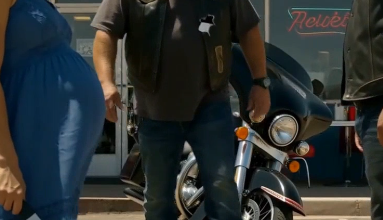
He rode a black Harley-Davidson Road King with dust on the saddlebags and a cracked leather Bible strapped under the rear bungee cord. Not because he preached, he told me later. Because it had belonged to a man who never gave up on him.
Clay did not explain that in the store. Bikers don’t hand you their heart just because you ask nicely. They make you earn the soft parts.
At first, all I saw was what everyone saw.
His arms were covered in old ink. One tattoo was a snake wrapped around a chain. Another was a date nobody asked about. His knuckles had small blue letters, worn with age, spelling HOLD FAST. His beard was thick and wild, the kind that made mothers pull their kids closer in parking lots. His cut had road grime in the seams. The smell of gasoline, leather, engine heat, and black coffee followed him like weather.
But there were things that didn’t fit.
His fingernails were clean.
His boots were rough, but polished at the toes.
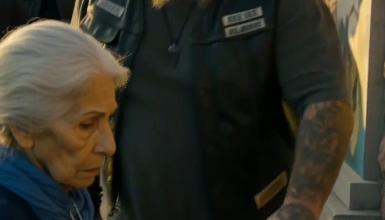
When Mr. Pike’s coat hung open, Clay didn’t grab him, didn’t accuse him, didn’t puff up like men do when they want to be seen. He bent down slowly, picked up the old man’s cane, and set it upright against the cart.
Then he buttoned Mr. Pike’s coat with hands big enough to bend pipe.
“Cold in here,” Clay said.
Mr. Pike blinked at him.
Clay did not smile, but something passed between them. Not recognition exactly. More like an old song heard through a wall.
Our shift manager, Daryl, was twenty-six, red-faced, and too proud of the little black radio clipped to his belt. He told Clay this was store business. Clay looked at him once. Daryl stepped back like the floor had moved.
“Then handle it right,” Clay said.
Behind him, three more bikers had come in from the parking lot. One was Black, mid-fifties, lean, with a gray mustache and a denim vest under his leather. They called him Saint. Another was a white man with a shaved head and a limp named Boone. The third was a younger Latino prospect named Mateo, probably twenty-three, still trying to look harder than his eyes allowed.
They didn’t surround anyone. They just stood near the door. Quiet. Heavy. Present.
That was worse than shouting.
I had seen biker groups roll through before, mostly on charity rides or veterans’ runs. They bought coffee, used the restroom, left cash tips in the donation jar, and disappeared back onto the highway. But this felt different. Clay wasn’t passing through. He had come into that store like the building owed him a debt.
Daryl picked up the steaks with two fingers.
“Sir, we found merchandise in your coat,” he said to Mr. Pike. “You didn’t pay.”
Mr. Pike’s mouth trembled. “I didn’t put—”
“You expect us to believe that?”
Clay’s jaw tightened.
The leather on his vest creaked as his shoulders shifted.
“Camera,” he said again.
Daryl laughed once. Not because it was funny. Because he was scared and hated being scared.
“We don’t show security footage to customers.”
Clay looked at the ceiling camera. Then at me.
“You the cashier?”
I nodded.
“You ring him up?”
I swallowed. “No. He hadn’t checked out yet.”
That mattered.
Clay turned back to Daryl. “Then he ain’t stolen anything yet.”
The whole front end went quiet.
Daryl’s face changed. He hated that Clay was right. He hated that the old man was watching. He hated that a biker had just used common sense better than his rulebook.
That was the first time I noticed Mr. Pike’s cane.
Black tape around the handle. Under the tape, a little strip of blue cloth had been wrapped tight, faded nearly gray. The same blue as the patch inside Clay’s vest, though I didn’t know that yet.
The old man kept touching it with his thumb.
Like it was a rosary.
Like it was all he had left.
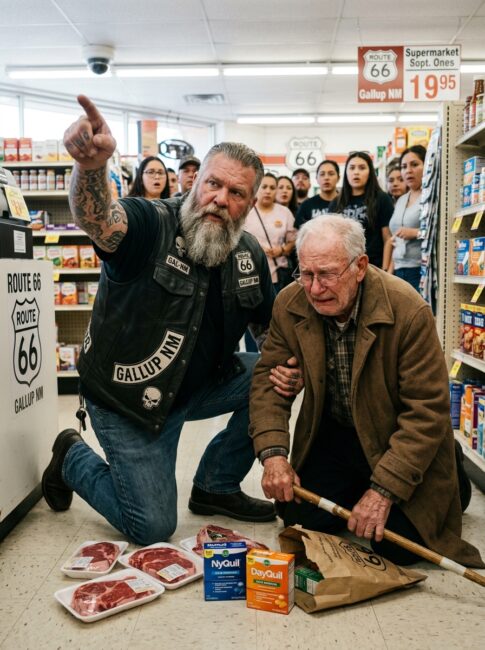
Daryl called the police anyway.
That was when the store split into two kinds of people. The kind who watched because they wanted justice, and the kind who watched because they wanted a show.
A little crowd formed near the self-checkout. Cart wheels squeaked. A freezer hummed. Somewhere in aisle four, a child asked too loudly if the old man was going to jail.
Mr. Pike heard it.
His shoulders folded inward.
That did something to Clay.
Not a big thing. He didn’t explode. He didn’t threaten anyone. He just reached into his pocket, pulled out a folded red bandanna, and handed it to the old man.
“For your hands,” he said.
Mr. Pike looked down and realized his fingers were shaking.
He took it.
Daryl whispered into the store phone, then came back with that stiff walk men use when they think authority is the same as courage.
“The deputy is on the way,” he said.
Clay nodded toward the office door. “Footage first.”
“No.”
“Why?”
“Because I said so.”
Saint made a soft sound behind Clay. Not a laugh. More like air leaving a tire.
Clay turned slightly. “Easy.”
One word.
The bikers stayed still.
That one word told me more about brotherhood than any speech could have. Those men would have moved if he asked. I believe that. But he didn’t ask. He held them back because the old man didn’t need a fight. He needed the truth.
That was harder.
Daryl pointed at Clay. “You people don’t get to come in here and intimidate my staff.”
“You people?” Boone said.
Clay lifted one hand.
Boone stopped.
The automatic doors opened again, and Deputy Elaine Porter walked in. She was a white woman in her early forties, square-jawed, tired-eyed, with sunglasses pushed up on her head. She had the look of somebody who had been called to too many small-town scenes that were never as simple as the caller claimed.
“What happened?” she asked.
Daryl gave her the neat version. Elderly male. Concealed merchandise. Attempted theft. Witnesses.
Clay gave her the short version.
“He didn’t leave the store.”
Deputy Porter looked at Mr. Pike. Then at the steaks. Then at the cold medicine.
“Sir,” she said gently, “did you put those in your coat?”
Mr. Pike tried to speak. His jaw worked. No words came.
That made him look guilty.
People love a simple story. Old man steals. Manager catches him. Police fix it. Everyone gets to go home feeling the world still makes sense.
Deputy Porter asked if the store had cameras.
Daryl hesitated.
Clay saw it.
So did I.
That pause was small, but it had weight.
Daryl said, “Yes.”
“Then pull it up,” Porter said.
The office was too small for all of us, but somehow we squeezed in. Daryl, Deputy Porter, me, Clay, and Mr. Pike sitting in the chair beside the desk like a child outside a principal’s office. Saint waited in the hall, one boot holding the door open.
The monitor flickered.
Grainy black-and-white footage appeared.
There was Mr. Pike entering the store at 2:17 p.m. Cane in one hand. Cart in the other. He moved slow. Painfully slow. He went to aisle seven, cold medicine. He took one box, looked at the price, put it back. Took another. Put it in the cart.
Then the meat section.
Two steaks.
Into the cart.
No problem.
Then aisle three.
A young white woman in a green hoodie came around the corner pushing a cart with a toddler in the child seat. She moved close to Mr. Pike. Too close. The camera angle was bad. Her body blocked the view for three seconds.
When she moved away, Mr. Pike’s coat bulged.
Daryl slapped the desk. “There. See?”
The deputy leaned in.
Clay didn’t move.
On screen, Mr. Pike looked confused. He touched his coat, then kept walking.
Daryl crossed his arms. “That’s enough.”
For one sick second, I thought it was over.
The old man closed his eyes.
The biker stared at the screen with a face carved out of old road and harder memories.
Then Clay said, “Rewind.”
Daryl didn’t want to rewind.
That made Deputy Porter want to.
She tapped the desk. “Back it up.”
Daryl dragged the footage back with the mouse, irritated, sweaty now. Clay leaned closer to the screen, and I noticed something strange. His hand, the one with HOLD FAST across the knuckles, had started to tremble.
Not from anger.
From recognition.
“Stop,” he said.
The frame froze with the woman in the green hoodie standing beside Mr. Pike. Her toddler was looking at a bag of chips. Mr. Pike had turned his head toward a sale sign.
“Zoom her hand,” Clay said.
Daryl scoffed. “This isn’t a movie.”
Deputy Porter leaned in. “Do it anyway.”
The image blurred, then sharpened just enough.
The woman’s left hand was not on her cart.
It was inside Mr. Pike’s coat pocket.
My stomach dropped.
Daryl said nothing.
Clay’s voice went rough. “Play.”
The footage moved.
The woman slid the cold medicine into Mr. Pike’s coat. Then the steaks. Quick. Practiced. While pretending to adjust her child’s shoe.
Mr. Pike never saw it.
He never touched the items.
He just stood there, old and slow and trusting the world not to use his weakness against him.
Deputy Porter straightened. “Find that woman.”
Daryl went pale.
I thought that was the twist.
It wasn’t.
Clay pointed to the lower corner of the screen. “Back up again. To when she entered.”
Daryl’s hand shook on the mouse now.
The woman in the green hoodie had come in at 2:08 p.m. She wasn’t alone. A man entered ten seconds before her. Young white man, ball cap, store vest, no name tag.
Daryl’s face changed.
I knew that man. His name was Travis. Daryl’s cousin. He worked stockroom some weekends, mostly when he needed cash.
On the footage, Travis handed the woman something near the newspaper rack.
A receipt.
Then he walked behind the customer service counter and never looked at her again.
Deputy Porter turned slowly toward Daryl.
“What is that?”
Daryl opened his mouth. Closed it.
Clay looked at him with no expression at all.
Now the whole thing made sense in a way that made me feel dirty. The planted items. The old man chosen because he looked too weak to argue. The call to police before anyone checked the camera. The receipt that would make the woman look like she had paid if she got stopped.
Except she hadn’t expected the old man to freeze at the alarm.
She hadn’t expected the stolen items to fall.
And nobody had expected Clay Mercer to walk through the door.
Deputy Porter stepped into the hallway and spoke into her radio. Her voice was calm, but her eyes were hard.
Daryl whispered, “I didn’t know.”
Clay turned his head.
That was all.
Daryl started crying.
Not loud. Not dramatic. Just a small, ugly sound from a man realizing the room had measured him and found him cheap.
Mr. Pike still hadn’t moved.
He stared at the frozen screen.
Then he looked at Clay and whispered, “How did you know?”
Clay reached inside his vest.
He pulled out a little blue cloth patch.
Faded. Hand-stitched. One word.
PIKE.
The office got so quiet I could hear the ice machine kicking on near the soda fountain.
Clay held the patch like it weighed more than his motorcycle.
Mr. Pike’s face went empty first. Then confused. Then afraid to hope.
Clay said, “You gave me this.”
Mr. Pike shook his head slightly. “I don’t…”
“1989,” Clay said. “Outside Grants. Rainstorm. Rollover on old Route 66.”
Mr. Pike’s fingers tightened around the red bandanna.
Clay swallowed once.
He was not a man built for long speeches, so the words came out rough, like they had to be dragged over gravel.
“I was nine. My mother was gone. My old man was drunk. Truck went off the shoulder. I was pinned under the dash.”
Mr. Pike’s eyes widened.
The blue cloth on his cane suddenly made sense to me.
Clay kept going.
“Volunteer fire crew got there before the county boys. One man crawled in through the windshield. Cut his arm open on the glass. Kept telling me to hold fast.”
He lifted his tattooed hand.
HOLD FAST.
Mr. Pike’s lips parted.
Clay tapped the patch.
“Your jacket tore. This came off in my hand. You told me if I could hold it, I could hold on.”
Mr. Pike started breathing through his mouth, like the memory had come back too fast.
Clay’s voice dropped.
“You stayed until they pulled me out. My father ran before the ambulance came. You stayed.”
Nobody spoke.
Not Daryl. Not me. Not even Deputy Porter, who had come back into the office doorway and stopped there.
Clay tucked the patch back into his vest.
“After that, I got bad,” he said. “Real bad. Fights. Cages. County time. Hurt people who didn’t deserve it. Took years before I figured out surviving ain’t the same as living.”
He looked at Mr. Pike.
“But I kept that patch.”
Mr. Pike covered his face with one shaking hand.
The red bandanna was still in it.
Now I understood the clean fingernails. The polished boots. The cracked Bible. The way Clay had buttoned the old man’s coat before defending him.
He wasn’t being gentle because he was naturally soft.
He was being gentle because somebody had once crawled through broken glass for him.
The seeds were all there from the beginning.
The blue cloth around the cane. The faded PIKE patch. The words on Clay’s knuckles. Even the way he had looked at the camera before he looked at the stolen items. He had seen too many men get blamed for what other people put on them.
Daryl was escorted to the break room while Deputy Porter waited for another unit. Travis was found hiding behind the loading dock. The woman in the green hoodie had already left, but the cameras caught her license plate. The toddler was safe with a grandmother by evening, which was one small mercy in a day full of ugly ones.
Mr. Pike kept apologizing.
That hurt most.
He apologized to the deputy. To me. To the customers who had stared. To Clay.
“I made trouble,” he whispered.
Clay shook his head.
“No,” he said. “Trouble found you.”
Then he did something I will never forget.
He picked up the steaks and the cold medicine from the evidence bag after Deputy Porter photographed them. He paid for them himself. Then he added soup, bread, bananas, coffee, oatmeal, and a small cherry pie from the bakery case.
Mr. Pike tried to stop him.
Clay didn’t argue.
He just put the bags in the cart and said, “Let an old debt ride.”
Outside, the other bikers stood beside their Harleys under the hard New Mexico sun. Their engines were off. No thunder. No show. Just men waiting.
Saint opened Mr. Pike’s car door. Boone loaded the groceries. Mateo, the young prospect, wiped the dust off the old man’s windshield with his sleeve.
Mr. Pike looked overwhelmed.
Clay helped him into the driver’s seat, then crouched beside the open door.
The scary man with the skull patch lowered his voice so only a few of us heard.
“You still got family?”
Mr. Pike looked at the steering wheel.
“Had a wife,” he said. “Had a son.”
Clay nodded like he understood the difference between “had” and “have.”
Then Mr. Pike said something that made Clay go still.
“My boy would’ve been about your age.”
The highway made a long rushing sound behind the store.
Clay looked down at his boots.
For a moment, I thought he might tell Mr. Pike everything else. About the foster homes. About the jail time. About the men in the club who had become brothers because blood had failed first. About how many nights he probably opened that vest and looked at a patch from a man who had forgotten him.
But bikers don’t always say the thing.
Sometimes they just stand there and let the silence carry it.
Clay shut the old man’s door gently.
Then he tapped the roof twice.
“Hold fast, Mr. Pike.”
The old man’s eyes filled again.
This time, he remembered.
After that day, things changed at the store.
Not in some movie way. The building didn’t become kinder overnight. People still complained about coupons. Kids still spilled blue slushies near the freezer. Truckers still cursed at the coffee machine when it ran empty.
But every Thursday at 2 p.m., a black Harley-Davidson Road King parked beside the handicapped spaces.
Clay never came in loud.
He cut the engine before the doors. Let the rumble die. Sat for a second with both hands on the bars, like he was leaving something out there in the heat before walking inside.
Mr. Pike still bought soup and bread.
Only now, he bought two coffees.
They sat on the bench near the Route 66 postcard rack. The old man with his taped cane. The biker with his skull patch and scarred hands. Sometimes they said almost nothing. Sometimes Mr. Pike told stories from his volunteer fire days, back when radios crackled and men went into wrecks with tools that looked too small for the job. Sometimes Clay listened with his elbows on his knees, turning that red bandanna between his fingers.
The club came through once a month after that.
They called it a grocery run, but everybody knew what it was. Saint would check the oil in Mr. Pike’s old Buick. Boone fixed the porch rail at his trailer. Mateo brought dog food after learning Mr. Pike had been feeding a stray with more loyalty than sense.
Nobody posted photos.
Nobody made speeches.
The only ritual was the patch.
Every time Clay left, he touched the inside of his vest. Two fingers against the faded blue cloth. Then he touched his knuckles to Mr. Pike’s cane, right where the matching strip of blue cloth was wrapped under the tape.
Once, I asked Clay why he still carried the patch after all these years.
He looked at the highway.
“Somebody ought to remember who pulled them out,” he said.
Then he put on his helmet, and the Road King started with a low iron growl that made the windows tremble.
Not loud enough to scare.
Just loud enough to say he was still there.
Three months later, the supermarket got a new manager.
We got new cameras too. Better angles. Clearer footage. The kind that doesn’t let cowards hide in blurry corners.
Mr. Pike kept coming every Thursday.
Clay kept meeting him.
And every time someone new saw that huge tattooed biker sitting beside that fragile old man, they stared the same way we all had stared at first. Like the world had put two wrong pieces in the same picture.
They didn’t know the story.
They didn’t know about the crash in 1989. The broken windshield. The boy under the dash. The old volunteer firefighter bleeding through his sleeve and telling a terrified child to hold fast.
They didn’t know a man could carry one torn patch for thirty-seven years and still feel the hand that gave it to him.
One afternoon, I watched them leave together.
Mr. Pike drove slow in his old Buick. Clay followed behind on the Harley, not too close, not too far, guarding him through traffic until they reached Route 66.
The sun was low.
The taillights turned red.
The engine faded toward the highway.
Two men. One debt. No words.
Just the road carrying them home.
Follow the page for more true-feeling biker stories that show the heart behind the leather.