They Said the Mother Didn’t Qualify for Food — Then a Biker Left Something at Her Door
“Don’t open that door until I’m gone,” the biker said, dropping a heavy grocery bag on the apartment stoop as if he knew exactly how suspicious he looked.
It was just after 5:40 p.m. on a gray Tuesday in November, the kind of wet Kentucky cold that crept into hallways, under sleeves, and straight through cheap apartment windows. The Maple Crest Apartments on the west side of Louisville looked tired even in daylight—brick stained dark from old rain, railings chipped down to rust, a laundry room that never stayed locked, and narrow balconies where plastic chairs leaned sideways through every season like nobody had the strength to fix them.
By that hour, most people in Building C were either back from work or standing outside pretending they needed air while really keeping track of everybody else’s trouble.
That was why so many of them saw him.
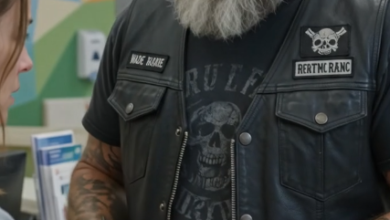
The motorcycle came in first, loud enough to turn heads before it even killed the engine. Black bike. Hard chrome. Rain-specked tank. The rider took off his gloves slowly, like a man in no hurry to explain himself to anyone. He was broad through the shoulders, heavy in the chest, beard rough with gray, tattooed forearms dark under the sleeves of a worn black thermal shirt, sleeveless leather vest hanging open over it. He looked like the kind of man people described in lowered voices after the fact.
Not because he had done anything yet.
Because he looked like he might.
He didn’t go to the office. Didn’t check the mailboxes. Didn’t glance around like someone looking for the right unit. He walked straight across the wet concrete courtyard carrying two grocery bags in one hand and a cardboard flat of canned goods tucked under the other arm, then stopped outside Apartment C-17.
That apartment belonged to Lena Hart and her daughter, Ivy.
And everybody in that building knew Lena Hart had just gotten denied food assistance that morning.
Nobody knew all the details. They never did. But by noon, the outline had already traveled from the caseworker’s front desk to the church thrift room to the apartment complex like bad weather: a paperwork problem, a missed verification, a letter she didn’t understand in time, some correction they said she should have made online, some number that changed the calculation just enough to make her ineligible when she needed help most.
By three o’clock, people had turned it into a story about irresponsibility.
By five-thirty, a biker was at her door with groceries.
That was enough to make the whole place hold its breath.
Mrs. Pauline Keeter from C-12 had been shaking out a towel over the railing when she saw him climb the stairs. She was seventy-three, white-haired, narrow as a coat hook, and blessed—or cursed—with the kind of eyesight that got sharper whenever drama wandered into range.
She leaned over the balcony and called down, “You lost, sir?”
The biker didn’t answer.
He set one grocery bag down, then the other, then knocked once.
Not hard. Not soft either.
Inside the apartment, something small scraped across linoleum. A chair leg maybe. Or a child moving too fast because children always ran toward doors before adults could stop them.
“Mommy?” a little girl’s voice called from inside.
That voice changed everything.
Now every pair of eyes in the courtyard sharpened.
From the first-floor walkway, Hector Ruiz, who worked maintenance when the landlord remembered to pay him on time, stepped out with a wrench still tucked in his back pocket. Across the courtyard, two teenage boys paused halfway through carrying laundry baskets. On the sidewalk near the dumpsters, a veteran named Curtis Bell—everyone called him Mr. Bell even though most of them knew almost nothing about him except that he walked with a stiff left leg and fed the stray cats—turned to look up at the landing.
Inside C-17, the chain stayed on.
Lena opened the door only three inches.
That was enough for everyone to see part of her face. Pale. Tense. Thirty-two maybe, but with the drawn, careful look of someone who had spent several years learning how to stretch every dollar, every ounce of patience, and every explanation she gave other people.
Her hair was still tied back from work. She had on a grocery store sweatshirt under a faded coat, and her eyes went immediately from the bags on the ground to the man standing over them.
She stiffened.
Because no woman in a building like that saw a stranger with that face, that body, that silence, on her doorstep at dusk—and assumed kindness first.
“What do you want?” she asked.
The biker glanced once toward the partly open door, maybe hearing the child behind it, then back at Lena.
“Take the bags inside,” he said.
No greeting. No name. No explanation.
From the balcony, Mrs. Keeter gasped loud enough to be heard across the courtyard.
Lena’s grip tightened on the door. “I don’t know you.”
“I know.”
“Then why are you here?”
He didn’t answer that.
Instead, he crouched and adjusted one of the bags, as if making sure the milk stayed upright. That small, practical movement only made him seem stranger. More wrong. More deliberate.
The courtyard had gone almost silent by then except for the ticking of rain from a broken gutter and the thin buzz of a hallway light starting up overhead.
Then the biker said, “Don’t open that door until I’m gone.”
Lena’s face changed instantly.
Not softer. Harder.
Her daughter appeared beside her then, a little girl maybe six years old, light-brown curls escaping a red knit hat that was too warm for indoors. Ivy tried to peek through the gap in the door, and Lena immediately pulled her back with one arm.
That was when the shouting started.
“What the hell is that supposed to mean?” Hector yelled from below.
The biker straightened slowly.
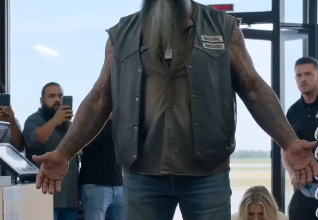
He looked down over the railing at the growing audience in the courtyard, and in the harsh yellow hall light he looked exactly like what people feared he was: too calm, too large, too unreadable.
Mrs. Keeter clutched the railing and said, “Lena, don’t you touch those bags.”
Lena didn’t.
Neither did he.
He just stood there in the damp cold, grocery bags at his boots, staring at a frightened mother through a door cracked only a few inches wide, while a little girl hid behind her legs and half the building decided this was about to become something terrible.
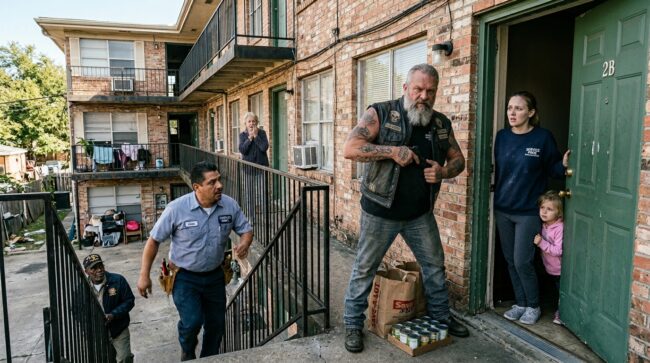
Within a minute, it stopped being a private moment and became neighborhood theater.
That was the problem with poverty in places like Maple Crest. Nobody had enough of anything, but everyone had front-row seats to everyone else’s collapse. Doors opened. Feet shuffled onto balconies. Someone on the second floor pushed aside a curtain and stayed there, visible only as a silhouette holding a phone. Two kids stopped bouncing a half-flat basketball in the courtyard and just stood with it trapped under one arm. Even the stray tabby Mr. Bell fed every evening slipped under a rusted bench and watched from there.
Lena kept the chain on and didn’t move her hand from Ivy’s shoulder.
“I said I don’t know you,” she repeated.
The biker nodded once, as if acknowledging a fact, not a protest. Rain darkened the leather on his shoulders. Water ran off the edge of the cardboard flat he’d brought up, exposing the labels on the cans beneath—beans, soup, corn, pasta sauce. Cheap things. Useful things. Not random.
That made it weirder.
Hector came up the stairs two at a time, half angry and half eager in the way men sometimes got when danger gave them a stage. He planted himself three feet from the biker and said, “You deaf? Lady said she doesn’t know you.”
The biker turned his head slightly. “I heard her.”
“Then back away from the door.”
Still calm. Still maddeningly calm. “I will.”
“Now.”
Instead of moving, the biker glanced once toward the bags and said to Lena, “The eggs are on top.”
That line sent a fresh wave through the landing. Mrs. Keeter muttered, “Jesus Christ,” like she was witnessing the start of something criminal and intimate at the same time. One of the teenage boys below raised his phone to record. Another tenant yelled that somebody should call the police.
Ivy, who had been quiet until then, whispered, “Mommy, is that for us?”
Lena didn’t answer.
She was staring at the biker in a way that wasn’t just fear anymore. It was calculation. Not because she trusted him. Because she was trying to figure out whether he was dangerous, delusional, cruel, or simply one more humiliation sent to her door on the worst day possible.
“Who told you where I live?” she asked.
The biker’s expression didn’t change.
“Doesn’t matter.”
“It matters to me.”
He was quiet for a beat too long.
That was all it took for people to fill the silence with their own versions.
Hector stepped closer. “Back up.”
The biker did the opposite thing—not violent, not theatrical, but worse for the nerves of everyone watching. He bent down again and nudged the second bag closer to the threshold with two fingers, careful not to cross the frame of the door.
Lena jerked backward instinctively. Ivy gasped. Mrs. Keeter let out a small scream from above.
“There!” one of the boys shouted from the courtyard. “You saw that? He’s trying to force it in.”
The phone cameras lifted higher.
Curtis Bell, who rarely said much to anyone, moved in from the sidewalk and stopped at the bottom of the stairs. He wore an old Army jacket and a knitted cap pulled low, and though his left leg dragged slightly, his voice carried.
“Son,” he called up to the biker, “you need to step away before this turns into something ugly.”
The biker looked down at him.
For the first time, something like recognition flickered across his face—not of the man, maybe, but of the tone. The old controlled warning in it. The kind men learned in places where mistakes cost more than pride.
Still, he didn’t leave.
He just said, “That would be best.”
It was the wrong sentence.
Or maybe the right sentence in the wrong mouth.
Because now it sounded like threat.
A woman on the far balcony shouted, “I already called 911!” Another voice yelled, “Lena, lock it!” Someone else said the man had probably been watching her. Mrs. Keeter was now openly crying in indignation, one hand pressed to her chest as though the entire building had become a witness to evil.
And in the center of all of it, Lena Hart stood in a half-lit apartment doorway with her daughter behind her and a day’s worth of swallowed shame still hot in her body from that morning’s denial.
“You need to take those away,” she said.
The biker held her gaze. “No.”
That one word dropped like a bolt on metal.
Hector reached for his arm.
Fast. Angry. Not smart.
The biker caught Hector’s wrist before it fully landed—not twisting, not striking, just stopping it with a firm grip and an economy of movement that was somehow more unsettling than a shove would have been.
Everyone went dead still.
Hector froze too, mostly from surprise.
The biker released him immediately.
But it was too late.
Because now the scene had upgraded in every mind watching it. Not suspicious anymore. Dangerous.
Lena pulled Ivy farther behind the door and fumbled the chain tighter, though it was already locked. One of the boys downstairs cursed under his breath. Curtis Bell took one step up the stairs. Somewhere in the distance, faint but coming closer, a siren turned a corner.
Then the biker did the strangest thing yet.
He reached into the inside pocket of his vest.
Three different people shouted at once.
Hector lunged backward. Lena sucked in a sharp breath and shoved Ivy behind the wall. Mrs. Keeter screamed for everyone to get down.
Even Curtis Bell stopped moving.
For one second, on that damp apartment landing under a flickering light, everyone thought the same thought.
The biker pulled out… a folded receipt.
Nothing else.
No weapon. No threat. Just a long grocery receipt, damp at the edges, folded twice and held between two thick fingers.
He looked at Lena, then down at the paper, then back at Lena again.
The siren was closer now.
And nobody understood why a man like that had just reached into his vest for a grocery receipt like it mattered more than the crowd closing around him.
The police arrived before anyone had the chance to make sense of it.
One patrol SUV rolled into the lot too fast, red and blue lights washing over rain-dark brick and apartment windows, turning the whole courtyard into a stage nobody could step off. Two officers came through the entrance at once—one young white officer with a tight jaw and clipped movements, one older Black sergeant with a tired face that suggested he had already lived through too many nights that began exactly like this.
The younger one, Officer Talbot, saw the scene in pieces that probably arranged themselves instantly in his mind: a frightened mother, a child hidden behind a door, an angry crowd, a large biker on the landing, phones out, voices raised.
He went straight for the obvious center.
“Hands where I can see them!”
The biker did it at once.
Receipt in one hand. Other palm open.
No protest.
No swagger.
That should have helped. Somehow it didn’t.
Sergeant Denise Holloway took in the rest more carefully—Hector rubbing his wrist, Mrs. Keeter shaking on the balcony, Curtis Bell on the stairs, Lena pale in the doorway, the two grocery bags at the threshold, one bottle of milk visible through a stretched plastic handle.
“What happened?” she asked, voice low but carrying.
Five people answered at once.
“He was pushing into her apartment—”
“He grabbed me—”
“He told her not to open the door—”
“He’s been harassing her—”
“He brought those bags like she owed him something—”
Sergeant Holloway held up one hand. “One at a time.”
Officer Talbot kept his focus on the biker. “Step away from the door. Slow.”
The biker obeyed again, backing toward the railing of the landing until rainwater dripped off the edge behind his boots.
Talbot’s hand stayed near his holster. “Name.”
“Ray Voss.”
“Why are you here, Mr. Voss?”
Ray didn’t answer immediately.
That hesitation sharpened everything.
Talbot took one step closer. “I asked you a question.”
Ray looked once toward Lena’s apartment, toward the child hidden behind the wall, and then said, “Dropping off groceries.”
The courtyard erupted.
“Yeah, right.”
“That’s not normal.”
“He knows her name!”
“Ask him how!”
Talbot’s eyes narrowed. “Do you know the resident?”
“No.”
Lena spoke from behind the chain. “Then how do you know where I live?”
Ray still didn’t look at Talbot when he answered. “I asked around.”
“That is not helping you,” Talbot snapped.
Sergeant Holloway was watching Ray’s face, not his clothes. “Why this apartment?”
Ray said nothing.
Below, Curtis Bell climbed another step with the careful patience of a man who knew chaos rarely improved by rushing toward it. He looked from the officers to the biker, then to the grocery bags, and something in his expression altered—not trust, not yet, but attention.
Lena’s voice came sharper this time, humiliation starting to burn hotter than fear. “Who sent you?”
“Nobody.”
“Then why my daughter?”
That question cut through the whole landing.
Even Talbot shifted.
Because until then, the crowd had been reacting to a threat. Now the shape of a more complicated wrong began to appear—why had he chosen that specific door, that specific night, that specific family?
Ray’s jaw tightened once. “Take the bags.”
“No,” Lena said. “You answer me first.”
The little girl peeked out then despite everything, one small hand holding the edge of the door. Ivy’s eyes went straight to the groceries, not the man. Kids that age knew the difference between spectacle and hunger faster than adults did.
“Mommy,” she whispered, too softly for most people to hear, “is that cereal?”
Sergeant Holloway heard it.
So did Curtis Bell.
So, unmistakably, did Ray Voss.
The expression on his face barely moved, but something in it pulled inward the way a hand closes over an old wound.
Talbot didn’t notice. He was already looking at the folded receipt. “What’s in your hand?”
Ray held it out carefully. “Receipt.”
“Set it down.”
Ray did.
The paper landed near one boot, half open from the rain. Talbot nudged it with the toe of his shoe and saw the store header from Kroger, a time stamp from forty-three minutes earlier, and a list long enough to feed more than one person. Milk. Eggs. Bread. Peanut butter. Rice. Apples. Soup. Pasta. Diapers.
Diapers.
Talbot looked up. “You buying for somebody else too?”
Ray’s voice stayed flat. “No.”
That made even less sense.
Sergeant Holloway stepped toward the bags instead of the man. She crouched near one and peered through the plastic without touching it. The contents were neat, thought through, too specific to be random charity and too ordinary to be some theatrical stunt.
Then she noticed something else.
A white envelope tucked beneath the bread loaf in the first bag.
She looked up. “What’s in the envelope?”
For the first time since the officers arrived, Ray looked genuinely caught off guard.
Not panicked. Not guilty.
Caught.
His eyes went to the bag, then to Lena’s face, then away.
Talbot’s tone hardened immediately. “What envelope?”
Ray didn’t answer.
The whole landing seemed to constrict around that silence.
“Mr. Voss,” Holloway said, quieter now, “what’s in the envelope?”
Ray’s mouth flattened.
Below, another tenant whispered, “Oh God,” and somebody’s camera zoomed in.
Lena had gone very still.
Ivy, still holding the doorframe, asked the question nobody wanted from a child.
“Is it for us?”
No one spoke for one long second.
Then Sergeant Holloway rose, slipped on a pair of gloves, and reached slowly toward the grocery bag.
Ray took one sudden step forward.
Not attacking. Not enough for force. But enough.
Talbot grabbed his arm.
Hector shouted.
Mrs. Keeter screamed again.
Curtis Bell moved up two stairs at once despite the bad leg. Lena slammed the door halfway shut with Ivy behind her. The plastic bags tipped, one can rolled out across the landing, and the white envelope slid free onto the wet concrete.
It landed face-up.
Lena saw her own name written on it.
Not just her name.
Her maiden name.
The one almost nobody in that building knew anymore.
And just as every voice on that landing started rising again, Curtis Bell looked hard at the handwriting, then up at the biker’s face, and something like shock passed through the old veteran’s eyes.
“Wait,” he said.
Not loud.
But enough to change the room.
Because whatever he had just recognized—
it made him go completely still.
Curtis Bell stared at the envelope as if the rain on the landing had suddenly turned to glass.
Then he looked at the biker.
Then back at the name.
“That handwriting,” he said slowly, his voice quieter now than anyone there had heard it all evening, “belongs to Michael Keane.”
Lena stopped breathing for a second.
The wet apartment landing, the police lights, Hector’s anger, Mrs. Keeter’s panic, the phones lifted in everyone’s hands—it all seemed to pull backward around that name.
Keane.
Her father’s name.
The name she had not used in years, not since a rushed courthouse marriage that ended too fast and left her back in apartments like this one with a child and bills and no room left for sentiment. The name only a few old records still held. The name the county office had used that morning when the caseworker kept asking her to confirm documents from before her divorce.
Sergeant Holloway turned toward Lena. “Michael Keane was your father?”
Lena’s hand tightened on the doorknob. “Yes.”
Her voice came out thin. Raw. “He died when I was nineteen.”
Curtis kept staring at the biker with a look that was halfway between recognition and disbelief. “I knew Mike Keane. Not well. Enough. He used to come by the VFW hall with canned drives every winter and act like it wasn’t him dropping them off.” Curtis glanced at the envelope again. “That’s his printing. I’d know it.”
Officer Talbot looked from Curtis to Ray Voss, suspicion still locked into every line of his body. “Why would this man have an envelope with her father’s writing on it?”
Nobody answered immediately.
Because that question changed the shape of everything.
It no longer sounded like harassment.
It sounded older than that.
Sergeant Holloway bent and picked the envelope off the wet concrete. She turned it over once in her gloved hands, then looked at Lena. “Ma’am, do you want to open this yourself?”
Lena did not move.
Ivy, still tucked behind the door, whispered, “Mommy?”
Lena swallowed. “No. You read it.”
Ray finally spoke.
“Not out here.”
The words were low, steady, almost tired.
Talbot snapped back instantly. “You don’t get to dictate anything right now.”
Ray didn’t even look at him. His eyes stayed on the envelope in Sergeant Holloway’s hand.
“Not out here,” he repeated.
That should have sounded controlling. Threatening, even. But it didn’t. Not this time. It sounded like someone protecting the last piece of something.
Or the first.
Lena stared at him. “Why?”
Ray’s face gave almost nothing away. Rain ran off his beard and down the dark seam of his vest. The courtyard had gone strangely still, as if even the people filming knew they were standing too close to something that had suddenly become private.
“Because your father hated crowds for the wrong kind of giving,” Ray said.
The sentence hit Lena harder than she wanted it to.
It was true.
Or close enough to truth that her chest went tight.
Her father had hated any help that made people look smaller while receiving it. He used to leave money folded inside school lunch forms, used to pay other people’s electric deposits through the union hall and come home acting like he’d just been stuck in traffic. Lena had been young when she noticed it, younger still when she stopped asking why.
And now a biker she had never seen in her life was standing outside her apartment saying something only someone from the old world around her father would know.
Sergeant Holloway studied Ray for a long second, then held the envelope toward Lena through the gap in the chain.
Lena hesitated before taking it.
The paper was damp but intact. Her maiden name—Lena Keane—was written in the thick block letters her father used on birthday cards, report cards, lunch notes, and the side of every cardboard box in their garage. For one dizzy second, the years between then and now felt like somebody else’s mistake.
She opened it with clumsy fingers.
Inside was a folded index card.
And something small and metallic that slipped into her palm before she could stop it.
A St. Christopher medal on a worn chain.
Her father’s.
Lena made a sound so soft it almost disappeared under the rain.
She knew that medal.
He had worn it under his work shirts for years, tucked against his chest, even after he stopped going to church regularly. When she was little, she used to tug it out by the chain and ask whether saints worked if you forgot prayers halfway through.
He always gave the same answer.
For the road, bug. That’s enough.
Lena closed her fist around it.
The whole landing seemed to lean toward her without moving.
“Read the card,” Curtis said quietly.
Lena unfolded it.
At first she could barely see through the blur in her eyes. Then the words sharpened.
Only two lines.
If a Keane ever opens the door hungry, you leave the food and your name out of it.
You hear me? — Mike
The courtyard fell silent.
Even Hector.
Even Mrs. Keeter above, one hand still at her chest.
Officer Talbot let his hand drop farther from his belt.
Lena looked up slowly.
Not at the officers. Not at the neighbors.
At Ray.
And for the first time that night, she was not looking at him like a threat.
She was looking at him like a question.
Nobody on the landing seemed eager to speak first.
The card in Lena’s hand had changed the weather of the whole place. Not the rain or the cold, but the human weather. The easy judgments. The gathered outrage. The borrowed certainty. All of it had cracked open and spilled out onto the wet concrete where the grocery bag had tipped over.
Ivy peeked around the door again, eyes fixed on the cereal box now visible in one of the split bags. “Mommy,” she whispered, “who’s Mike?”
Lena shut her eyes for a second.
“My dad,” she said.
The little girl absorbed that with the solemn seriousness children reserve for adults who suddenly sound fragile. “He sent food?”
No one laughed.
Lena opened her eyes and looked at Ray again. “How do you know him?”
Ray seemed to take a breath from somewhere deeper than the lungs.
Then he said, “He found me when I was twenty-two and stupid.”
It was such a plain answer that it made the truth feel even heavier.
Sergeant Holloway glanced once at Talbot, a silent warning to let the moment happen. Talbot backed off half a step.
Ray kept his eyes on Lena, not the crowd. “I was sleeping behind a machine shop on Preston Highway. Drinking too much. Stealing copper when I got desperate. Your father could’ve called the cops the first night he caught me in the loading bay.”
Curtis let out a quiet breath, like a man starting to remember pieces he had not known belonged together.
Ray went on. “Instead he handed me half a sandwich, told me if I was gonna steal from him I ought to at least pick a place with better lighting, then told me to be there at six the next morning if I wanted honest work.”
Mrs. Keeter, who had been prepared for violence and scandal and disgrace, now looked almost offended by mercy.
Lena stared at him without blinking.
“He gave you a job?”
Ray nodded once. “Cleaning carburetors. Running parts. Sweeping floors. Nothing glamorous.” A pause. “He also taught me never to knock on a hungry person’s door empty-handed and never to stand there long enough to make them ashamed.”
That landed everywhere.
On Hector, who had rushed in hot because a frightened woman needed backing up, yes—but also because poor people learned to smell humiliation before they even knew what room they were entering.
On Lena most of all.
Because shame had already burned through her once that day in the county office, under fluorescent lights, while a woman behind plexiglass explained in a bored voice that the system had recalculated her eligibility and there was nothing she could do until next month unless she wanted to appeal and wait.
Ray seemed to know it.
Not the details maybe. But the shape.
“How did you find out?” Lena asked.
His answer came after just enough silence to prove he had thought about lying and refused.
“I was behind you at the office.”
The neighbors stiffened again, not fully trusting relief.
Ray saw it and added, “You didn’t see me. I saw the last name on the old insurance form when the caseworker slid it back. Keane.” He rubbed a thumb once over his palm. “You’ve got his eyes. Same look when you’re trying not to ask for help.”
Lena’s throat tightened.
“I asked around after,” he said. “At the VFW first. Curtis pointed me to the complex. I went to Kroger on the way.”
Curtis gave a small nod. “He asked if Mike had family left in Louisville. Didn’t say why.”
“You didn’t tell me that,” Lena said.
Curtis looked almost ashamed. “Didn’t know it was this.”
Ray said, “Didn’t want a parade.”
It was such a Mike Keane thing to have taught him that Lena almost hated the sound of it.
The rain had eased to a fine mist by then, soft against the railings, the brick, the shoulders of everyone who had rushed outside ready to witness the wrong story. The groceries still sat at the threshold, absurdly ordinary in the middle of so much tension—milk, bread, soup, rice, apples, peanut butter, diapers.
Diapers.
Lena looked at them and then at Ray. “Ivy’s six.”
Ray frowned slightly. “I know.”
“Then why diapers?”
For the first time all night, something almost like embarrassment crossed his face.
“Different bag’s for C-9,” he said. “Single dad with twins. Mrs. Keeter talks loud from the balcony.”
A startled hush moved across the courtyard. Somewhere below, a man’s window closed quickly.
Mrs. Keeter went red clear to the roots of her white hair.
And just like that, the man everyone had labeled a threat became something much harder to deal with:
a witness.
Not just to Lena’s hunger.
To all of it.
The whole building. The quiet shortages. The too-proud silences. The people breaking in units stacked wall to wall while everyone else pretended it was private because privacy felt kinder than intervention.
Lena’s eyes dropped to the medal in her hand.
“My father died twelve years ago,” she said. “Why now?”
Ray’s expression went still again. Too still.
Curtis saw it first.
“What aren’t you saying?” the old veteran asked.
Ray looked at the groceries. Then at the card. Then finally back at Lena.
“Your father didn’t just tell me to drop food if a Keane was hungry,” he said.
And the moment he said it, Lena understood that whatever came next was the part he had not wanted spoken on a wet landing in front of strangers.
But it was too late for private now.
Too late for small truths.
Ray’s voice stayed low, but every person in that courtyard heard him.
“He made me promise something the week before he died.”
Lena felt Ivy press closer against her leg.
The officers did not move. Neither did Curtis. Even Talbot, who had arrived ready for confrontation, looked as though he understood he was standing inside somebody else’s history now.
“My dad died in a truck accident,” Lena said automatically.
That had been the story for twelve years. Clean enough to repeat. Incomplete enough to survive.
Black ice. County road. Bad timing. One paragraph in the paper and two casseroles from women at church who stopped calling after a month.
Ray looked at her with a kind of tired sorrow that made her chest go cold.
“No,” he said. “That’s not all of it.”
The rain ticked softly off the metal railing.
Lena’s face hardened. “Then what is?”
Ray’s jaw tightened once before he answered. “He was driving to my trailer.”
She stared at him.
“What?”
Curtis’s eyes narrowed, old memory shifting behind them.
Ray did not look away. “Ice storm in January. My son was eight months old. Power had gone out. Formula had spoiled. I had fifty-three dollars to my name and a truck that wouldn’t start. I called Mike because I didn’t know who else to call without sounding like I’d failed at everything again.”
The words came without performance. That was what made them brutal.
“He packed groceries, formula, bottled water, two blankets, and a space heater into his pickup and said he’d be there in forty minutes.” Ray’s mouth flattened. “He never made it.”
Lena could hear her own pulse.
“No,” she said again, weaker this time. “No, he was coming home from a tow shift. That’s what Mom said.”
Ray gave the smallest shake of his head. “Your mother knew enough to bury him. Maybe not enough to survive it.”
That sentence hit like something dropped from a height.
Curtis lowered himself slowly onto the stair rail as if his bad leg had suddenly become less trustworthy. “Jesus.”
Ray kept going because stopping now would have been another kind of cowardice.
“The county said the road was ice. Truck slid under a guardrail outside Shepherdsville.” He looked down at his hands. “The groceries ended up in the ditch. Officer who found the truck called the machine shop from a card in his wallet. I got there before sunrise.”
Lena could not feel her fingers anymore.
The medal in her palm had gone cold.
“My father died taking food to you,” she said.
Ray didn’t flinch from it.
“Yes.”
No defense. No softening. Just the truth she had not known she had spent twelve years standing beside.
Ivy looked from one adult face to another, lost but alert to pain the way children always were. “Mommy?”
Lena did not answer.
Ray’s voice roughened for the first time. “He told me something the week before that storm. Said if life ever circled back ugly on his girls, and if I was still breathing when it did, I was to carry it for him one time. No speeches. No debts. Just food.”
Sergeant Holloway looked at the groceries again, then at Ray, then at Lena, and the whole scene took on a terrible, quiet symmetry.
Part of Lena wanted to be angry.
Part of her was angry.
At Ray. At her father. At the way men sometimes made private promises with the bodies and futures of women who would later inherit the cost. At the fact that hunger had a longer memory than love. At the county office. At the building. At the whole humiliating machinery of needing.
But the deeper pain came from somewhere else.
“My mother knew?” Lena asked.
Ray’s eyes lifted to hers. “She found out a year later.”
That startled her more than the rest.
“How?”
“She came to the shop with a box of Mike’s things.” Ray swallowed. “Said she found my number in an address book. Asked me straight whether he was headed to help somebody that night. I told her yes.” A pause. “She cried for a while. Then she told me not to come around anymore.”
“Why?”
“Because she said if you were going to grow up missing him, you deserved to miss him clean.”
The line cracked something open inside Lena that had nothing to do with tears and everything to do with understanding what adults amputated from the truth when they thought they were protecting children.
Ray reached into his vest again.
Talbot tensed on instinct, then checked himself.
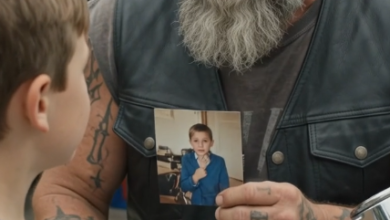
Ray pulled out a folded photograph inside a clear plastic sleeve. He held it out to Sergeant Holloway, who passed it carefully to Lena through the chained door.
It showed a younger Mike Keane standing beside an old pickup, smiling in that tired sideways way Lena had not seen in years. In the bed of the truck were grocery sacks. Beside him stood a younger Ray, thinner, rawer, holding a bundled infant under a wool blanket.
On the back, in her father’s block letters, were six words:
Keep the kid fed. Stay sober.
Lena broke then.
Not loudly.
Not theatrically.
Just enough that the hand holding the photograph began to shake.
Because the final twist was no longer abstract. It was staring at her from cheap glossy paper.
Her father had not died in some random accident on his way back from work.
He had died doing, quietly, exactly what Ray had shown up to do for her.
Nobody rushed the silence after that.
Some truths arrived with shouting. Others entered a place and simply removed everyone’s appetite for noise.
The courtyard at Maple Crest had been full of voices twenty minutes earlier—accusations, filming, panic, self-righteous fear. Now it held only the soft hiss of rain, a patrol engine idling in the lot, and Ivy’s careful breathing as she leaned into her mother’s hip and tried to understand why so many adults had gone still at once.
Lena opened the door.
First the chain.
Then the lock.
Then the whole door, inward, with a movement so quiet it might have been missed if everyone hadn’t already been watching her hands.
No one said a word.
She looked at Ray, at the man she had feared, resented, and not understood, and then down at the groceries by his boots.
“Bring them inside,” she said.
Ray did not move.
Maybe because he knew invitations like that could break if touched too fast.
Maybe because he had spent enough years being the wrong-looking man at the right moment to distrust welcome.
Lena repeated it, softer. “Please.”
That was enough.
He bent, gathered the bags, righted the spilled can, picked up the carton of eggs with a mechanic’s care, and stepped only as far as the tiny kitchen linoleum just inside the door. No farther. He set everything down by the refrigerator, including the second bag.
“The diapers go downstairs after,” he said.
Somewhere below, a man behind a half-open window coughed in embarrassment.
Ivy stepped around her mother’s leg and looked up at him with open, child-sized seriousness. “Did you know my grandpa?”
Ray glanced at Lena first, asking permission without words.
Lena nodded once.
“Yeah,” he said.
“Was he nice?”
Ray thought about that longer than anyone expected.
Then he said, “Not soft. Nice isn’t the word people use when a man makes you show up at six in the morning for work you don’t want and tells you excuses are just lies with makeup on.” A pause. “But he was good.”
Ivy seemed satisfied by that.
“Mom cries when she misses him,” she said.
Lena gave a weak laugh through the remains of tears. “Ivy.”
But Ray only nodded as if the statement belonged in the room.
“Mine did too,” he said.
That startled Lena.
“Your son?” she asked quietly.
Ray looked toward the doorway, out at the rain-dark landing where everybody else still hovered between witness and intruder. “Died at nineteen. Overdose.” The words were plain, worn down by years of repetition inside the skull. “Mike kept him fed when I didn’t deserve help. I didn’t keep him long enough after.”
The confession did not ask pity from anyone.
That was why it hit so hard.
Family. Past. Sacrifice.
There it was, all braided together in one exhausted sentence.
The building had a new silence now—not judgment, not gossip withheld for later, but the kind that comes when people realize they have just mistaken grief for menace and discipline for threat.
Sergeant Holloway took off her gloves. “Ms. Hart, do you need anything else tonight?”
Lena looked at the groceries, the photo, the medal, her daughter, the man standing inside her kitchen like he was careful not to touch more of her life than invited.
Then she shook her head. “No.”
Holloway gave one short nod. “All right.”
Officer Talbot muttered something that might have been an apology, but it did not fully make it into the air. He looked nineteen himself in that moment, embarrassed by how quickly he had trusted the picture instead of the people in it.
Curtis Bell pushed himself back upright with effort and met Ray’s eyes. “Mike would’ve liked the bike, by the way.”
Ray’s mouth moved just enough to suggest the memory of a smile. “It was his.”
That stunned Lena again.
“What?”
Ray glanced out through the open door toward the parking lot. “Bought it from your mother after the funeral. She needed the money. I kept it running.”
Lena turned her head slightly, and through the rain and police lights she could just see the motorcycle at the curb.
Her father’s bike.
Or what had once been his.
Twelve years gone, and there it was in the wet Kentucky dark, held together by another man’s hands.
A second inheritance.
Not money. Not comfort.
Duty.
Mrs. Keeter, still on the balcony, wiped at her eyes with the corner of a dish towel and pretended the rain had reached that high. Hector cleared his throat and stared very hard at the concrete. The teenage boys lowered their phones one by one.
People began to drift back toward their apartments.
Not because the story was over.
Because they understood it was no longer theirs.
Ray stepped back toward the door. “I should go.”
Lena looked at him. At the groceries. At the card in her hand. At the history she had just been handed in pieces sharp enough to bleed through.
“Did my mother ever forgive you?” she asked.
Ray took a moment.
“No.”
The answer was honest enough to feel respectful.
He started down the landing.
Then Lena said, “I don’t know what to do with all this yet.”
Ray stopped but did not turn around.
“You don’t have to tonight,” he said.
Another one of her father’s kinds of sentences. Plain. Unromantic. Usable.
When he reached the top stair, Ivy called after him.
“Wait.”
Ray turned then.
The little girl trotted to the doorway, pulled a single apple from the grocery bag, and held it out with both hands, as if repayment had to begin immediately or the universe would stay off balance.
“This is for your ride,” she said.
For one strange second, nobody moved.
Then Ray came back just far enough to take the apple from her carefully, like it might bruise if he accepted it too hard.
“Thank you, ma’am,” he said.
Ivy nodded, serious as church.
Ray went down the stairs after that, past Curtis, past the officers, past the neighbors who no longer knew where to put their eyes. He swung one leg over the old motorcycle, settled the apple into the front pocket of his vest, and started the engine.
The noise filled the courtyard and then softened.
He did not wave.
He did not look back.
But just before he rolled out through the gate, Lena saw him reach up once and touch the St. Christopher medal that was no longer around his neck.
Because it was in her hand now.
And long after the bike’s sound had faded into the Louisville traffic, that small piece of metal stayed warm in her palm while the groceries sat on the kitchen floor and the rain kept falling outside, steady and thin, like something old finally finishing what it had started.