Part 2: Eight Bikers Surrounded Our Car — Then They Said My Dead Father Sent Them
My name is Emily Mercer, and I am telling this story six years after the night eight bikers found us sleeping beside Route 41 like two pieces of lost luggage.
Back then, I did not know men could have two faces and both be true.
My father had one face for the world. Jack Mercer. Tire shop manager. Soft voice. Bad knees. The kind of man who cut coupons, remembered every neighbor’s trash day, and kept peppermint candies in the console of his truck because I got carsick on curvy roads.
Then there was the face he kept folded away.
The motorcycle face.
I had seen pictures of it once when I was little. Dad was younger, leaner, sitting on a Harley with his hair tied back, wearing a black leather cut with a patch that said Cumberland Saints MC. Mom shut the photo album so fast the air snapped.
“That was before,” she said.
Before what, she never told me.
Dad never talked much about it either. Sometimes on summer nights, when a motorcycle passed our house and the V-twin rumble shook the porch boards, he would stop whatever he was doing. Not for long. Just enough for me to notice. His hand would pause over the grill tongs or the lawn mower handle. His eyes would go somewhere else. Then he would come back to us and say, “Storm coming,” even when the sky was clear.
I thought he had left that life because it was bad.
Kids think in straight lines.
Good guys. Bad guys. Safe places. Dangerous places.
Then my father died, and every straight line in my life broke.
It happened at Miller’s Tire & Brake on a Tuesday in March. He was carrying a box of air filters from the back room when he stopped, put one hand on the counter, and told his coworker, “Call Lisa.” That was my mom. He did not say call 911. He said call Lisa. Like even his heart knew where home was.
He was gone before she got there.
The funeral was small because grief is expensive when you are poor. A pastor who barely knew him said kind things from a paper. Men from the tire shop stood in the back wearing work shirts with grease on the cuffs. Nobody from his old motorcycle club came.
I noticed that.
Mom noticed it more.
After the funeral, the bills came like weather. Mortgage. Hospital. Old credit cards. Car insurance. A late notice folded into another late notice. Mom worked front desk at a dental office and cleaned two houses on Saturdays, but my father had carried more than groceries into our home. He had carried numbers she had never been shown.
Two weeks later, a man from the bank called. Mom took the phone into the bathroom. I heard the shower turn on, but no water hit the tub. She just sat in there with the fan running so I could not hear her cry.
By April, we were out.
She sold what she could. Couch. Television. Dad’s tools. My bike. She packed our clothes into trash bags and told me we were going to stay with a friend.
That lasted three nights.
Then the friend’s boyfriend came home drunk and angry, and Mom drove us out before midnight with my backpack still open on the floorboard.
That was when the car became home.
We parked wherever the lights were bright and nobody asked questions. Walmart. Church lots. Truck stops. The closed laundromat off Route 41 became our safest place because the security light worked and there was a gas station across the road with a bathroom the night clerk let us use if we bought coffee.
Every night, Mom checked the locks four times.
Every night, I pretended to sleep first so she could cry.
The small detail I remember most is her hands. She kept them clean even when everything else was falling apart. She washed them in gas station sinks until the skin cracked. She used napkins as towels. She clipped my nails with a keychain clipper because “your daddy always said clean hands tell people you still respect yourself.”
That sentence came back later.
So did the vest.
The one Bishop held outside our window.
The one with a patch hidden inside.
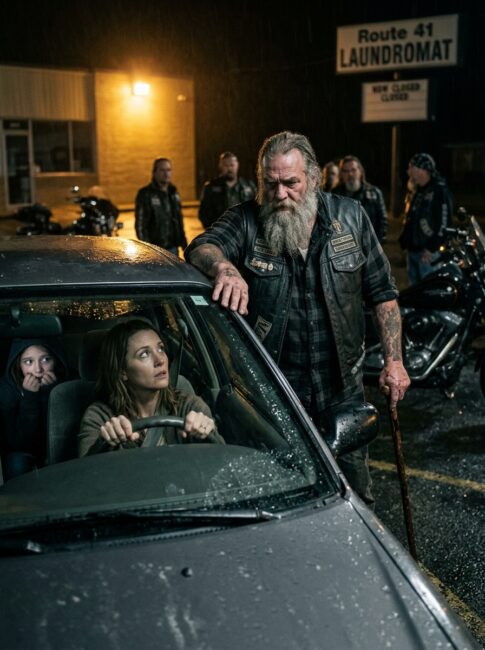
The night they found us, it had rained hard enough to turn the laundromat parking lot into a black mirror.
Mom had parked under the security light, nose facing the road in case we needed to leave fast. She always did that. She said it was so the sunrise would not hit my eyes, but I knew better. She wanted a way out.
I was in the back seat wearing two pairs of socks and Dad’s old UT hoodie. It smelled less like him every week, and that scared me more than sleeping in the car. I kept my face buried in the sleeve, trying to find the last place he still lived.
Mom was in the driver’s seat with her shoes on. She never took them off anymore. Her phone was plugged into a portable charger that barely worked. On the dashboard, there was a paper cup with thirty-seven cents inside and a grocery receipt folded into fourths.
I asked her if we would have pancakes on my birthday.
My birthday was three months away.
She said, “Of course.”
Her voice cracked on the second word.
I did not ask again.
Around two in the morning, the first motorcycle came down Route 41.
You hear a Harley before you see it. Not just loud. Deep. Like thunder caught in a metal barrel. The sound rolled through the wet parking lot and into the car door. Mom’s eyes opened.
Then came another.
And another.
Eight headlights turned in from the road.
They did not park close at first. They lined up near the edge of the lot, engines rumbling low, chrome flashing under the security light. The men sat there for a moment, big shapes on bigger machines, steam rising from hot pipes in the cold rain.
Mom whispered, “Stay down.”
I slid lower in the back seat.
The engines cut one by one.
That was worse.
After all that noise, the silence felt like somebody holding a hand over my mouth.
Boots hit gravel. Leather creaked. A chain tapped against somebody’s belt. I saw shapes move around the car through fogged glass. Eight men. Maybe more. My brain made them monsters because fear needs a costume.
One of them came to Mom’s window.
He was older than the rest. White beard. Heavy shoulders. A black leather cut dark with rain. His left hand was tattooed across the knuckles, but his fingernails were trimmed clean. That made no sense to me. Everything about him looked rough except that one small thing.
He tapped the glass with one finger.
Not hard.
Tap.
Tap.
Mom did not move.
The man stepped back and lifted both hands where she could see them.
“Ma’am,” he said through the glass, “we’re not here to scare you.”
That is exactly what a scary man would say, I thought.
Mom cracked the window less than an inch.
“You need to leave,” she said.
The man nodded like he understood why she said it.
“My name is Walter Boone. Folks call me Bishop. I was president of the Cumberland Saints before my knees went bad.”
“I don’t know you.”
“No, ma’am.”
“Then back away from my car.”
He did.
That was the first thing that changed the night. He obeyed.
He took three steps back into the rain and motioned for the other men to give space too. They did. Big men with beards and tattoos and leather cuts moved away from a car because one frightened mother asked them to.
Bishop reached slowly inside his vest.
Mom grabbed the keys.
He froze.
“No sudden moves,” she snapped.
“Yes, ma’am.”
He removed something wrapped in a black trash bag and held it out at arm’s length.
“Your husband left this with us five years ago,” he said. “We should’ve brought it sooner.”
Mom stared at the bundle like it might explode.
Then the plastic slipped, and I saw worn black leather.
Dad’s old vest.
Mom made a sound I had heard only once before, at the funeral home when they closed the casket.
“You knew Jack?” she asked.
Bishop looked down.
“Yes, ma’am.”
“Then where were you?”
The question hit harder than any punch could have.
Bishop’s face did not change much. Bikers do not let pain run around loose. But his jaw locked. His eyes went wet and stayed there, stubborn.
“We thought he wanted gone,” he said. “So we let him go.”
For one second, I thought that was the whole story.
My father had left them. They had left him. Now they had found us too late.
Then Bishop looked at me in the back seat and said, “Little girl, your daddy saved my life once.”
And that was when the night turned.
Mom opened the door, but only halfway.
Rain blew in. Cold air rushed over my legs. Bishop stood under the security light holding Dad’s leather vest like it was something sacred. The other bikers stayed back by their Harleys, silent, watchful, hands visible.
I saw them clearly for the first time.
One Black man in his fifties with a shaved head and silver beard, wearing reading glasses tucked into the collar of his shirt. One white man with a red beard and a limp. One Latino man maybe thirty-five, quiet and built like a refrigerator. One older white woman with gray hair in a braid, the only woman there, her leather cut zipped tight against the rain. Four more men I could barely separate from shadow and leather.
They all looked tired.
Not dangerous tired.
Worried tired.
Bishop held the vest out to Mom.
She did not take it.
“What do you want?” she asked.
He swallowed. His voice got rough.
“To make right what we missed.”
Then he told us the first twist.
Dad had not quit the club because he hated them. He quit because of me.
I was seven years old when he brought his cut back to the Cumberland Saints clubhouse in a cardboard box. He told Bishop he needed to be home every night. No runs. No late meetings. No calls at midnight. Mom was working weekends then, and I had started having panic attacks at school after a tornado warning trapped us in a hallway for two hours.
Dad told Bishop, “My kid needs a steady house more than I need a patch.”
Bishop said the club understood.
Dad said, “No. Don’t understand it. Respect it.”
So they did.
They stopped calling. Stopped visiting. Stopped checking in because they thought distance was what he wanted. Brotherhood sometimes makes men loyal in the wrong direction. They loved him enough to let him disappear.
Five years passed.
Then Jack Mercer died of a heart attack, and nobody told them.
They found out because a cashier at the Shell station across the road recognized Mom from a local church donation post. She had seen us brushing our teeth in the bathroom three mornings in a row. Her brother-in-law rode with the Cumberland Saints.
By sunset, the club knew Jack was gone.
By midnight, eight of them had found our car.
But the biggest twist was still sitting inside Bishop’s vest pocket.
He reached in slowly this time, watching Mom’s eyes for permission, and pulled out an envelope thick with folded paper.
“Eight men,” he said. “Twenty-four hours. Some cash. Some checks. One brother sold a bass boat. One sister sold two guitars. One prospect emptied a honeymoon fund his wife told him to empty.”
Mom stared at him.
Bishop held out the envelope.
“Thirty-five thousand dollars,” he said. “Apartment deposit is already paid. First year’s school supplies covered. Six months of groceries set up at Piggly Wiggly. There’s a lady waiting with keys when you’re ready.”
Mom did not reach for it.
I think her body had forgotten how to accept rescue.
Bishop’s hand shook just once.
“Lisa,” he said softly, using my mother’s name like he had earned it through my father. “Jack was our brother.”
Mom whispered, “He left.”
Bishop nodded.
“Brotherhood don’t end because a man walks out the door.”
I crawled out of the back seat then, still wrapped in Dad’s hoodie, my hair stuck to my face, my socks wet from the floor mat.
I looked at eight huge strangers in the rain.
And I asked the question that made them all fall apart.
“Why would you help me?”
Bishop crouched down until his knees cracked loud enough for everyone to hear.
“Because your daddy was family,” he said. “And when a brother dies, his family becomes ours.”
I looked at those leather cuts, those tattoos, those hard faces trying not to break.
“So are you my uncles now?”
Bishop looked back at the other seven.
One by one, they nodded.
Then he turned to me.
“Yes, ma’am,” he said. “If you’ll have us.”
We did not go to the apartment that night.
Mom tried to say no. That is something people do when they have been drowning too long. Someone throws a rope, and they apologize for making waves.
Bishop did not argue with her.
He just acted.
The woman biker with the gray braid, whose road name was June Bug, stepped forward carrying a duffel bag.
“Clean clothes,” she said. “Nothing fancy. Dry socks first.”
That was all.
She opened the laundromat with a key.
I stared at her.
She shrugged. “I own it.”
That was twist number three.
The closed laundromat was not random. June Bug had seen our car three nights earlier on the security cameras. She had been leaving the light on for us without saying anything because she did not want to scare Mom away. She had also been the one who called the Shell cashier and started the chain that reached the club.
Inside, the laundromat smelled like detergent, old quarters, and wet leather. The fluorescent lights buzzed overhead. Eight bikers stood awkwardly between washing machines while Mom sat on a plastic chair with Dad’s vest in her lap.
She finally opened it.
The outside was what I remembered from the photo. Cumberland Saints back patch. Road dust in the seams. A small burn mark near the bottom. But Bishop pointed to the inside lining.
There, stitched crookedly near the heart, was a small patch I had never seen.
A yellow house.
Under it were three words.
STEADY HOUSE FUND.
Mom covered her mouth.
Bishop looked at the floor.
“Jack started it,” he said. “Years back. Before he left. Every ride, he’d make us throw something in a coffee can. Five bucks. Ten. Whatever. Said too many kids around here were living out of cars while grown men wasted money acting rich.”
My mother’s hands trembled over the patch.
“He never told me.”
“He didn’t tell anybody much,” Bishop said. “Just did things.”
That was my father.
Quiet kindness. Hidden in plain sight.
The first family helped by that fund had been a mechanic with three kids after a fire. The second was a waitress whose landlord changed the locks. The third was a veteran sleeping behind the bowling alley. Dad had started the fund, then left the club, and the club kept it going because none of them wanted to be the man who let Jack’s best idea die.
But they had not known Jack’s own family would need it.
That was the part that hurt them.
You could see it on their faces. The shame. The anger at themselves. The grief with nowhere to go.
Bishop did not give a speech. He just put one hand on the washing machine beside Mom and said, “We should’ve checked.”
Mom said, “You couldn’t know.”
He shook his head.
“Brothers check.”
Those two words became a rule in my life.
While our clothes spun in the dryer, the bikers unloaded groceries from saddlebags and a pickup I had not noticed. Bread. peanut butter. apples. cereal. shampoo. a toothbrush still in plastic. A purple blanket with stars on it because June Bug had asked the store clerk what twelve-year-old girls liked and panicked.
The Latino biker, Mateo, fixed our car’s heater in the parking lot with a flashlight between his teeth. The Black biker, Darnell, called his sister, who worked at the middle school, and arranged for me to meet the counselor quietly so nobody would ask why I had missed so many days. The red-bearded man with the limp, Cutter, wrote down every utility company number we needed.
They did not hug us. They did not crowd us. They did not try to become heroes inside the story.
They made calls.
They carried bags.
They handed Mom coffee.
They stood outside in the rain while we changed clothes in the laundromat bathroom.
That was how they loved.
With logistics.
Before sunrise, Bishop drove ahead of us to a brick apartment building near Old Fort Street. Second floor. Two bedrooms. Beige carpet. A kitchen window facing a maple tree. Nothing fancy. Everything holy.
There were mattresses on the floor, towels in the bathroom, cereal in the cabinet, and a little desk in the corner of the smaller bedroom.
On the desk was a framed photo of Dad from his club days.
Next to it was an empty frame.
A note leaned against the glass.
For Emily’s first day back home.
Mom finally broke then.
Not pretty crying. Not movie crying. The kind where your ribs fold inward and no sound comes out at first.
Bishop stood in the doorway. His boots did not cross the threshold until she waved him in.
Then he set Dad’s vest on the kitchen table.
“Jack comes too,” he said.
The eight of them never left.
Not in the way people usually leave.
They had lives. Jobs. Bad knees. Court dates for old mistakes. Grandchildren. Wives who called them idiots when they rode in rain. But somehow, one of them was always there when the car made a sound, when Mom got a scary letter, when I needed a ride, when the sink backed up, when a school form had a blank space where “father” was supposed to go.
Bishop came every first Sunday.
He parked his Harley under the maple tree and let the engine idle exactly three seconds before shutting it down because Mom hated loud mornings. Then he would bring coffee, sit at our kitchen table, and ask, “Anything broken?”
He meant appliances.
He also meant us.
June Bug taught Mom how to make a budget that did not feel like a punishment. Darnell came to my first choir concert and clapped too early. Mateo taught me to change a tire in the apartment parking lot and made me do it twice because “pretty crying don’t loosen lug nuts.” Cutter built my bookshelf crooked and got mad if anyone called it crooked except him.
Every Christmas, the eight bikers hung one tiny yellow house ornament on our tree.
Every March, on the anniversary of Dad’s death, they rode to Miller’s Tire & Brake before sunrise. They did not make a ceremony of it. They parked out front, engines clicking in the cold, drank gas station coffee, and left one peppermint candy on the curb.
Then they came to breakfast.
Mom would fry eggs. I would make toast. Bishop would sit in Dad’s chair only after Mom told him to. He never assumed.
That mattered.
The vest stayed on a hook by our front door.
Not as a shrine. More like a promise with sleeves.
Sometimes I would touch the yellow house patch before school. Sometimes Mom did. Sometimes Bishop did when he thought nobody was looking.
When I turned sixteen, the club gave me a used Honda Civic with a red bow on the hood. Bishop handed me the keys and said, “It ain’t pretty.”
I said, “Neither are you.”
The whole parking lot went quiet.
Then Bishop laughed so hard he had to sit down on the curb.
That was the first time I realized I was not the scared girl in the back seat anymore.
I had grown up inside a circle of leather and engine noise and men who looked frightening to strangers but knew exactly which brand of cereal I liked.
I had eight uncles.
No blood.
All heart.
Six years after that night, I stood behind a podium in a high school gymnasium wearing a blue cap and gown, looking at a crowd that blurred every time I blinked.
My mother sat in the front row.
Beside her were eight bikers.
Older now. Softer around the middle. More gray in their beards. Bishop used a cane. Cutter’s limp was worse. June Bug wore reading glasses on a chain and threatened to fight the principal if the air-conditioning made her hair frizz.
They looked completely out of place among the church dresses and polo shirts.
They also looked exactly where they belonged.
When my name was called, they stood before anyone else did.
Eight leather cuts rising in the front row.
Eight pairs of boots on a gym floor.
Eight people my father had left behind who somehow carried me forward.
During my speech, I unfolded the paper with hands that did not shake as much as I expected.
“I did not graduate alone,” I said. “I graduated with my mother, who kept driving when she had nowhere to go. I graduated with my father, who built a house fund before his own house fell. And I graduated with eight uncles who are not my blood, but somehow had my heart before they ever knew my name.”
The gym went quiet.
Bishop took off his sunglasses.
That was how I knew he was crying.
Afterward, we took a picture outside under the Tennessee sun. Mom on one side. The eight bikers behind me. Dad’s vest folded over my arm, yellow house patch facing out.
When they rode away, the engines shook the pavement.
I watched the taillights disappear toward Route 41.
Then Bishop’s voice came back to me.
Brothers check.
Follow the page for more biker stories about the people behind the leather, the engines, and the silence.