Part 2: The Bride Asked the Music to Stop Mid-Wedding — Her First Sentence Left Both Families Silent
The empty chair had been bothering Clara since the doors opened.
It sat on the groom’s side, second row, aisle seat. A white rose had been tied to its back with a satin ribbon, just like all the others. But unlike the others, no program rested on the cushion. No purse. No jacket. No folded shawl from an elderly aunt saving her place.
Just one small thing lay there.
A blue handkerchief.
Clara had noticed it while waiting behind the chapel doors with her father. At first, she assumed someone had dropped it. Weddings were full of misplaced things. Lipsticks, cufflinks, tissues, old grudges disguised as smiles.
Then she saw the initials.
L.E.
Her fingers had gone cold.
She knew those letters.
Not because anyone had explained them.
Because she had seen them in a photograph hidden inside Matthew’s nightstand, weeks before the wedding.
A young woman with dark hair stood beside Matthew at a lake, both of them laughing at something outside the frame. In the corner of the photo, someone had written in blue ink, “Lake Eden, July 2018.”
When Clara asked him about it, Matthew had gone still.
“That was Leah,” he said.
Then he closed the drawer.
Clara did not push.
Every person comes to marriage carrying rooms another person has not yet entered. She told herself Leah was one of those rooms. A college girlfriend. A painful ending. A memory that deserved quiet.
But three days before the wedding, Clara found something else.
Not by snooping.
By accident.
Matthew had left his vows on the kitchen table beneath his Bible. Clara was looking for the florist’s final invoice when a folded envelope slipped from between the pages.
It was addressed to Matthew.
The handwriting was shaky.
Inside was a card with no signature, only one sentence.
She deserves to know before she wears your ring.
Clara had sat there for nearly ten minutes, hearing only the refrigerator hum.
When Matthew came home, she almost asked.
But he looked exhausted. His tie hung loose, and his eyes were red from arguing with his mother over seating charts, rehearsal dinner flowers, and whether Clara’s divorced aunt should be near the front.
So Clara folded the card and put it back.
That was the first small mistake.
The second came at the rehearsal dinner.
Matthew’s mother, Evelyn Ellis, stood to make a toast in the private dining room of a country club, her diamond bracelet flashing each time she moved her hand.
“My son,” she said, “has always chosen carefully.”
Everyone laughed softly.
Clara smiled.
Then Evelyn looked directly at her.
“And we are grateful he finally chose someone who understands family image.”
The room stiffened.
Matthew’s jaw tightened.
Clara’s father looked down at his plate. Her mother squeezed a napkin into a hard little ball. Evelyn went on smiling, as if cruelty sounded better when served with champagne.
Later, Clara found Matthew outside near the valet stand.
He was speaking to an older woman in a navy dress Clara did not recognize. The woman was small, with silver hair pinned at her neck and one hand gripping a cane.
Matthew held both of her hands.
He was crying.
Clara stepped back before they saw her.
She heard only one sentence.
“I tried, Aunt June. I tried to make it right.”
The woman answered so softly Clara could not catch the words.
Matthew wiped his face, kissed the woman’s forehead, and walked back inside wearing the smile guests expected from a groom.
That night, Clara lay awake beside him.
He slept with one hand open on the blanket, as though even in sleep he was waiting to be forgiven.
By the morning of the wedding, Clara had almost convinced herself to say nothing.
Almost.
Then she entered St. Augustine Chapel and saw the blue handkerchief on the empty chair.
L.E.
The same initials.
The same blue thread.
As she stood in the back with her father, the wedding planner leaned in and whispered, “We had one last-minute seating change from Mrs. Ellis. She said to leave that chair empty.”
“Why?” Clara asked.
The planner hesitated. “She said it was family business.”
Clara turned toward the altar.
Matthew stood there in a black tuxedo, handsome and pale, his eyes fixed on her like she was the last safe thing in the room.
But behind him, Evelyn watched Clara with a warning in her smile.
That was when Clara understood one terrible thing.
Whatever truth had been buried, both families had helped cover the grave.
The doors opened.
The music swelled.
Guests rose.
Clara took one step.
Then another.
Her father’s arm felt rigid beneath her hand.
Halfway down the aisle, the handkerchief fell from the empty chair and landed on the floor.
A small blue square against white marble.
Clara stopped walking.
The music kept playing.
For three more seconds, she tried to breathe through it.
Then she raised her hand.
And the whole wedding froze.
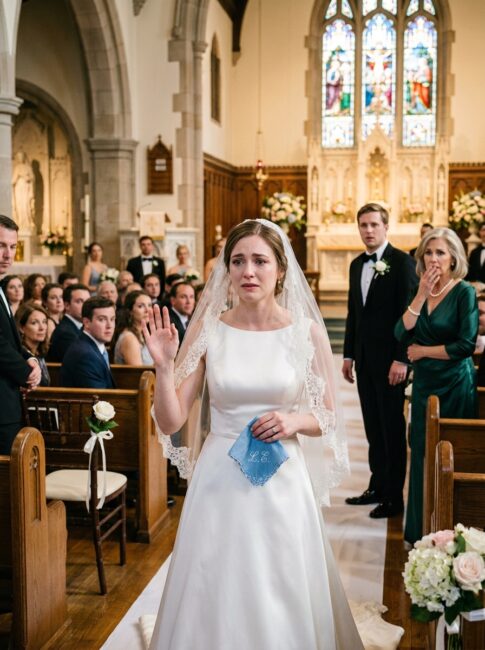
Clara’s first sentence had not been loud.
“I can’t walk any farther until someone tells the truth.”
But it moved through the chapel like a storm entering through stained glass.
Matthew looked wounded.
That hurt more than Clara expected.
If he had looked guilty, she might have found strength in anger. But he looked like a man watching the floor disappear beneath the only home he had chosen.
Evelyn stood first.
“This is inappropriate,” she said, her voice sharp enough to cut ribbon. “Clara, dear, whatever scene you think you’re making, it can wait.”
The word scene landed badly.
Clara’s mother, Helen, rose slowly. “Let her speak.”
Evelyn turned. “This is my son’s wedding.”
“It is hers too,” Helen said.
A murmur passed through the pews.
Matthew stepped down from the altar.
“Clara,” he said quietly, “tell me what you need.”
That was the third thing that did not fit.
A guilty man might defend himself.
Matthew offered her room.
Clara held up the handkerchief.
“Who is Leah?”
The chapel changed.
Not loudly.
Not with gasps.
Worse.
With recognition.
Several faces dropped at once.
Matthew’s father closed his eyes. Aunt June, the silver-haired woman from the rehearsal dinner, covered her mouth with a shaking hand. Evelyn remained still, but the color drained from her carefully powdered face.
Matthew stared at the blue cloth.
Then he looked at his mother.
“You brought that?”
Evelyn did not answer.
Clara’s heart thudded.
“She deserves to know,” Matthew said, but his voice was not aimed at Clara.
It was aimed at Evelyn.
For the first time, Clara saw something she had missed for months.
Matthew was not afraid of being exposed.
He was afraid of hurting someone who had already been hurt enough.
Aunt June began to cry.
She pushed herself up with her cane. “Matthew, honey, I’m sorry.”
“No,” Matthew said. “You don’t apologize.”
Clara’s father moved beside her. “Clara, maybe we should step aside.”
She turned to him. “Did you know?”
Richard’s face folded.
That was her answer.
Her mother whispered, “Richard.”
Clara stepped away from her father’s arm.
“What did you know?”
Richard looked at the aisle, at the guests, at the daughter he had carried on his shoulders when she was six and lied to when she was thirty.
“I knew there was another girl once,” he said. “I knew she was gone. That’s all.”
Evelyn laughed once, bitter and small. “Gone is a polite word.”
Matthew’s voice hardened. “Mom.”
“No,” Clara said. “Let her finish.”
Evelyn lifted her chin.
“Leah Ellis was my daughter,” she said.
The chapel went very still.
Clara looked at Matthew.
“My sister,” he said.
Clara’s grip loosened around the handkerchief.
Sister.
Not lover.
Not secret affair.
Not betrayal.
Something colder opened inside her.
Matthew continued, carefully, as if each word had sharp edges. “Leah died five years ago.”
Aunt June sobbed quietly.
Clara looked down at the embroidered letters.
L.E.
Leah Ellis.
“She loved weddings,” Matthew said, his voice breaking. “She used to say she would sit in the second row at mine and judge the flowers.”
A few guests gave pained little smiles through tears.
Matthew glanced at the empty chair.
“I asked for a chair for her. My mother said it would make people uncomfortable. She said grief had no place at a celebration.”
Evelyn’s mouth trembled.
“That is not what I meant.”
“It is exactly what you meant,” Matthew said.
For the first time since Clara had known him, Matthew did not soften himself for his mother.
He looked older suddenly.
And younger too.
Like a boy who had spent years standing guard at a locked door.
Clara turned to Evelyn. “Then why was the handkerchief there?”
Evelyn’s eyes flicked toward Aunt June.
Aunt June clutched the cane in both hands. “Because I put it there.”
Evelyn turned on her. “June.”
“I am tired,” Aunt June said, her small voice carrying through the chapel, “of pretending Leah was never here.”
Something in the room shifted.
Aunt June stepped into the aisle.
“Leah was not a shame. She was not a shadow to be removed from the family album. She was a daughter. A sister. A niece. And she loved Matthew more than anyone.”
Matthew wiped his eyes with the heel of his hand.
Clara could barely breathe.
Aunt June reached into her purse and pulled out a folded piece of paper.
“I was told not to bring this,” she said.
Evelyn whispered, “Please don’t.”
But the word please was not command anymore.
It was fear.
Aunt June handed the paper to Clara.
The paper was old, creased many times. On the outside, in blue ink, it read:
For my brother’s bride, someday.
Clara looked at Matthew.
He shook his head slowly, stunned.
“I didn’t know that existed,” he said.
Clara opened it.
The handwriting was playful at first, then uneven near the end.
Dear future sister, if you are reading this, it means my annoyingly serious brother found someone patient enough to marry him. First, congratulations. Second, hide the good cookies because he has no self-control.
A soft, broken laugh moved through the chapel.
Clara kept reading.
Matthew pretends to be strong because Mom needs him that way. Please don’t let him spend his whole life being useful instead of happy. He will carry everyone’s grief if nobody stops him. Make him dance. Make him talk. Make him keep a chair for me, not because I need it, but because he does.
The words blurred.
Clara pressed the letter to her chest.
There it was.
The truth was not that Matthew had betrayed her.
It was that he had been protecting a family wound so carefully, he had almost walked into marriage without showing her where it still bled.
Clara looked at the man she had been ready to accuse.
He had not lied because he loved another woman.
He had stayed quiet because his mother had made grief feel like disloyalty.
Twist after twist folded into the silence.
Leah was not a secret lover.
The empty chair was not a threat.
The warning card had not come from someone trying to ruin the wedding.
It had come from Aunt June, trying to save it.
Clara’s father had not known the truth, but he had known enough to keep quiet because wealthy families intimidated him.
And Evelyn, who seemed cold and vain, was not hiding scandal.
She was hiding a daughter she could not bear to remember without breaking.
Clara turned to her.
Evelyn was standing alone now. The perfect mother of the groom, wrapped in silk and pearls, looked like a woman holding water in her hands and losing it anyway.
“I couldn’t do it,” Evelyn whispered.
No one spoke.
“I couldn’t sit in the front row and look at an empty chair. I couldn’t watch my son marry the woman he loved while remembering my daughter would never have that day.”
Her voice cracked.
“So I called it dignity. I called it moving forward. I called it protecting the family.”
Aunt June stepped closer.
“You called it erasing her.”
Evelyn covered her face.
Matthew walked toward his mother.
For a moment, Clara thought he might turn away from her.
He didn’t.
He took Evelyn’s hands and lowered them from her face.
“I needed you to miss her with me,” he said. “Not make me miss her alone.”
That was when Evelyn broke.
Not elegantly.
Not privately.
She folded into her son’s arms in front of everyone she had spent years trying to impress. The chapel watched as a mother sobbed into the tuxedo of the son she had forced to become steady before he was ready.
Clara stood in the aisle, holding Leah’s letter.
For a few terrible minutes, she had looked like a bride who wanted to destroy her wedding.
Now she looked like the only person brave enough to stop it from being built on silence.
Matthew looked over his mother’s shoulder at Clara.
His eyes asked a question.
Not will you forgive me?
Not will you still marry me?
Something deeper.
Can you love me with this room opened?
Clara looked at the empty chair.
Then at Leah’s handkerchief.
Then at Matthew.
“Before I walk any farther,” she said, her voice shaking, “someone needs to put her program on that chair.”
The wedding planner moved first.
Then Aunt June.
Then Matthew’s father.
A program was placed gently on the seat.
Aunt June tucked the blue handkerchief beneath it.
Evelyn stepped forward, trembling. She removed the white rose from her own corsage and tied it to the empty chair.
No one told her what to do.
No one had to.
The music did not begin right away.
The chapel needed time to breathe again.
Guests sat with tissues pressed to their eyes. Some looked ashamed for the judgments that had formed so quickly. Others stared at the empty chair as if seeing all the empty places they had avoided in their own lives.
Clara stood beside her father.
Richard looked smaller than he had that morning.
“I should have asked more,” he whispered.
Clara looked at him, still hurt, but not ready to spend the rest of the day punishing every person who had been afraid.
“Yes,” she said softly. “You should have.”
He nodded.
That was enough for now.
Matthew came back to the altar, but he did not take his place immediately. He walked down the aisle to Clara, stopping just far enough away that she could choose the next step herself.
“I should have told you,” he said.
“Yes,” she answered.
“I thought if I brought all of this into our life, I would be giving you pain on purpose.”
Clara looked at Leah’s chair.
“Pain shows up anyway,” she said. “I just don’t want to meet it as a stranger.”
Matthew’s face crumpled.
He reached for her hand, slowly.
She let him take it.
That small movement changed the room more than any announcement could have.
The pastor, who had been silent since the music stopped, cleared his throat. “Would you like to continue?”
Clara looked at Matthew.
Then at Aunt June.
Then at Evelyn, who was still crying quietly beside the second row.
“Yes,” Clara said. “But not from here.”
She stepped backward to the chapel doors.
A soft confusion moved through the guests.
Clara turned to her father. “Walk me again.”
Richard’s eyes filled.
The musicians lifted their instruments.
This time, when the wedding march began, it sounded different. Not cleaner. Not more perfect. More human.
Clara walked down the aisle with her father on one side and Matthew waiting at the other end, while an empty chair held a program, a blue handkerchief, and a white rose from a grieving mother’s heart.
When Clara passed Leah’s chair, she paused.
She did not bow her head dramatically.
She only touched two fingers to the back of the chair.
Aunt June pressed a hand over her mouth.
Evelyn watched that tiny gesture as if someone had opened a window in a room where she had been suffocating for years.
At the altar, Matthew whispered, “Thank you.”
Clara whispered back, “Tell me about her later.”
“I will,” he said.
Their vows were not flawless after that.
Matthew stumbled on a line. Clara laughed through tears. The ring bearer sneezed at the worst possible moment, and somehow the whole chapel needed that small mercy of ordinary life.
When the pastor pronounced them husband and wife, the applause came slowly at first.
Then fully.
Not because the wedding had been perfect.
Because it had survived becoming honest.
At the reception, Leah’s chair was moved near the family table. No one announced it. No one made a speech about it. The chair simply appeared, with the handkerchief folded neatly across the seat.
Later, during dinner, Evelyn sat beside Clara.
For several minutes, neither woman spoke.
Then Evelyn opened her small silver purse and took out a photograph.
Leah stood beside Matthew at a lake, laughing at something outside the frame.
Clara recognized it.
But now the picture no longer felt like a secret kept from her.
It felt like an invitation.
“She would have liked you,” Evelyn said.
Clara looked at the young woman in the photograph, at the wild dark hair, the bright grin, the life stopped too soon.
“I wish I could have known her,” Clara said.
Evelyn’s lips trembled.
Then, very carefully, she placed the photograph in Clara’s hand.
Not as proof.
Not as payment.
As trust.
Near the end of the night, when the band played something slow, Matthew led Clara onto the dance floor. Around them, guests moved in quiet circles under warm lights.
At the edge of the room, Evelyn stood alone by Leah’s chair.
Aunt June joined her and slipped one arm through hers.
For a long moment, the two women stared at the blue handkerchief.
Then Evelyn reached down and touched the embroidered initials.
L.E.
This time, she did not look away.
Clara saw it from the dance floor.
Matthew did too.
He pulled his wife a little closer, not to hide from the pain, but to stand with someone while it passed through the room.
The last image Clara carried from her wedding was not the flowers, the cake, or even the kiss at the altar.
It was an empty chair that no longer felt empty.
And if stories like this remind you to look twice before judging what you don’t understand, follow this page for more heartfelt stories.