Part 2: The Groom Changed His Wedding Speech at the Last Minute — Then He Read a Name No One Expected
Ruth Morales did not look like the kind of person who belonged in that ballroom.
That was what many people thought, though no one said it loudly enough to own the cruelty.
Her dress was clean but old, with a careful mend near the sleeve. Her shoes were polished, but the leather had creased around the toes. She held a small black purse with both hands, as if she had come to return something she never should have borrowed.
The wedding planner had assumed she was part of the catering staff. Twice.
Claire’s mother had asked her, gently but firmly, if she was “looking for the kitchen.”
Ruth had only nodded and stepped aside.
She had not introduced herself. She had not asked for a seat. She had not touched the champagne passed around before dinner.
She had stood near the service doors through the ceremony, quiet enough to be mistaken for furniture.
Now every face in the room turned toward her.
Evan’s mother, Patricia Whitaker, looked as though someone had opened an old wound in public.
“Evan, not here,” she said.
That was the first small twist.
Because it was not Claire who looked betrayed first.
It was his mother.
Evan kept his eyes on Ruth.
“I invited her,” he said.
Claire’s fingers slipped from his arm.
“You invited her?” she whispered.
He heard the hurt in her voice. Everyone did.
He turned to his wife, and something in his face softened, but he still did not step away from the microphone.
“I did,” he said. “But I should have told you why.”
That made the room lean in.
Claire’s brother, sitting at the front table, muttered, “This better be good.”
Ruth closed her eyes.
At table seven, a bridesmaid whispered, “Was she his ex?”
The question moved silently from face to face. Ruth was older than Evan by at least twenty-five years, but judgment does not need facts before it begins working.
Evan looked back at the crowd.
“When I was seventeen,” he said, “most of you knew me as the son who had everything. Good school. Good family. Good future.”
His father stared down at his untouched wine.
“That was the version people liked,” Evan continued. “But there was another version nobody brought to dinner parties.”
Patricia’s lips tightened.
Ruth’s hands began to shake around the purse.
Evan swallowed.
“I was angry. Reckless. Cruel in ways I didn’t understand yet. I thought pain gave me permission to create more pain.”
The room was silent now.
He glanced at Claire.
“You know some of this,” he said to her. “But not all.”
Claire’s face changed. Not anger exactly. Something worse. The look of a woman realizing there was a locked room inside the man she had just married.
Evan took a folded envelope from inside his jacket.
It was yellowed at the corners, softened from years of being opened and closed.
“This letter,” he said, “was written to me eighteen years ago. I didn’t read it until last month.”
Ruth shook her head almost imperceptibly.
Patricia whispered, “Please.”
But Evan had already opened it.
He did not read the whole thing. Only one line.
“‘A boy can survive a ruined night, but not if everyone decides that night is all he is.’”
Claire looked toward Ruth.
For the first time, Ruth looked back.
Something passed between them, fragile and wordless.
Evan folded the letter again.
“At seventeen, I did something that should have destroyed my future.”
A murmur rose, then died.
He continued slowly, as if each word had weight.
“I stole my father’s car after a fight. I had been drinking. Not enough to pass out. Enough to make me stupid and proud.”
Patricia sat down.
His father closed his eyes.
“I drove through the east side of town in a storm. I hit a mailbox, a stop sign, and finally the front steps of a little house on Mercer Street.”
Ruth’s house.
No one had to say it.
The guests understood at once, but not fully.
Not yet.
Evan’s voice broke for the first time.
“I ran.”
Claire covered her mouth.
That was the second twist.
The groom, polished and beloved, had not simply been hiding a mistake.
He had been hiding a crime.
“I ran two blocks before I realized there was blood on my shirt,” he said. “Not mine.”
Ruth stepped backward, but the cart stopped her.
Evan looked at her with an apology that seemed eighteen years late.
“Mrs. Morales was on those steps that night.”
The ballroom seemed to lose air.
“She had come outside because her grandson was afraid of thunder. She was carrying him back inside when my car hit the porch.”
A woman at the front table gasped.
Claire’s father pushed his chair back, half-rising.
Evan lifted a hand.
“He lived,” he said quickly. “Her grandson lived.”
Several people exhaled at once.
Then Evan added, “Because she turned her body before impact.”
Ruth looked at the floor.
Her right hand moved to her left ribs, almost without thought.
The gesture was small. Too small for a stage.
But Claire saw it.
So did half the room.
A scar hidden beneath fabric. A pain carried so long it had become ordinary.
Evan looked down.
“She broke four ribs, her wrist, and part of her hip. She could have pointed to my license plate. She could have told the police exactly whose car it was.”
He paused.
“She didn’t.”
Now the whispering stopped completely.
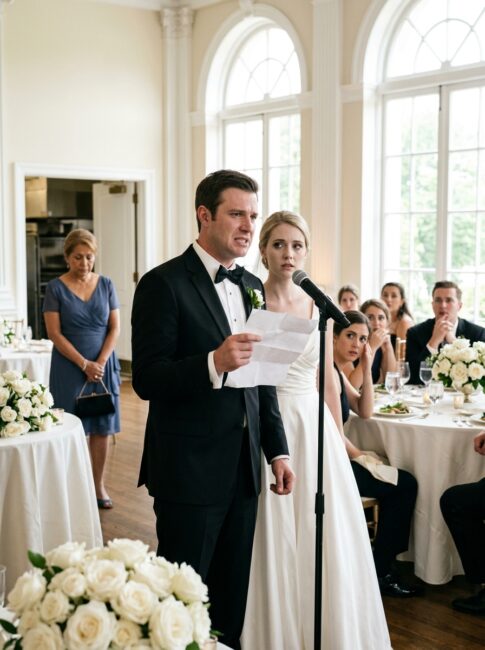
The first person to speak was Evan’s father.
“Son,” he said, his voice rough. “Enough.”
But Evan shook his head.
“No. Not enough. That’s been the problem.”
He turned toward the guests, many of whom had known the Whitaker family for years. They knew the country club version. The charity-gala version. The version with polished shoes and Christmas cards.
They did not know the version built on silence.
“My parents told everyone I had gone away for a leadership program that summer,” Evan said. “That was not true.”
Patricia covered her face.
“I was sent to my uncle’s ranch in Colorado because my father knew the police chief, and because Mrs. Morales refused to identify me.”
Claire stared at him.
This time, her hurt mixed with something else.
Not forgiveness. Not yet.
Understanding had not arrived, but it had begun walking toward her.
Evan turned to Ruth.
“I hated you for that,” he said softly.
A ripple of confusion moved through the room.
Ruth looked up.
“You hated her?” Claire asked.
“I did,” Evan said. “Because if she had accused me, I could have been punished once and called it over. But she did something worse. She made me live with the fact that I had been spared by someone I had hurt.”
Ruth’s eyes filled, but she did not wipe them.
Evan looked at the letter again.
“She sent this to my uncle’s ranch. I refused to open it. I told myself she wanted money. I told myself she wanted to make me feel guilty.”
He laughed once, without humor.
“I was seventeen. I thought guilt was something other people caused.”
Claire’s grandmother, sitting in the second row, lowered her napkin into her lap.
Evan continued.
“My uncle made me work at a shelter kitchen that summer. I washed dishes. Cleaned floors. Served breakfast to men who smelled like rain and cigarettes.”
His eyes moved around the room.
“I thought it was punishment. Then one morning, I saw Mrs. Morales there.”
Ruth shifted uncomfortably.
“She was volunteering,” he said. “With a cast on her wrist. Walking with a cane. Serving coffee to strangers while I was still pretending I was the victim of my own consequences.”
That was the third twist.
Ruth had not disappeared after the accident.
She had returned to the kind of work that made no headlines.
Evan’s voice lowered.
“She saw me drop a tray. She picked up the cups before I did. I remember her saying, ‘Careful, baby. Broken things cut twice if you grab them wrong.’”
He looked at Claire.
“I never forgot that.”
Claire’s eyes were wet now.
But she still did not take his hand.
Good, Evan thought. She should not have to make this easy.
“I wanted to apologize that day,” he said. “But I was too ashamed. So I said nothing.”
Ruth’s mouth trembled.
“For years, I said nothing.”
The room seemed to bend around that confession.
Evan took a breath.
“When I came home from Colorado, my father had arranged everything. The car was repaired. The report was softened. The story was buried.”
His father’s face went gray.
“But Ruth’s medical bills were not buried,” Evan said.
Patricia looked up sharply.
That was the fourth twist.
Even she did not know where this was going.
Evan reached into his jacket again and removed a thin stack of receipts.
“These are copies,” he said. “I found them in my father’s old desk after he had his stroke last month.”
His father looked away.
“Payments made under a company name. Sent every month to a clinic. Then stopped after two years.”
Ruth shook her head.
“Please don’t,” she whispered.
But Evan’s voice stayed gentle.
“My father paid because he was afraid of scandal. Not because he was sorry.”
The words landed hard.
Claire’s father sat down slowly.
“When the payments stopped, Mrs. Morales lost her house.”
A stunned sound moved through the ballroom.
Not a gasp.
Something lower.
Something ashamed.
Ruth gripped the purse tighter.
Evan’s eyes shone.
“She never told anyone. Not the church. Not the paper. Not a lawyer. She moved into a small apartment behind the laundromat and kept raising her grandson.”
A waiter near the wall wiped his eye with his sleeve.
Evan looked at Ruth as if finally seeing her clearly.
“Last month, after I found the receipts, I went looking for her. I thought she would slam the door in my face. I would have deserved that.”
Ruth gave the smallest sad smile.
“She invited me in,” he said. “She made tea.”
Claire let out a quiet sob.
“She still had a limp,” Evan said. “She still had pain when she sat too long. And on her wall, there was a photo of her grandson in a graduation cap.”
He paused.
“Marcus is a nurse now.”
Ruth’s face changed at the name.
Pride came first. Then grief. Then both.
Evan turned back to the room.
“I asked her why she protected me.”
Ruth looked at him sharply, as if begging him not to say more.
He said it anyway.
“She told me she did not protect what I did. She protected what I might become.”
The sentence seemed to settle over every table.
No one reached for champagne now.
No one checked their phone.
Evan’s voice shook.
“She said her own son had made one terrible choice at nineteen. People decided that was the whole of him. He died believing he was nothing more than his worst day.”
Ruth closed her eyes.
“So when she saw me that night, drunk and terrified and selfish, she didn’t see innocence. She saw danger. But she also saw a boy standing at the edge of becoming a man who would either spend his life hiding or spend it changing.”
He turned to Claire.
“I should have told you before today. I was afraid you would look at me differently.”
Claire’s tears slipped down her cheeks.
“I do,” she said.
The room froze.
Evan nodded as if he accepted the sentence.
Then Claire finished.
“I just don’t know yet whether that difference is smaller or bigger than the man I married.”
That was the fifth twist.
She was not saving him from the moment.
She was making him stand inside it.
Evan lowered his head.
“That’s fair,” he said.
Then he faced Ruth again.
“I asked her what I could do to repay her.”
Ruth shook her head harder now.
“I told you,” she said, her voice barely audible. “You don’t repay mercy like a bill.”
For the first time, Evan stepped away from the microphone and walked toward her.
The guests turned in their chairs to follow him.
He stopped several feet away, leaving space between them, as if even now he would not take what she did not offer.
“I know,” he said. “But I can stop letting you carry the cost alone.”
He turned toward the wedding party.
“Claire and I had planned to announce a donation tonight to the children’s hospital in honor of her late mother.”
Claire’s mother looked startled, then touched her chest.
Evan looked at his bride.
“That donation will still happen, if Claire agrees. But I am adding something else with my own money, not wedding money, not family money.”
He looked back at Ruth.
“I bought back the house on Mercer Street.”
Ruth’s knees seemed to weaken.
A bridesmaid stood as if to help, but Ruth lifted a hand.
Evan continued, his own voice breaking open.
“It’s in your name. No conditions. No speeches after this one. No photographs. No plaque. Your grandson helped me arrange it. He is outside because he didn’t want to make you nervous.”
Ruth pressed her fist against her mouth.
Claire turned toward the entrance.
At the back doors, a young man in a charcoal suit stood quietly, eyes red, holding a small brass key.
Marcus.
Ruth saw him and made a sound that was almost a laugh, almost a wound reopening.
He walked to her slowly.
For eighteen years, people had assumed Ruth Morales was simply poor, quiet, forgettable.
Now the ballroom watched her grandson place a key in her palm like he was returning a piece of time.
Ruth looked at Evan.
“I didn’t ask for this,” she whispered.
“I know,” he said.
“I didn’t save you for this.”
“I know.”
She looked down at the key.
Then at the bride, still standing beneath the chandelier with tear-streaked cheeks.
Ruth’s voice trembled.
“Then don’t let this be your finest hour, Mr. Whitaker.”
Evan nodded.
“I won’t.”
Claire walked down from the head table.
The room watched her approach the woman her husband had named before her.
For a moment, nobody knew what Claire would do.
She stopped in front of Ruth and looked at the key in her hand.
Then she said, “May I hug you?”
Ruth broke before she answered.
Claire wrapped her arms around her carefully, mindful of old injuries she had only just learned existed.
That was when Patricia began to cry.
Not softly.
Not elegantly.
She cried like someone who had spent eighteen years keeping a tablecloth over a fire.
The reception did not return to normal after that.
Some things cannot be folded back into a schedule.
The cake was still cut. The band still played. The photographer still tried to gather people beneath the white roses. But the room had changed.
People spoke more quietly.
They looked at the servers differently.
They held doors open longer than necessary.
Evan’s father left before the first dance. Patricia stayed, sitting alone for a while near the windows, her mascara gone and her shoulders smaller than before.
Near nine o’clock, Claire found Evan outside on the veranda.
The night air smelled of wet grass and gardenias. Beyond the glass doors, their wedding continued in softened fragments: music, laughter, silverware, the low hum of people trying to make sense of what they had witnessed.
Evan stood with both hands on the railing.
“I ruined our wedding,” he said.
Claire leaned beside him, not touching him yet.
“You changed it,” she said.
He looked at her.
“That may not be better.”
“No,” she said. “But it may be truer.”
For a while, neither of them spoke.
Inside, Ruth sat at a corner table with Marcus. She had finally accepted a plate of cake. Not a large slice. Just enough. Marcus kept looking at her hand, where she still held the brass key.
Claire followed Evan’s gaze.
“You should have told me,” she said.
“I know.”
“Before the rehearsal.”
“I know.”
“Before I put on the dress.”
He closed his eyes.
“Yes.”
She turned toward him.
“I’m angry,” she said. “And I’m proud of you. And I hate that both are true.”
Evan nodded, tears gathering again.
“I can live with angry,” he said. “I don’t want to live with hidden anymore.”
Claire looked through the windows at Ruth.
“She was the name no one expected,” she said.
Evan gave a faint, broken smile.
“She was the name I built my life around avoiding.”
Claire reached for his hand then.
Not as a promise that everything was repaired.
Not as a clean ending.
Only as a beginning honest enough to hurt.
Later that night, after most guests had gone and the staff began clearing the tables, Ruth walked toward the exit with Marcus beside her.
Evan and Claire met her near the door.
For a long moment, Ruth said nothing. She looked at the bride’s gown, then Evan’s loosened tie, then the empty ballroom behind them.
“You two will have hard days,” she said.
Claire smiled through tired eyes.
“I think we started early.”
Ruth laughed softly.
It was the first easy sound she had made all evening.
Then she opened her purse and took out the old yellowed letter.
Evan stared at it.
“You kept a copy?” he asked.
Ruth nodded.
“I kept it in case you ever forgot there was more to you than that night.”
She placed it in Claire’s hands, not Evan’s.
Claire understood the weight of that choice.
Ruth turned to leave, but Evan stopped her with one word.
“Ruth.”
She looked back.
He tried to speak, but no polished sentence came. No groom’s speech. No public confession. No grand repair.
Just a man standing in the doorway of his own truth.
“Thank you,” he said.
Ruth studied him for a moment.
Then she reached up and straightened his crooked boutonniere with her careful, weathered fingers.
“You’re welcome, baby,” she said. “Now go be worth it.”
She walked out with Marcus into the warm night, the brass key closed inside her palm.
The next morning, long after the flowers had wilted and the rented chairs had been stacked, Claire found Evan’s original speech on the hotel desk.
It was sweet. Funny. Safe.
She read two lines and set it down.
Then she picked up Ruth’s letter instead.
By the window, Evan was asleep in his shirt sleeves, one hand open on the blanket like a man no longer holding a secret.
Claire sat beside him and read until sunrise.
At the bottom of the last page, beneath Ruth’s careful handwriting, there was one final sentence Evan had not read aloud.
“Someday, when people clap for you, remember the ones who only prayed you would make it home.”
Claire folded the letter gently.
Outside, the city was waking up. Somewhere across town, an old woman was unlocking the front door of a house she never thought she would touch again.
And inside a quiet hotel room, a bride placed her wedding ring against that yellowed paper and whispered, “We’ll remember.”
Follow the page for more emotional stories that stay with you long after the last line.