Part 2: The Stepmother Sat Quietly at the Back of the Wedding — Until the Bride Asked Her to Speak
Marian did not move when Lily said her name.
For a moment, only the sound of forks and glasses settling could be heard across the reception hall. Sunlight poured through the tall windows of the vineyard estate, touching the white tablecloths, the gold-rimmed plates, and the roses Lily had chosen because her late mother used to grow them.
That was the first reason people disliked Marian.
She was not Lily’s mother.
Everyone remembered Caroline Harper, the woman with the garden gloves, the big laugh, and the habit of sending thank-you notes for things no one remembered doing. Caroline had died when Lily was thirteen, after an illness that took her slowly enough for the town to watch and quickly enough for no one to accept.
Marian married Richard two years later.
In most stories told at grocery stores and church luncheons, that was where the kindness ended.
“She moved in before the grief moved out,” Lily’s aunt had once said.
No one corrected her.
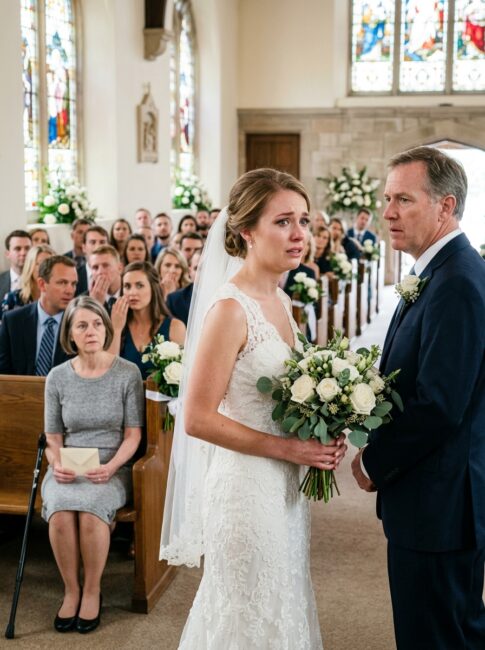
Now Marian sat at table nineteen, far from the head table, with her gray dress pressed carefully over her knees. She looked smaller than she had in the chapel. Older too. Not weak, exactly, but tired in a private way.
Lily still held the microphone.
“I mean it,” she said gently. “Marian, please.”
Richard stood halfway from his chair.
“Lily,” he said under his breath, but the microphone caught just enough of it.
The room noticed.
That was the first small twist.
The father seemed more afraid than angry.
Marian slowly reached down for the envelope she had dropped. Her fingers trembled when she picked it up, and the cream paper bent at one corner.
Lily watched her.
So did everyone else.
Marian rose carefully, using the edge of the table for balance. A man near the bar gave a quiet scoff, as if the performance had already gone on too long.
“She didn’t even stand for the bride,” someone whispered.
Marian heard it. Her eyes flicked toward the voice, then away.
She began walking toward the front with measured steps. Not dramatic. Not proud. Just slow, like each step had to be negotiated with pain.
Halfway there, Lily’s younger cousin noticed something and frowned.
“Is she limping?” she whispered.
Nobody answered.
Marian reached the microphone, but she did not take it from Lily right away. Instead, she looked at the bride’s face as if asking permission one last time.
Lily nodded.
Richard’s hand tightened around his water glass.
Marian held the microphone with both hands.
“I was not supposed to speak today,” she said.
Her voice was low and plain. No polished toast. No motherly sweetness arranged for guests.
A few people shifted uncomfortably.
“I wrote something in case I lost my nerve,” she continued, glancing at the envelope. “But Lily asked me not to read a speech.”
Lily’s eyes filled at once.
That made the room lean forward.
Marian looked down at the envelope again.
“She asked me to tell the truth.”
Richard whispered, “Marian, don’t.”
His voice carried this time.
Lily closed her eyes.
There it was, the second twist.
Whatever Marian had carried into that room, Richard already knew.
Marian did not look at him.
“When Lily was sixteen,” she said, “she stopped speaking to me for almost a year.”
A few relatives nodded faintly. They remembered that year. Lily had been angry, sharp, unreachable. Marian had become the easy explanation.
Marian continued.
“She believed I had thrown away her mother’s things.”
Lily’s aunt straightened in her chair.
“You did,” someone said softly.
Marian heard that too.
She opened the envelope and pulled out a photograph.
It was old, with faded color and a crease through the middle.
Lily covered her mouth.
Marian held it up just enough for the front tables to see.
It showed Caroline Harper in a hospital bed, thin but smiling, holding a teenage Lily’s hand. Marian was in the corner of the photo, barely visible, holding a paper cup of coffee.
“I did pack Caroline’s room,” Marian said. “But I did not throw her away.”
The room went still.
“I packed every sweater, every recipe card, every gardening book, every birthday letter, because Richard could not walk past that door without breaking down.”
Richard lowered his head.
“And Lily,” Marian said, her voice tightening, “you were sleeping in that room every night on the floor.”
Lily nodded through tears.
“I told everyone I did it because I wanted space,” Marian said. “Because letting you hate me was easier than letting you know how scared your father was.”
That was the third twist.
The woman accused of erasing a mother had been hiding a father’s collapse.
But Marian was not done.
She looked at the envelope again.
“And there was one more thing in that room.”
Richard stood fully now.
“Please,” he said.
Lily turned to him.
“Dad,” she whispered. “Let her finish.”
Marian’s hands shook harder.
“In Caroline’s nightstand, I found a letter addressed to Lily on her wedding day.”
A sound moved through the hall.
Lily froze.
Her father looked as if the floor had shifted under him.
Marian pressed the envelope against her chest.
“I have carried it for twelve years.”
For the first time all day, nobody looked away from Marian.
Not because they admired her.
Not yet.
They looked because the story they had trusted had begun to crack in public, and everyone wanted to see what was underneath.
Lily stared at the envelope in Marian’s hands.
“My mother wrote me a letter?” she asked.
Marian nodded.
“Why didn’t I know?”
The question was soft, but it entered the room like a blade.
Richard stepped forward.
“Because I asked her not to tell you.”
Another twist landed at the head table.
The relatives who had blamed Marian for years turned toward Richard, slowly and almost together.
He looked older than he had that morning.
“When Caroline died,” he said, “I could barely function. I was angry at the doctors, at the house, at God, at anyone still breathing.” He swallowed. “And when Marian found the letter, I told her Lily was too young.”
Marian looked at him then.
“You told me she would break.”
“I believed that.”
“No,” Marian said, still gentle. “You were afraid you would.”
Richard’s face crumpled, but he said nothing.
Marian turned back to Lily.
“I should have given it to you anyway.”
Lily’s tears slipped down her cheeks.
“Why didn’t you?”
Marian looked at the envelope as if it had become heavy enough to bruise her.
“Because I loved your father,” she said. “And because I was new in a house where grief already had a chair at every table. I thought love meant keeping peace.”
Her voice shook.
“I was wrong about some things.”
That sentence changed the air.
It did not excuse her. It did not polish her into a saint. It made her human enough for the room to finally listen.
Marian continued.
“When you were sixteen, you found the closet empty and believed I had erased her. Your father let you believe it. I let you believe it. I told myself you needed someone to blame.”
Lily pressed the microphone closer to Marian, though Marian already held it.
“You never defended yourself,” Lily said.
“No.”
“Not once.”
“No.”
“Even when I called you cruel?”
Marian closed her eyes.
“Especially then.”
The room seemed to hold its breath.
Marian looked out at the tables. At the cousins who had whispered. At Caroline’s sister, who had never invited her to Thanksgiving without making it feel like a test. At the neighbors who had brought casseroles after Caroline’s funeral and cold shoulders after Marian’s wedding.
“I am not your mother,” Marian said to Lily. “I never was. I never tried to be Caroline.”
Her mouth trembled.
“But I was there.”
Lily wiped her cheeks with the back of her hand.
Marian’s voice steadied, not louder, just clearer.
“I was there the night you got your first period and cried because your mother wasn’t there to tell you what to do. I stood outside the bathroom door with clean pajamas and pretended not to hear you sobbing.”
A bridesmaid lowered her head.
“I was there when you failed your driver’s test and threw the keys into the azalea bushes. I waited until you went upstairs, then found them with a flashlight.”
A small, broken laugh came from Lily.
“I was there when you mailed college applications and refused to let me check the stamps, so I followed you to the post office after work and made sure they went out.”
Lily looked up sharply.
“You did that?”
Marian smiled faintly.
“You used too little postage on two of them.”
The room softened in small places.
Marian went on.
“I was there when your prom dress ripped ten minutes before your date arrived. You thought your aunt fixed it.”
Lily’s aunt looked down at her plate.
Marian did not accuse her.
She only said, “I sewed it in the laundry room while your aunt kept you busy.”
Lily’s lips parted.
That was the fourth twist.
All those tiny rescues had belonged to the woman Lily had spent years resenting.
Marian’s hand moved to her left hip, just briefly.
Lily noticed.
The gesture carried her back to the chapel, to the strange way Marian had stayed seated when everyone stood.
“Why didn’t you stand today?” Lily asked.
The room tightened again.
Marian looked embarrassed for the first time.
Richard stepped in before she could answer.
“She had surgery six days ago.”
Every guest turned to him.
Marian’s eyes flashed.
“Richard.”
“No,” he said, voice breaking. “I am tired of letting you carry my shame because I find silence convenient.”
Lily stared at her father.
“Surgery?”
Marian lowered the microphone.
“It was minor.”
Richard shook his head.
“It was not minor. She postponed it twice to help with your wedding.”
Lily went pale.
Marian’s face folded with quiet distress.
“I wanted the day to be about you.”
Richard laughed once, painfully.
“She tore the tendon in her hip falling down our basement stairs in March. She was carrying boxes of Caroline’s things.”
Lily looked at the envelope.
Marian’s eyes filled.
“I wanted to bring you everything,” she whispered. “Not just the letter.”
The fifth twist arrived without music, without drama, without anyone standing.
Marian had been sitting in the back not from coldness, but because pain had made standing nearly impossible.
And still she had hidden it, because she believed her presence already took up too much room.
Lily put one hand over her mouth.
“Why were you in the basement?”
Marian looked down.
“Your father could not go through the boxes.”
Richard’s shoulders shook.
“I kept saying I would,” he said. “Year after year. Marian finally told me you were getting married, and Caroline should not be trapped in cardboard while her daughter walked down the aisle.”
Lily’s aunt began crying silently now.
Marian opened the envelope.
“I asked Lily last week if she wanted me to speak because I planned to give this to her privately.” She glanced at Lily. “But she said secrets had done enough damage in our family.”
Lily nodded.
Marian removed the letter.
The paper was thin and slightly yellowed, folded with care that had survived twelve years.
“I won’t read all of it,” Marian said. “It belongs to Lily.”
She looked at the first lines and took a breath.
“Caroline wrote, ‘My sweet girl, if you are reading this in a white dress, I hope someone remembered to tell you that love is not proven by being perfect. It is proven by staying gentle when life gives you reasons not to be.’”
Lily bent forward as if the words had touched her physically.
Marian swallowed and read one more part.
“‘If your father remarries, do not think I have been replaced. No woman who loves you kindly is stealing from me. She is helping me reach you from farther away.’”
A sob rose from somewhere in the hall.
Maybe from Lily.
Maybe from Caroline’s sister.
Maybe from half the room at once.
Marian folded the letter and held it out.
Lily did not take it immediately.
Instead, she looked at Marian’s hands.
The knuckles were swollen. The fingers were rough from work, from dishes, from sewing, from carrying boxes no one else could face.
Then Lily stepped forward and took both the letter and Marian’s hand.
“I hated you for so long,” Lily whispered.
“I know.”
“I thought you wanted her gone.”
“I know.”
“You let me think that.”
Marian’s tears finally fell.
“I did.”
Lily’s voice broke.
“Why would you let a child hate you?”
Marian looked at her, and her answer was not grand enough for a movie.
It was smaller.
That made it worse.
“Because you were still talking to me,” she said. “Angry words meant you were still in the room.”
Lily closed her eyes.
The bride in lace and the stepmother in gray stood under the soft vineyard light, surrounded by people who had spent years choosing the easier story.
Then Lily reached out and wrapped her arms around Marian.
Carefully.
Gently.
Mindful of the hip everyone had ignored.
Marian stiffened at first, as if love arriving late still felt like impact. Then she folded into the hug with a sound that barely escaped her throat.
Across the room, Richard sat down and wept into both hands.
The reception changed after that.
Not loudly.
No one made a speech about forgiveness. No one asked for a group photo to prove the family had healed in one afternoon. The band played softly, and the servers moved between the tables with plates of chicken and roasted vegetables.
But people were different in small ways.
Lily’s aunt came to Marian’s table and stood there for nearly a minute before speaking.
“I was cruel,” she said.
Marian looked up, tired and pale.
“You were grieving.”
“That doesn’t make it clean.”
“No,” Marian said. “It doesn’t.”
The aunt nodded, accepting the mercy without being excused by it. Then she pulled out the chair beside Marian and sat down.
Later, during the father-daughter dance, Richard held Lily as the first notes began. He cried before she did.
“I failed you,” he whispered.
Lily rested her forehead against his shoulder.
“You were broken.”
“That isn’t the same as innocent.”
She did not answer.
He deserved the silence, and she let him have it.
Across the room, Marian watched from her chair. Her cane rested against the table leg, where she had hidden it beneath the linen most of the day. Lily saw it then, the plain black cane with a silver scratch along the handle.
Another thing Marian had tried to keep invisible.
Halfway through the song, Lily stepped back from her father.
Guests thought she was tired.
Instead, she crossed the floor toward Marian.
The band kept playing.
Marian’s eyes widened.
“No, sweetheart,” she whispered. “You don’t have to.”
Lily held out her hand.
“I know.”
Marian looked around the room, embarrassed by the attention.
“My hip won’t let me dance.”
“Then we won’t dance much.”
There was a long pause.
Then Marian took Lily’s hand.
The groom, Daniel, quietly pulled a chair to the edge of the dance floor. Lily helped Marian stand just enough to move with her, not in circles, not gracefully, not for photographs. They swayed near the chair while Richard watched with one hand over his mouth.
Caroline’s letter rested on Lily’s sweetheart table, beside her bouquet.
For the rest of the evening, people approached Marian differently. Not as the woman who had sat in the back. Not as the second wife. Not as the convenient villain in a story that had needed one.
They came softly.
They said her name.
When the reception ended, the roses were beginning to droop from the heat of the long day. Guests drifted toward the parking lot under a lavender sky, carrying slices of cake in little white boxes.
Marian waited near the entrance while Richard brought the car around.
Lily found her there, holding the cream envelope against her chest.
“You almost left before I asked you to speak,” Lily said.
Marian smiled faintly.
“I thought it might be kinder.”
“To who?”
Marian looked toward the vineyard, where the last light was caught between the rows.
“I’m still learning that.”
Lily reached for the envelope.
Marian handed it over, but her fingers lingered for one second on the paper.
“I used to be afraid that if I loved you out loud, it would sound like I was asking you to love me back,” Marian said.
Lily folded the letter carefully into her small bridal purse.
“And now?”
Marian’s eyes shone.
“Now I think love gets tired of hiding.”
Lily stepped closer and kissed her cheek.
It was not dramatic. It was not enough to erase twelve years. It was only a bride, at the end of her wedding night, touching her stepmother’s face as if finally seeing the woman who had been there all along.
Richard pulled up to the curb.
Before Marian got into the car, Lily stopped her.
“Mom would have liked you,” she said.
Marian looked startled.
Then she looked down, and the tears returned before she could stop them.
“She was very easy to love from a distance,” Marian whispered.
Lily smiled.
“So were you.”
The next morning, after the guests had gone home and the vineyard staff swept rose petals from the floor, Lily opened Caroline’s letter again. A small photo slipped out from between the pages.
It showed Caroline in the hospital bed, smiling weakly, with Marian in the corner holding coffee.
On the back, in Caroline’s handwriting, were six words Lily had never seen before.
“Thank you for staying when I can’t.”
Lily sat beside her new husband in the quiet hotel room and held that photo until the morning light reached the floor.
Then she took out her phone, found Marian’s contact, and changed the name from “Marian” to “Marian Wells — Home.”
Follow the page for more emotional stories about the quiet people we almost misunderstand.