Part 2: The Bride Stopped the Ring Ceremony — Her Confession Before Both Families Left the Hall Silent
For several seconds, nobody moved toward the ring.
It lay on the runner between Emma and Noah, bright and impossible, as if the smallest object in the room had suddenly become the heaviest.
Diane Bennett, Noah’s mother, gripped the pearls at her throat.
“This is humiliating,” she whispered, though not quietly enough.
Emma heard her.
So did the woman at the back.
The woman lowered her eyes, and in that small motion, Emma saw the old habit. The quiet retreat. The way some people learn to make themselves smaller when judgment enters a room.
“Noah,” Emma said, “her name is Grace Miller.”
Noah looked over his shoulder.
Grace stood near the open doors, pale under the afternoon light. She appeared to be in her early fifties, with tired blue eyes, a narrow face, and the careful posture of a woman used to being invisible in expensive rooms.
Noah frowned.
“I don’t know her.”
“I know,” Emma said.
That answer made the hall tighten.
Emma’s father, Robert Caldwell, stepped into the aisle.
“Put the microphone down,” he said. “Whatever this is, it can wait.”
Emma finally looked at him.
“No, Dad. That’s what you said last time.”
A ripple passed through the guests.
That was the first small twist.
This was not a bride’s sudden panic. This had roots.
Robert’s face hardened.
Noah reached down and picked up the ring, but he did not move toward Emma again. He held it in his palm, studying her as if she had become someone he loved and did not recognize.
“Emma,” he said carefully, “what happened?”
She looked at his hand around the ring.
“Six years ago,” she said, “I was driving home from my mother’s memorial dinner.”
Her mother’s name moved silently through the Caldwell side of the hall. Margaret Caldwell had been loved in the public way some women are loved after death. Graceful photographs. Garden club scholarships. A bench outside the library.
Emma swallowed.
“I was twenty-two. I had barely slept in days. I was angry at everyone who was still breathing.”
Robert closed his eyes.
Emma continued, her voice thin but steady.
“It was raining. I took Oak Hollow Road too fast.”
Grace’s fingers tightened around the strap of her purse.
A bridesmaid covered her mouth.
Emma looked at Grace, then away.
“I hit someone.”
The room seemed to tilt.
Noah’s face changed first. Not anger. Not yet. Shock moving into fear.
“You what?” he asked.
“I hit someone with my car.”
The pastor lowered his head.
Emma’s cousin whispered, “Was anyone killed?”
Emma heard that too.
“No,” she said quickly. “No one died.”
Several people breathed again.
Then Emma added, “But that does not mean no one paid for it.”
Grace stepped backward, but the doors stopped her.
Emma’s voice wavered.
“I hit Grace Miller.”
Noah looked from Emma to Grace, his confusion deepening.
“But why would anyone blame her?”
Emma did not answer at once.
Instead, she looked at the front row, where her father stood very still.
Robert had built his life on being respected. He owned three car dealerships, sponsored Little League teams, and shook hands with men who never questioned his version of events.
That afternoon, his daughter was about to do what no one in the Caldwell family had ever done in public.
She was going to make him small.
“The police report said Grace walked into the road,” Emma said.
Grace’s mouth trembled.
Emma shook her head.
“She didn’t.”
The second twist landed slowly.
One table at the back murmured. Diane’s hand dropped from her necklace. Noah’s fingers closed around the ring until his knuckles whitened.
Emma went on.
“She was crossing at the marked walk near St. Luke’s, carrying grocery bags and an umbrella. I saw her too late. I hit the brakes too late.”
Robert’s voice cut through the hall.
“That is not what you said that night.”
Emma turned toward him.
“No,” she said. “It isn’t.”
A bitter quiet followed.
Emma looked at Noah.
“I lied.”
Noah’s lips parted, but no words came.
“I told my father she came out of nowhere. I said I had no time. He called our lawyer before the ambulance left.”
Grace flinched at the word ambulance.
It was such a small reaction that most people almost missed it.
Emma did not.
She saw Grace’s left hand move toward her right knee, the way it had outside the courthouse years ago. The same knee that had never healed right.
“Grace had two broken ribs,” Emma said. “A fractured knee. A concussion. She missed work. Then she lost her job.”
Grace shook her head once, a quiet plea.
Emma understood the plea.
Please do not make me the center of this room.
But Emma had hidden behind Grace’s silence for too long.
“My father’s lawyer found out Grace had once been treated for alcohol addiction,” Emma said. “Years before the accident. Years sober by then.”
A few guests shifted uncomfortably.
“They used it anyway.”
The third twist came like a cold draft.
Grace had not been the reckless stranger.
She had been the convenient one.
Emma’s eyes filled.
“They made her look unstable. They made me look grieving and innocent. And I let them.”
Noah looked down at the ring in his hand.
Then he looked back up.
“Did you ever tell me this?”
Emma shook her head.
“No.”
“Why?”
Her breath caught.
“Because I was afraid you would stop seeing me as good.”
Noah’s mother whispered, “Maybe he should.”
Emma nodded as if accepting the wound.
“Maybe he should.”
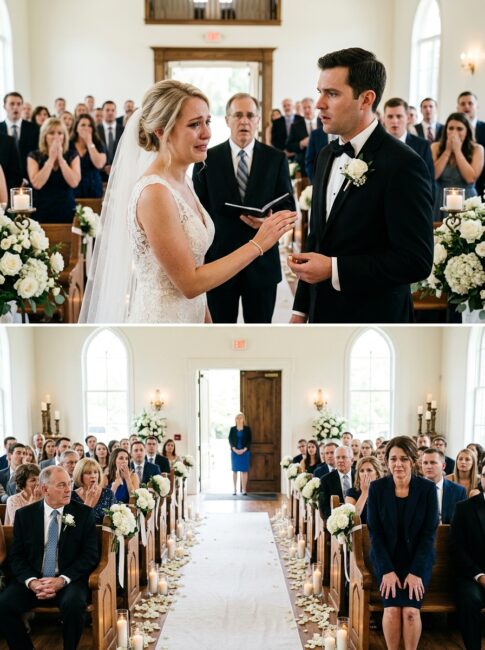
The hall did not erupt.
That would have been easier.
Instead, everyone stayed seated in a silence thick with discomfort, because Emma had not confessed something distant or vague. She had named the shape of a wrong, and wrongs become harder to ignore when they have a face.
Grace Miller stood with that face lowered near the doors.
Noah stepped away from the altar and walked toward her.
Emma watched him go and felt something inside her loosen, painfully.
He stopped a few feet from Grace.
“Mrs. Miller,” he said, “I’m sorry.”
Grace looked startled.
“You didn’t do anything to me.”
“No,” Noah said. “But I was standing up there ready to marry a story I did not fully know.”
Emma closed her eyes.
That hurt more than anger.
Robert moved toward his daughter.
“This is enough,” he said under his breath. “You are destroying your life.”
Emma turned to him.
“No, Dad. I destroyed part of hers. Today I am only telling the truth about it.”
His jaw clenched.
“I protected you.”
“You protected our name.”
The fourth twist unfolded in his face.
Because it was true, and everyone could see he knew it.
Robert looked toward the Caldwell relatives, the business partners, the old friends sitting among roses and candlelight. For the first time, he seemed afraid of the room he had always controlled.
Emma lifted the microphone again.
“I did not bring Grace here to make her forgive me,” she said. “I asked her to come because I wanted to stop hiding behind a clean dress and a pretty aisle.”
Grace shook her head.
“You asked,” she said softly. “I almost didn’t come.”
Her voice, small as it was, carried.
Emma looked at her.
“I know.”
Grace stepped forward slowly.
A limp became visible with each step.
Some guests lowered their eyes, not from boredom, but from shame. They had stared at her when she arrived late, assuming she was an outsider who had wandered into the wrong place.
She had not wandered anywhere.
She had walked into the room that had once erased her.
Grace reached the front of the hall but did not take the microphone. Instead, she looked at Noah.
“She came to my apartment three months ago,” Grace said.
Emma’s bridesmaids turned toward her.
Noah listened without moving.
Grace continued.
“She stood in the hallway for ten minutes before knocking. I saw her through the peephole. She looked like she might run.”
A faint, sad smile touched Grace’s mouth.
“When I opened the door, she had a folder in her hands. Police records. Insurance letters. Court papers. A cashier’s check.”
Robert’s head snapped up.
Emma did not look at him.
Grace did.
“I didn’t take the check,” she said.
The hall shifted.
That was the fifth twist.
This was not a public apology bought with money.
Grace’s eyes moved back to Emma.
“She said she wanted to pay me back. I told her I did not want her money if it was only there to make her sleep better.”
Emma wiped her cheek with her thumb.
“She was right.”
Grace looked toward the guests.
“I spent years thinking she never cared. Then she came back with every document her father’s lawyer had buried. She had already reopened the civil case against herself.”
A gasp rose from the Caldwell side.
Robert’s face went dark.
“You did what?”
Emma faced him.
“I signed a sworn statement last week.”
Diane Bennett sat down hard, just as the old women in the front row began whispering prayers under their breath.
Noah stared at Emma.
“You were going to tell me after the wedding?”
“No,” Emma said. “I was going to tell you before. I tried at the rehearsal dinner, but your father toasted our ‘perfect future,’ and I lost my nerve.”
Noah winced.
Emma’s voice broke.
“Then I stood here and saw that ring, and all I could think was that a vow built on a lie is still a lie, even if everyone claps for it.”
The pastor looked at the open Bible in his hands.
No one asked him to continue.
Grace finally reached for the microphone.
Emma handed it to her.
Grace held it awkwardly, as if it belonged to someone important.
“I don’t want revenge,” she said.
Her voice trembled, but it did not collapse.
“I wanted my name back.”
Those six words stilled the room.
Grace swallowed.
“After the accident, people in town looked at me like I had done something dirty. My landlord asked questions. My boss said customers were uncomfortable. Some old friends stopped calling because it was easier to believe the newspaper than a woman who cleaned offices at night.”
Emma looked down.
Grace continued.
“I was angry for a long time. Then I was tired for longer.”
She looked at Emma.
“When she came to my apartment, I did not forgive her. I made coffee because I did not know what else to do with my hands.”
A few people laughed softly through tears.
Grace’s eyes glistened.
“She cried so hard she could barely speak. Not the pretty kind of crying people do when they want to be comforted. The ugly kind, when the truth finally catches up.”
Emma pressed her hands together at her waist.
“Then she asked me what I wanted.”
Grace looked around the hall.
“I told her I wanted the record corrected. I wanted the clinic bill collectors to stop finding me. I wanted my niece to stop thinking I had been drunk in the street.”
Grace’s mouth trembled.
“And I wanted one person in the Caldwell family to say my name without shame.”
Emma took the microphone back, but she did not speak to the guests first.
She turned to Noah.
“I love you,” she said. “But I cannot ask you to marry me today unless you know this part of me. I cannot put your ring on and pretend I only became honest after being chosen.”
Noah stood very still.
The ring rested in his palm.
Emma looked at Grace.
“Grace Miller was sober. Grace Miller was careful. Grace Miller was crossing where she was supposed to cross. I hit her. I lied. My family helped me hide it.”
Robert’s face collapsed, but Emma did not stop.
“And Grace Miller deserved a courtroom that did not treat her bank account like evidence against her.”
The words hit harder than anger.
They were plain.
They were clean.
They left nowhere to hide.
Noah looked at his mother.
Diane had been watching Emma with a face full of judgment. But now her eyes had gone to Grace’s shoes, practical black flats worn at the edges, and the limp she had tried to disguise.
Diane looked away.
Noah walked back to Emma.
For a second, everyone thought he would place the ring on her finger after all. The photographer lifted his camera. The bridesmaids held their breath.
Instead, Noah placed the ring in Emma’s open palm.
Not on her finger.
In her hand.
“This belongs to the truth first,” he said.
Emma cried then, quietly.
Noah looked at Grace.
“Mrs. Miller, would you stay for the reception?”
Grace gave a startled laugh.
“I wasn’t invited.”
Noah turned to the room.
“She is now.”
The hall remained silent, but something changed.
A chair scraped.
Then another.
At the front row, Emma’s grandmother stood with effort and turned toward Grace.
“I have heard your name for years,” she said, voice shaking. “I am ashamed of how I heard it.”
Grace’s face folded.
Noah looked back at Emma.
“I don’t know what happens next,” he said.
Emma nodded.
“I know.”
“But I know I would rather begin with the truth hurting than with a lie smiling.”
He reached for her hand.
Not to finish the ceremony.
Not yet.
Just to hold it while everyone watched the woman they had judged stand beside the woman who had wronged her.
The wedding did not continue the way programs said it would.
The pastor closed his book.
The string quartet stopped checking the schedule. The caterers stood quietly near the side doors, unsure whether to bring out trays of crab cakes or wait for someone to decide what kind of day this had become.
Noah and Emma stepped down from the altar together, but no one announced them husband and wife.
That mattered.
It made the room ache.
At the reception, the head table was rearranged without anyone saying who ordered it. One empty chair appeared beside Emma’s grandmother. Grace tried to refuse it, but the older woman patted the seat.
“Please,” she said. “I have spent enough years being late.”
Grace sat.
Emma did not sit beside Noah. She sat across from Grace, her veil removed, her hair slightly loosened from its pins. She looked less like a bride now and more like a woman who had finally stepped out of a photograph.
Robert left before dinner.
No dramatic goodbye. No slammed door. Just a man folding his napkin, standing from a table that had gone quiet around him, and walking into the afternoon light with his suit jacket over one arm.
Emma watched him go.
Noah did too.
“He may not forgive me,” Emma said.
Noah answered softly, “That is not the first thing you need from him.”
Across the table, Grace heard it but pretended she had not.
Dinner was served slowly. People spoke in lower voices. Some guests avoided Grace’s eyes. Others came over awkwardly, offering apologies too late and too small.
Grace accepted some.
She refused others by simply saying, “Not today.”
No one argued with her.
Near sunset, Emma found Grace outside on the terrace overlooking the garden. The wedding flowers glowed white in the fading light, and the gold chairs inside the hall had begun to look less festive and more like witnesses.
Grace stood with one hand on the stone railing, resting her knee.
Emma stopped a few feet away.
“I’m sorry they keep coming up to you,” she said.
Grace looked at the garden.
“I wanted my name back. I suppose names attract voices.”
Emma folded her hands.
“I don’t know how to fix this.”
Grace turned to her.
“You don’t fix a scar by staring at it hard enough.”
Emma nodded, tears gathering again.
Grace’s voice softened.
“But you can stop pretending it isn’t there.”
They stood together without touching.
Inside, Noah was speaking with the pastor. Not about canceling. Not about pretending. About waiting.
A month, maybe two.
Enough time for the legal statement to be filed. Enough time for Emma to tell the truth without a bouquet in her hands. Enough time for Noah to decide freely.
Emma looked at Grace.
“Why did you come today?”
Grace’s answer took a while.
“Because when you came to my apartment, you did not ask me to save you.”
Emma looked down.
Grace continued.
“You asked me to let you stop being saved by a lie. That is different.”
The garden lights flickered on.
Emma reached into the small pocket sewn inside her dress and pulled out a folded page.
“I wrote vows,” she said. “They don’t fit anymore.”
Grace looked at the paper.
“Maybe they finally do.”
Emma unfolded the page, then stopped.
The first line was sweet. The second was polished. The third sounded like someone trying to be admired.
She folded it again.
Then she tore it once, clean down the middle.
Grace watched without speaking.
Emma did not throw the pieces away. She held them gently, as if even false beginnings deserved to be handled with care.
Later, as guests began leaving, Noah found Emma in the hall where the ring had fallen.
The white runner was still there. One petal remained near the place where everything stopped.
Noah held the wedding band between two fingers.
Emma’s breath caught.
“I’m not putting it on today,” he said.
“I know.”
“But I don’t want to take it home without you knowing something.”
She looked at him.
He placed the ring in a small velvet box and closed it.
“I still love you,” he said. “I just want to meet the honest version slowly.”
Emma pressed a hand to her mouth.
Noah touched her shoulder, then walked toward the doors where Grace waited for a rideshare under the portico.
Emma followed.
Grace turned when she heard them.
For a moment, all three stood beneath the soft entrance lights: the groom with a ring he had not used, the bride with vows she had torn, and the woman whose name had finally been spoken correctly.
Grace reached into her purse and pulled out a small paper receipt.
Emma frowned.
“What is that?”
“My cab fare from the courthouse six years ago,” Grace said.
Emma stared at it.
Grace smiled sadly.
“I kept it because that was the day I thought nobody would ever believe me.”
She placed it in Emma’s hand.
“Keep it until you don’t need reminders.”
Emma held the faded receipt like something sacred.
Then Grace stepped into the waiting car.
Before the door closed, Emma bent toward the window.
“Grace?”
The older woman looked up.
Emma’s voice shook.
“Thank you for coming.”
Grace rested her hand on the open window.
“Thank you for stopping.”
The car pulled away into the evening.
Behind Emma, Rosewood Hall glowed with leftover flowers, half-cleared tables, and a wedding that had not ended as planned.
Noah came to stand beside her.
Neither of them spoke.
Emma opened her hand and looked at the receipt, the ink faded but still readable. Then she looked at the empty ring finger that had frightened everyone into silence.
For the first time all day, it did not feel empty.
It felt waiting.
Follow the page for more emotional stories about truth, kindness, and the people we almost judge too soon.