Part 2: The Girl Who Ate Lunch Alone All Year — What Her Classmates Did on the Last Day Made Her Cry
At first, nobody understood what Noah had placed on the table.
It was not a trophy, not a gift bag, not a yearbook.
It was a lunchbox.
Small, blue, scratched around the corners, with a faded yellow star sticker on the lid. The zipper pull had been replaced by a red string, tied carefully into three knots.
Maya stared at it as if someone had opened a door she had spent all year trying to keep closed.
Her hands went behind her back.
That was what Mrs. Palmer noticed first.
Not the tears.
Not the silence.
The hands.
All year long, Maya had hidden them whenever attention turned toward her. She tucked them into sweatshirt sleeves, pressed them under the cafeteria table, or folded them so tightly her knuckles went pale.
Now they trembled behind her back.
Noah looked at the lunchbox, then at Maya.
“You left this in Room 214,” he said.
Maya whispered, “That’s not mine.”
But her voice sounded too small to be believed.
A few students exchanged glances. The kind of glances children use when something they thought was simple begins to feel complicated.
Principal Hargrove entered from the hallway, drawn by the strange quiet. He was a tall man with silver hair, a warm voice, and the tired walk of someone who had spent the week signing report cards and calming parents.
“What’s going on here?” he asked.
Nobody answered.
Maya took one step backward.
Her heel touched the trash can.
Behind her, inside it, sat the brown paper bag she had just thrown away.
Mrs. Palmer moved slowly toward it.
“Maya,” she said softly, “may I?”
The girl shook her head.
But it was too late. A lunch aide had already noticed something odd about the bag. It had not fallen open like most lunch bags did. It had been folded at the top, tight and careful, with one corner marked by a tiny pencil line.
Mrs. Palmer lifted it out.
The whole cafeteria watched her open it.
Inside were two orange slices, half a peanut butter sandwich, a small bag of pretzels, and a folded napkin.
Nothing unusual.
Nothing that explained a year of loneliness.
Then Mrs. Palmer saw the writing on the napkin.
She did not read it out loud.
Her face changed first.
That was the second small thing.
The teacher who never lost her classroom smile suddenly looked like she had swallowed a stone.
Principal Hargrove stepped closer and glanced down.
His expression changed too.
Maya looked at the floor.
Noah said, “There are more.”
Maya’s head lifted sharply.
He reached into his backpack and pulled out a stack of napkins, all folded the same way. Some were white. Some were brown. Some had tiny flowers printed along the edges.
The students murmured.
A girl named Brianna, who had once told her friends Maya acted “too mysterious,” covered her mouth.
Noah placed the napkins beside the blue lunchbox.
“She wrote one almost every day,” he said.
Maya’s voice broke. “You weren’t supposed to keep them.”
Noah looked down. “I know.”
The room tightened around that sentence.
Mrs. Palmer opened the top napkin.
This time, she read only the first line.
“Eat something today. You have math before gym.”
The cafeteria stayed silent.
Another napkin said, “The nurse has granola bars if your stomach hurts.”
Another said, “Don’t forget your inhaler.”
Another said, “If they laugh, pretend you dropped your pencil and breathe first.”
Noah’s face had gone red.
“They were for me,” he said.
Maya shut her eyes.
Principal Hargrove looked from Noah to Maya, then back again.
All year, the school had seen one story.
A girl sitting alone.
A girl refusing kindness.
A girl throwing away food like it meant nothing.
But now there was a second story on the table, written in pencil across cheap cafeteria napkins.
“Why?” Mrs. Palmer asked, though her voice made clear she already feared the answer.
Noah looked toward a table near the windows.
At that table sat three boys from his old reading group. Their faces changed at once.
That was the third small thing.
They stopped looking curious.
They looked caught.
Maya saw it too.
And for the first time that year, she looked angry.
Not loud angry.
Not dramatic angry.
The quiet kind that arrives after a child has been asked to carry too much.
“They took his lunch,” she said.
The words were barely louder than breath.
Noah stared at his shoes.
Maya continued, still not looking at anyone. “Not every day. Just enough so he stopped knowing when it would happen.”
The three boys shifted in their seats.
The cafeteria remained motionless.
Mrs. Palmer looked down at the unopened sandwich in Maya’s bag.
Then she understood part of it.
Only part.
Maya had not been throwing away her lunch because she hated it.
She had been making sure everyone thought she had one to waste.
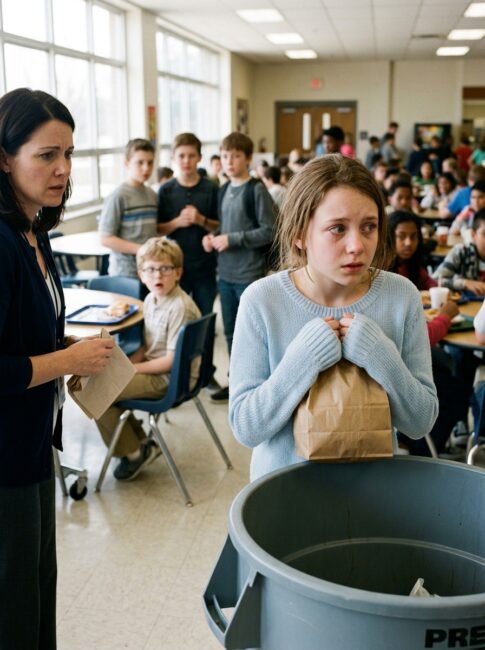
The truth did not come all at once.
It came in pieces, the way children reveal pain when they are still trying to protect someone from it.
Noah Reed had transferred to Cedar Hollow in October, two months after the school year began. He was small for twelve, with pale skin, sandy hair, thick glasses, and a habit of apologizing when someone else bumped into him.
His father was deployed overseas. His mother worked nights at the county nursing home. Most mornings, Noah packed his own lunch in the blue lunchbox with the yellow star sticker.
At first, Maya noticed him because he sat only two tables away.
She noticed his careful routine.
He would unzip the lunchbox, check inside, then place one item on his tray at a time. Sandwich. Fruit. Crackers. Napkin. Water bottle.
Then, one Tuesday, three boys walked past and knocked his lunchbox to the floor.
The sandwich came apart.
The orange rolled under the table.
The boys laughed and told him it was an accident.
Noah said nothing.
Neither did anyone else.
Maya had been sitting alone by the broken clock, watching over the top of her library book.
The next day, she saw one of the same boys reach into Noah’s lunchbox while he was turned away.
Not enough to make a scene.
Just enough to take his crackers.
The next week, they took his fruit.
Another day, they hid the whole lunchbox behind the trash can and watched him search for it until the bell rang.
Noah never reported them.
Children like Noah often learn early that asking for help can make the trouble louder.
Maya knew that too.
Not because she was rude.
Not because she thought she was better than anyone.
Because the year before, at her old school, she had been the girl people laughed at.
Her mother had died when Maya was nine. After that, her father worked two jobs, and her grandmother moved in with a walker, a pill organizer, and a heart that was stronger than her legs.
Money became a quiet thing in the Bennett house.
Nobody said they were poor.
They said things like “next week,” and “after payday,” and “we can make that stretch.”
Maya’s lunches were often plain. Peanut butter sandwiches. Store-brand crackers. Apples with bruises cut away. Once, a girl at her old school took a picture of her lunch and posted it in a group chat.
By the next day, half the grade had seen it.
After that, Maya learned to eat quickly, alone, and without giving anyone a reason to look.
When she came to Cedar Hollow, she chose the back table because nobody wanted it. The broken clock above it always read 11:18, as if time had given up there.
It felt safe.
Then Noah arrived.
At first, Maya did not speak to him. She only watched.
When she saw him skip lunch after the boys hid his food, she walked to the nurse and asked for a granola bar. She said she had a stomachache and wanted to save it for later.
Then she slipped it into Noah’s backpack while he was at recess.
The next day, she wrote the first napkin note.
Eat something today.
She left it inside his blue lunchbox when nobody was looking.
Noah found it after his sandwich went missing.
He looked around the cafeteria, confused and embarrassed, but Maya stared down at her book. She did not want thanks. Thanks meant attention. Attention meant questions. Questions meant people looking too closely at both of them.
So she kept doing it.
Whenever Noah’s food disappeared, Maya gave him part of hers. Sometimes the orange slices. Sometimes the pretzels. Sometimes the better half of the sandwich, the half with more peanut butter near the crust.
Then she would wrap the rest back up and throw it away before anyone could see what was missing.
That was why people thought she wasted food.
That was why she never joined another table.
If she sat with other girls, she could not watch Noah’s lunchbox.
If she laughed too loudly, she might miss the moment one of the boys reached across his tray.
If she told a teacher, Noah might become the boy who told.
And Maya remembered too clearly what happened when a lonely child became a story.
The fourth twist came from Mrs. Della, the lunch aide.
She was a Black woman in her sixties with silver braids, soft eyes, and the sharp memory of someone who noticed every child who tried not to be noticed.
“I wondered,” she said quietly.
Everyone turned to her.
She stood near the milk cooler with a towel in her hands.
“I saw Maya buy milk twice a week with coins,” Mrs. Della said. “But she never drank it.”
Maya looked away.
Mrs. Della’s voice softened. “She left it beside Noah’s tray when he went to dump his trash.”
Noah wiped his eyes with his sleeve.
“She told me it wasn’t her,” he whispered. “Every time.”
Principal Hargrove looked as if he had aged ten years since entering the room.
He turned toward the three boys near the windows.
Their names were Carter, Miles, and Jordan. They were not monsters. That almost made it harder. They were ordinary boys with summer haircuts, basketball shoes, and parents waiting for report cards in sealed envelopes.
Carter’s mother stood near the back of the cafeteria. Her face was white.
“Carter,” she said.
The boy did not answer.
Miles stared at the table.
Jordan began to cry before anyone spoke to him.
Mrs. Palmer did not shout. Principal Hargrove did not drag anyone into the hallway. No adult turned the moment into theater.
But the silence did something worse.
It made everyone sit inside what they had allowed.
Then Noah reached into his backpack again.
“There’s one more thing,” he said.
Maya’s eyes widened. “Noah, don’t.”
But he had already pulled out a small envelope, bent at the corners and covered in pencil fingerprints.
“This is what we were going to give her today,” he said.
“We?” Mrs. Palmer asked.
Noah looked around the cafeteria.
One by one, students stood up.
Brianna stood first.
Then a girl from choir.
Then two boys from science class.
Then half of Mrs. Palmer’s homeroom.
They had known something. Not the whole story, but enough. Some had seen Maya leave food. Some had seen Noah open his lunchbox and find notes. Some had seen the three boys bothering him.
At first, they had done nothing.
That was the truth sitting between them.
But over the last month, Noah had started saving the napkins in his binder. Brianna had found one when his papers spilled in class. She had read it before he could stop her.
Instead of laughing, she had gone quiet.
Then she told two others.
Then they began watching too.
Slowly, shame turned into a plan.
The envelope passed from hand to hand around the cafeteria. Inside were folded notes from students who had never sat with Maya but had finally seen her.
Thank you for noticing when we didn’t.
I’m sorry I called you weird.
I thought you were mean because you were quiet.
You gave away your lunch and let us think the worst.
There were grocery store gift cards too, bought with crumpled dollars from allowance jars, babysitting money, and coins collected from desk drawers.
Maya stared at the envelope like it was too heavy to hold.
“I don’t want charity,” she said.
Her voice was sharp, but her eyes were full.
Noah stepped closer.
“It isn’t charity,” he said. “It’s lunch.”
That was when Maya broke.
Not loudly.
She folded in on herself, one hand over her mouth, tears slipping down her face as if they had been waiting all year for permission.
Mrs. Palmer moved toward her, but stopped when Noah reached first.
He did not hug her.
He simply placed the blue lunchbox in front of her and said, “You forgot something.”
Maya looked at the scratched lid, the red string, the yellow star.
Then Noah opened it.
Inside was not his lunch.
Inside were all of Maya’s napkins, smoothed flat and tied together with a ribbon.
A year of quiet kindness.
A year of being misunderstood.
A year of a lonely table that had never truly been empty.
The last lunch period of the school year did not end the way anyone expected.
Nobody rushed outside when the bell rang.
Nobody shouted about summer.
For several minutes, the cafeteria remained still, as if the whole room understood that some moments should not be stepped over too quickly.
Principal Hargrove finally asked Carter, Miles, and Jordan to come with him. Their parents followed.
There would be consequences, but that was not what stayed in people’s minds.
What stayed was the table beneath the broken clock.
Brianna picked up her tray and walked toward it first.
She did not ask if the seat was taken. She did not make a speech.
She simply sat down across from Maya.
Then Noah sat beside her.
Then two more students came.
Then four.
Soon the lonely table was crowded with trays, lunch bags, yearbooks, milk cartons, and children trying carefully to become better than they had been that morning.
Maya sat very still at the center of it.
Her face was blotchy from crying. Her hands still trembled a little. But when Noah pushed half his cookie toward her, she did not refuse.
She broke it in two and gave half back.
Mrs. Della watched from near the serving line, wiping the same clean counter three times.
Mrs. Palmer stood beside her.
“I should have noticed sooner,” the teacher said.
Mrs. Della looked at the broken clock.
“We all notice some things too late,” she replied.
That afternoon, as buses lined the curb and children poured through the doors, Maya stayed behind for a moment.
She walked back into the cafeteria alone.
The tables had been wiped clean. The trash cans had been emptied. The room smelled faintly of lemon cleaner and warm bread.
Only one thing remained on the back table.
The blue lunchbox.
Noah had left it there for her.
Maya touched the yellow star sticker with one finger.
Then she opened the lunchbox and found one final napkin inside.
This time, the handwriting was not hers.
It was Noah’s.
You don’t have to sit alone next year.
Maya read it twice.
Outside, her father’s old pickup waited by the curb. He had taken an early break from work to pick her up on the last day, the way her mother used to do before she got sick.
When Maya climbed in, he noticed her red eyes.
“What happened?” he asked.
She held the lunchbox in her lap.
For a moment, she looked like the little girl he remembered from before grief made her careful.
Then she said, “I think I made some friends.”
Her father did not ask too many questions.
He only reached over and squeezed her shoulder while the buses pulled away in slow yellow lines.
The next fall, the broken clock was finally replaced.
But the table beneath it stayed different.
Kids still called it the back table.
Teachers still walked past it every day.
Yet whenever someone new came into the cafeteria carrying a tray with both hands, unsure where to belong, someone at that table always looked up.
Someone always made room.
And years later, when Maya found the blue lunchbox in a box of old school things, the red string still tied to the zipper, she opened it and saw the stack of napkins tied with ribbon.
She did not remember every word.
But she remembered the sound of trays being set down around her.
She remembered Noah’s shaking voice.
She remembered the strange, warm feeling of being seen after spending so long trying not to be.
And she remembered one simple note, written by a boy who had once been hungry and quiet.
You don’t have to sit alone next year.
Follow this page for more heartfelt stories about the quiet kindness people carry when no one is watching.