Part 2: He Cried Cutting Her Hair — But Not Because She Was Leaving
I grew up behind the sound of a Harley.
Some kids remember lullabies. I remember exhaust cooling in the garage after midnight, that soft ticking sound like metal whispering to itself. I remember the smell of gasoline, leather, coffee, and my father’s work shirts. I remember falling asleep on a couch while men with beards and cuts sat around our kitchen table, speaking low, laughing hard, going silent whenever I wandered in with a blanket dragging behind me.
They scared everyone else.
They were my uncles.
There was Preacher, who had no religion but somehow always knew what to say at funerals. Moose, who looked like he could pull a truck out of a ditch and once spent four hours helping me build a cardboard castle for school. Red, who had burn scars on his neck and carried butterscotch candies in his vest pocket. And my father, Hammer, president of the Cedar Saints Motorcycle Club.
People thought that meant trouble.
Sometimes, maybe it had.
Dad never pretended he was clean all the way through. He had done eighteen months in prison before I was born for putting a man in the hospital outside a bar in Murfreesboro. He had scars from fights he refused to explain. He had friends who vanished, friends who got sober, friends who did neither.
But by the time I knew him, his violence had gone quiet.
Not gone.
Just caged.
He used his size for groceries, busted pipes, broken-down cars, and walking frightened women to their trucks after closing shifts. He used his voice rarely, which made it land harder when he spoke.
When I was seven, a man at a gas station yelled at a cashier until she shook. Dad stepped between them, not touching him, not raising his hand.
“Buy your smokes or leave,” he said.
The man left.
When I was nine, a boy at school called me “biker trash.” Dad found out and did not go to the school. He did not call the boy’s father. He sat me on the porch steps and said, “People throw what they carry.”
That was all.
When I was eleven, Mom died.
Cancer.
Slow at first, then fast.
My mother, Elaine, had been the only person on earth who could tell Hammer Maddox to move his boots off the coffee table and make him do it without a word. She was small, red-haired, sharp-eyed, and had a laugh that made men in leather straighten their backs.
When she got sick, the club changed.
No more late-night noise. No more engines idling outside the house. The men came one at a time, bringing casseroles, fixing gutters, mowing the lawn, sitting in the garage with Dad when he couldn’t sit beside the hospital bed anymore.
Mom lost her hair before she lost her voice.
One night she asked Dad to cut it.
I watched from the hallway.
He stood behind her in our bathroom with clippers in one hand and his other hand on the sink. His tattooed fingers trembled so hard the little plastic guard rattled.
Mom looked at him in the mirror.
“Ray.”
He swallowed.
“Yes, ma’am.”
“Don’t make me ask twice.”
So he cut it.
Slow. Careful. Like each strand was something alive.
When it was done, Mom rubbed her palm over her bare head and smiled.
“You ever think about becoming a barber?”
Dad’s face broke, but only for a second.
“No.”
“Good,” she said. “You’d scare the customers.”
Two months later, she was gone.
After the funeral, Dad disappeared into the garage every night.
He did not drink. That would have been easier to understand. He sat on an overturned milk crate beside his Harley, holding the pink helmet I used to wear when I was little.
That helmet became the first seed of everything I did not know.
It stayed on the wall.
Never moved.
Never sold.
Never packed away.
A little pink thing hanging in a garage full of chrome, tools, black leather, and men who did not know where to put their grief.
The summer before college, I cut my hair short.
Not because of fashion.
Not rebellion.
I told myself it was practical. Knoxville would be hot. Dorm showers would be gross. Long hair was a hassle. That was all true.
But another truth sat under it.
I wanted to leave home as someone new.
Someone not known as Hammer’s daughter. Someone not followed by the sound of pipes and whispers. Someone who could walk into a classroom without people knowing her father had once worn handcuffs.
I loved him.
That was the hard part.
You can love someone and still want space from their shadow.
The night before move-in, I stood in the garage doorway while Dad checked tire pressure on the Harley. He was taking me to Knoxville the next morning. Not in the truck. Not with boxes stacked high like every other family.
On the bike.
My clothes had already been mailed. My roommate had picked up the mini fridge. All I had left was one duffel bag, one helmet, and one father who acted like checking oil could stop time.
“You don’t have to ride me there,” I said.
The air changed.
He did not look up.
“Want me to drive the truck?”
“I mean… I can go with Aunt Linda.”
He wiped his hands on a red rag.
The garage smelled like oil, old rubber, and the coffee he had forgotten on the workbench.
“You don’t want to ride?”
I hated how small his voice got.
“It’s not that.”
He nodded once, like men do when they hear a bullet coming and decide to stand still.
“Okay.”
“Dad.”
“It’s okay, Leah.”
He turned away and started winding the hose like it mattered.
I should have stopped there.
I didn’t.
“I just don’t want to show up like some biker kid cliché.”
His hand froze around the hose.
Outside, cicadas screamed in the dark trees.
Inside, the only sound was the soft ticking of the Harley’s engine cooling from an earlier ride.
Dad still did not turn around.
“Biker kid cliché,” he repeated.
I felt mean the second it left my mouth. But pride is a stupid animal. Mine had teeth.
“You know what I mean.”
“No,” he said. “I don’t.”
The garage door was half open. Streetlight cut across his boots. He looked enormous and tired, shoulders bent under things I had never asked him to name.
Then he reached up and took the pink helmet off the wall.
The one from when I was five.
He held it in both hands.
“You remember this?”
“Barely.”
His jaw moved.
“Yeah.”
That was all.
He put it back on the hook, careful as church, and walked into the house.
The next morning, I woke before sunrise to the sound of scissors.
Not clippers.
Scissors.
Click.
Click.
Click.
I walked into the kitchen and found Dad sitting at the table with Earl, the old barber from town, who had cut half the club’s hair for twenty years. Earl was seventy, Black, lean, always pressed in a white shirt, with hands steadier than doctors.
On the table lay a leather roll of barber tools.
Dad looked at me.
“Earl’s letting us use the shop early.”
“For what?”
He pointed to my hair.
“You said you wanted it short.”
“I was going to a salon.”
His face did not change.
“I know.”
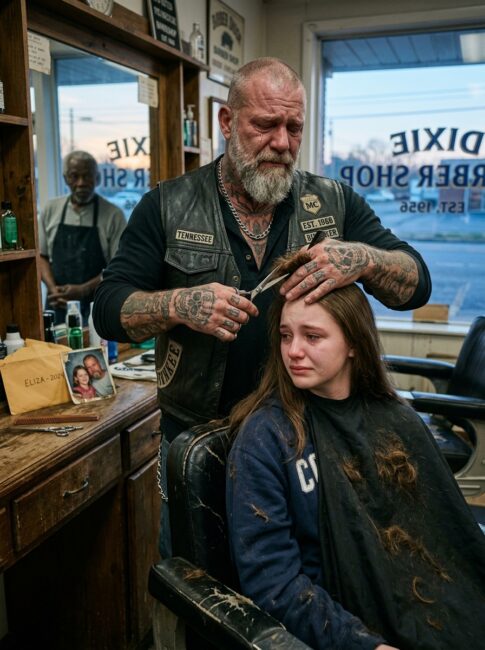
At Earl’s Barbershop, the neon sign was still off. The chairs smelled like old leather and talcum powder. Dawn pressed blue against the front windows. On the wall were photos of Little League teams, veterans, prom boys, and one faded picture of Dad from twenty years ago with a darker beard and harder eyes.
I sat in the chair.
Dad stood behind me.
Earl placed the scissors in his hand.
“Slow,” Earl said. “Hair don’t forgive a nervous man.”
Dad almost smiled.
Then he lifted the first section.
His hands were scarred. Knuckles thick. Tattoos faded green-black. The same hands that held handlebars, wrenches, coffins, my mother’s hand in a hospital bed.
They shook.
The scissors clicked.
A lock of my hair fell onto the cape.
And my father cried.
I thought that was the climax.
I thought the whole story was one hard man breaking because his only daughter was leaving.
I was wrong.
After the first tear, Dad stopped cutting.
He turned away fast, like I had caught him stealing.
“Sorry,” he muttered.
Earl didn’t move.
Old men who have seen enough pain know when silence is the only decent thing in the room.
“Dad,” I said, softer than before.
He shook his head.
“Not about college.”
That stung in a strange way.
“Then what?”
He opened the drawer under Earl’s counter.
That was odd. He knew exactly where to reach. Like he had put something there before.
He pulled out a small envelope, yellowed at the corners, with my name written across it in my mother’s handwriting.
Leah.
Not baby girl. Not sweetheart. Leah.
My hands went cold.
“Mom wrote this?”
Dad nodded.
“When?”
“The week before she died.”
The barbershop seemed to shrink around us.
Outside, a truck rolled past on West Main Street. Its tires hissed on damp pavement. Somewhere down the block, someone unlocked a diner door.
I opened the envelope.
Inside was a photograph.
Me at five years old, asleep on the back of Dad’s Harley. Pink helmet crooked. Tiny arms around his waist. My cheek pressed against the back of his leather vest. Dad’s head was turned slightly, like he was checking to make sure I was still there.
On the back, Mom had written:
Don’t let this be the last.
Under that, smaller:
When she leaves, take her the long way.
I looked up.
Dad’s eyes were wet, but his face had gone hard. Not angry. Holding.
“What does this mean?”
He took a breath through his nose.
“The day that photo was taken, your mother was already sick. We didn’t know how bad yet. You had a fever the night before. You wouldn’t sleep unless you were touching my vest.”
I stared at the picture.
He continued.
“She told me someday you’d be too big to hold on like that. Said I’d try to act tough and let you go without asking for one more ride.”
Earl looked out the window.
Dad rubbed his thumb over the edge of the photo.
“She made me promise. Last ride before college. Just us. No club. No truck. No boxes. The long way to Knoxville.”
My throat closed.
The main twist should have been enough.
But then Earl spoke.
“Tell her the rest, Ray.”
Dad looked at him like a warning.
Earl didn’t blink.
“She’s old enough.”
Dad’s hand tightened around the envelope.
The leather of his cut creaked as his shoulders rose and fell.
“There was another reason she wanted it,” he said. “That ride when you were five… it wasn’t just for fun.”
He looked at me in the mirror.
“It was the day I came home.”
I didn’t understand.
He touched the prison ink on his knuckles.
“Really came home.”
Dad told it in pieces.
That was how he spoke when things mattered.
No long speech. No polished confession. Just broken boards laid down one at a time until there was a bridge.
When I was five, he had almost left the club, the house, everything.
Mom was sick. Bills were piling. Dad had taken side work he would never name, the kind that put cash in a coffee can and made men knock on our door after midnight. He had convinced himself he was doing it for us.
Mom knew better.
One afternoon, they fought in the garage.
Not screaming. Worse. Quiet.
She told him fear money still smelled like fear. He told her the world did not care how clean a man’s hands were when his family needed medicine. She told him if he kept going, he would lose me before he lost her.
He walked out.
He got on the Harley.
And I ran after him wearing that little pink helmet backward.
That was the part I remembered only as sunlight and noise.
I had climbed onto the bike before he could stop me, wrapped my arms around his waist, and said, “Go slow, Daddy. I’m little.”
Dad froze.
Mom stood in the garage doorway, pale and thin, one hand pressed to her ribs.
She did not ask him to stay.
She took the picture.
Then she said, “Take her around the block. Decide who you are before you come back.”
So he did.
Not around the block.
The long way.
Down Route 70. Past the feed store. Past the old Shell station. Past cedar trees and split-rail fences and churches with white signs. I fell asleep against his back before we reached the county line.
Dad rode for nearly two hours with one hand steady on the bars and the other checking my knee every few minutes.
By the time he came home, the bad cash was gone from the coffee can.
The men who knocked at midnight never came again.
Hammer stayed.
Ray came home.
That was why Mom wrote the note.
Not because motorcycles are magic. They are not. They are steel and fuel and noise. They do not fix men.
But sometimes a child’s arms around your waist at fifty miles an hour can remind you there is still something behind you worth not destroying.
The haircut had its own meaning too.
Mom had asked Dad to cut her hair when cancer took it. Not because he was good at it. Because she wanted his hands to learn gentleness in a place where he could not fake it.
Before she died, she asked Earl to teach him.
Once a month after the funeral, Dad came to the barbershop before sunrise. Earl taught him how to hold scissors. How to comb without pulling. How to trim bangs. How to stand behind someone and not look like a man preparing for damage.
“Your mama said one day you’d ask for short hair,” Earl told me. “Said girls do that before leaving home. Said your daddy better be ready.”
Dad looked embarrassed.
“I wasn’t ready.”
Earl snorted.
“No man ever is.”
The little pink helmet on the garage wall. The barber tools. The photo hidden at Earl’s shop. The way Dad never pushed me to ride but always kept the Harley ready. The way the club called me “Little Passenger” even after I turned eighteen.
All seeds.
All waiting for that morning.
I looked at my father in the mirror. Big, tattooed, gray-bearded, terrifying to strangers. A man who had done wrong. A man who had stayed. A man who had learned to cut hair because his dying wife asked him to be gentle when grief came back for their daughter.
I touched the short hair at my shoulder.
“Can we still ride?”
He looked up fast.
I almost laughed. Almost cried.
“To Knoxville,” I said. “The long way.”
His mouth tightened.
“Your dorm stuff?”
“Already there.”
“The weather might turn.”
“So go slow,” I said. “I’m little.”
That broke him more than the haircut.
Not loudly.
Just enough.
Earl cleared his throat, pretending to clean scissors.
Dad finished the cut with careful hands. Not perfect. A little uneven near the left side. I never fixed it.
Then he paid Earl, though Earl told him not to. Dad put two twenties under the comb jar anyway.
Outside, the Harley waited at the curb.
Black. Heavy. Warm from nothing yet.
Dad handed me my helmet.
Not the pink one. A grown-up black helmet with a tiny purple scratch on the side where I had dropped it last summer.
He climbed on first.
The engine turned over with that low V-twin cough, then settled into a rumble I had known my whole life.
I got on behind him.
At eighteen, I had to fold myself differently than I did at five. My knees bent awkwardly. My boots found the pegs. My hands hovered for half a second.
Then I wrapped my arms around his waist.
Dad went still.
Just like in the story.
Then his gloved hand covered mine once.
No speech.
No lesson.
He pulled away from the curb.
We did not take the interstate.
Dad hated I-40 for rides that mattered. Too much speed. Too many trucks. Not enough places to remember yourself.
We took Route 70 east.
Past Lebanon waking up slow. Past gas stations steaming with early coffee. Past fields still wet from morning rain. Past old barns, tire shops, church signs, and little towns with one stoplight and three opinions about everyone in them.
The road smelled like cut grass, diesel, wet asphalt, and summer heat starting to rise.
I held on.
At first because turns still made me nervous.
Then because I wanted to.
We stopped at a diner outside Carthage where the waitress knew Dad by name and called me “the college girl” like I had already become something new. Dad ordered black coffee and toast. I ordered pancakes and ate three bites.
A man in a booth stared at Dad’s tattoos.
Dad noticed.
I noticed Dad noticing.
For once, I did not shrink from it.
Let him stare.
He did not know about the barbershop. He did not know about Mom’s note. He did not know about a five-year-old asleep against a leather vest or a man choosing home somewhere on Route 70.
After breakfast, three bikes rolled into the lot.
Preacher, Moose, and Red.
Dad sighed when he saw them.
“I said no club.”
Preacher lifted both hands.
“Brother, we’re not riding with you. Just happened to want eggs fifty miles from home.”
Moose hugged me so hard my spine popped.
Red gave me a pack of butterscotch for the dorm.
No one said goodbye like it was goodbye.
Bikers are strange that way. They can stand around a hospital bed for twelve hours, but they get awkward at normal sadness.
Preacher looked at my haircut.
“Hammer do that?”
“Yes.”
He studied the uneven left side.
“Brave girl.”
Dad told him to shut up.
The three of them stayed in the diner lot as we pulled away. In the side mirror, I saw them standing shoulder to shoulder, cuts moving in the wind, hands raised low.
Not waving.
Holding the moment.
Every August after that, Dad rode Route 70.
Even when I had my own car.
Even when I moved into my first apartment.
Even when I told him he did not need to make the trip.
He went anyway.
Sometimes I rode with him. Sometimes I drove behind him. Sometimes, when I was buried under exams, he rode alone to a gas station halfway between Lebanon and Knoxville, bought one black coffee and one pack of butterscotch, sat outside for ten minutes, and rode home.
A ritual.
Not for college.
For the promise.
For Mom.
For the man he almost became and the child who stopped him without knowing.
Four years later, I graduated.
Dad showed up in a clean black shirt under his leather cut, beard trimmed, boots polished, tattoos still making strangers look twice. He sat in the folding chairs with Earl on one side and the Cedar Saints on the other, all of them too large and too quiet for the polite university crowd.
When my name was called, they did not cheer at first.
They stood.
That was worse.
Twelve bikers rising like a wall in the middle of Thompson-Boling Arena.
Then Moose whistled loud enough to scare a dean.
Afterward, Dad found me outside near the parking garage.
He held out the old pink helmet.
The one from the wall.
It had been cleaned. The scratches were still there. The little faded sticker on the back still peeled at one corner.
“Thought you might want it,” he said.
I took it carefully.
Inside, tucked under the padding, was the photograph.
Me at five.
Asleep on the Harley.
Arms around him.
On the back, Mom’s handwriting had faded but not disappeared.
Don’t let this be the last.
Dad nodded toward the road.
“Long way home?”
I looked at my cap, my gown, my short hair grown out past my shoulders again, my life waiting in boxes and plans and unknown places.
Then I looked at him.
The big scary biker everyone misunderstood.
The man who stayed.
I handed him my helmet.
“Go slow,” I said.
His engine rolled to life.
And I held on.
Not the last.
Follow the page for more emotional biker stories about the heart behind the leather.