Part 2: He Refused Every Wednesday Job — Then I Found Him Signing to Children
My name is Caleb Price, and back then I was six months into prospecting for the Tulsa Iron Saints.
Prospecting is mostly doing what nobody else wants to do.
Sweep the clubhouse. Watch the bikes. Make coffee. Shut up. Listen. Learn who jokes with knives and who means it. Learn which brothers talk loud because they are weak and which brothers talk low because they have already survived the thing you’re pretending to be.
Graves was the second kind.
He didn’t raise his voice because he didn’t need to.
The clubhouse sat in an old body shop off Southwest Boulevard, not far from the stretch of Route 66 tourists still came to photograph. Rusted sign out front. Oil-dark concrete. Coffee that tasted like burned rope. A row of Harleys under the awning, ticking and cooling after runs, the air always carrying gas, leather, chain lube, cigarette smoke, and something fried from the diner next door.
Graves kept to the corner table.
Back to the wall.
Eyes on the door.
Left hand wrapped around a mug he rarely drank from.
I had heard the stories.
Everybody had.
He did four years in McAlester for assault before he found the club. Or before the club found him. Depends who tells it. He was an Army mechanic in Iraq before that. Came home with one ear half-deaf, two nightmares, and a temper nobody could stand near for long.
He had once put a man through a windshield outside a pool hall in Sapulpa.
He had once ridden three hundred miles in sleet to bring a brother’s daughter insulin.
He had once sat all night outside a hospital room because an old lady was scared of dying alone and her husband was too broken to stay awake.
All of it could be true.
That was Graves.
Violence and tenderness sitting in the same chair, neither one pretending the other didn’t exist.
The club president, Bishop, trusted him more than anyone. Bishop was Black American, late 60s, bald, calm, and heavy in a way that made rooms rearrange themselves around him. If Bishop said ride, men rode. If Bishop said sit down, men sat.
But even Bishop did not push Wednesdays.
At first, I thought it was respect.
Later, I learned it was fear.
Not fear of Graves hurting anyone.
Fear of touching the one thing holding him together.
The first time I noticed Wednesday was during a storm.
A spring one. Oklahoma kind. Sky green at the edges, wind hitting the garage doors, weather radio crackling on the shelf. A family from Claremore had blown a tire on the turnpike after visiting their kid at Saint Francis Hospital. Bishop wanted two bikes and the van.
Graves stood, grabbed his gloves, then looked at the wall clock.
Tuesday night had turned into Wednesday morning.
12:03.
He stopped.
Bishop saw it.
“Go,” Bishop said.
Graves shook his head once.
Cutter slammed his hand on the table.
“Are you kidding me?”
Graves didn’t look at him.
“I don’t ride Wednesdays.”
“It’s a family on the shoulder.”
“Then send me Thursday.”
Cutter laughed, ugly.
“They might not need you Thursday.”
Something flashed in Graves’s face.
Not anger.
Pain first.
Then anger covering it.
Bishop stepped between them without moving much at all.
“Prospect,” he said to me. “Get the van keys.”
So I went.
But the question stayed.
Every Wednesday after that, I watched him.
He left the clubhouse at 2:40 p.m. Same time. Same jacket. Same beat-up saddlebag on the left side of his Harley. He never let anyone touch that bag. Not even when rain came hard and brothers helped cover bikes with tarps.
Once, I saw the zipper open.
Inside was not a weapon.
Not whiskey.
Not money.
Children’s books.
Bright ones. Board books. Picture books. One had a rabbit on the cover. One had a moon. One had a little blue truck.
Beside them was a small plastic case filled with hearing aid batteries.
That was the first seed.
The second was the blue star patch inside his cut.
The third was the way Graves watched kids at charity events.
Not soft.
Not cheerful.
Careful.
Like every child carried invisible glass around them, and he was the only man in the room afraid of breaking it.
Cutter made it worse.
Men like Cutter always do. He was white American, early 40s, thick neck, red beard, loud laugh, and eyes that never settled. He had been patched for six years and thought that meant the club owed him agreement.
He hated unanswered questions.
And Graves was one big unanswered question.
The blowup came on a Wednesday morning in July.
A brother named Deacon got arrested in Broken Arrow after a custody exchange went bad. No violence, but enough shouting for neighbors to call police. His ex-wife was terrified, his little boy was crying, and Deacon needed someone calm to help Bishop deal with it before the club got dragged into court papers.
Bishop looked at Graves.
Everybody did.
Graves was the calmest man we had when things were ugly.
The clock said 10:15 a.m.
Wednesday.
Graves took one slow breath.
“No.”
Deacon stared at him.
“Brother, it’s my kid.”
Graves’s jaw tightened.
“I know.”
“Then help me.”
“I can’t.”
That sentence changed the room.
Not “won’t.”
Can’t.
Cutter stood up so fast his chair scraped backward.
“Bull.”
Bishop said, “Sit down.”
Cutter didn’t.
“No. I’m sick of this. Every damn Wednesday this man disappears like the rest of us are beneath him.”
Graves kept his hands flat on the table.
I noticed that.
Men like Graves make choices with their hands first.
Cutter stepped closer.
“What’s on Wednesday, huh? You got a little side business? You talking to cops? You meeting somebody?”
Silence.
The engine of a bike outside ticked as it cooled.
A fly buzzed against the front window.
Graves looked at Deacon, not Cutter.
“I’m sorry about your boy.”
Deacon’s face broke in half.
“Not enough.”
That hit Graves harder than any insult.
He stood.
Slow.
His leather cut creaked. The room felt smaller with him upright.
Cutter smiled like he wanted it.
“Yeah,” Cutter said. “Walk away.”
Graves looked at him then.
One eye sharp. One eye tired.
“I am walking away so I don’t become who you think I am.”
Then he left.
Boots on concrete.
Door slam.
Harley cough.
V-twin rumble rolling out toward Route 66.
Nobody spoke for a while.
Bishop finally looked at me.
“Prospect.”
“Yes, sir.”
“Clean the table.”
I cleaned the table.
Then I did the dumbest thing I could have done.
I took my truck and followed Graves.
I told myself I was protecting the club. That a prospect had to know if a senior member was hiding something dangerous. That Cutter had a point, even if he was an ass.
Truth was simpler.
I was twenty-seven and nosy.
Graves rode east through Tulsa, past old signs, pawnshops, tire stores, taquerias, and sun-faded motels. He did not ride fast. He never did in town. He stopped at every light, left space for cars, let a woman in a minivan merge even though she cut him off. Not exactly the criminal mastermind I had imagined.
He turned near downtown and parked behind the Tulsa City-County Library.
I almost laughed.
The library?
He killed the engine.
The sudden quiet was strange after the rumble.
He took the saddlebag off the bike and slung it over one shoulder. Then he stood there for a second, one big hand resting on the seat, head bowed.
Like he was changing skins.
When he walked inside, I waited two minutes and followed.
Libraries have their own smell. Paper, dust, carpet cleaner, old air conditioning, children’s glue. It hit me after months of oil and smoke like another country.
I expected Graves to look out of place.
He didn’t.
He signed to the woman at the front desk.
Not waved.
Signed.
Her face lit up. She signed back.
My stomach dropped.
I followed at a distance, past stacks and computer stations, to a children’s room decorated with paper stars and ocean animals hanging from the ceiling.
A group of kids sat in a circle on a rug.
Six of them.
Ages maybe four to eight.
Some with hearing aids. One with cochlear implants. One boy with thick glasses and sneakers that blinked red when he moved his feet.
Graves walked in.
The kids turned.
Their faces changed like someone had opened a window.
The smallest girl signed something fast.
Graves signed back.
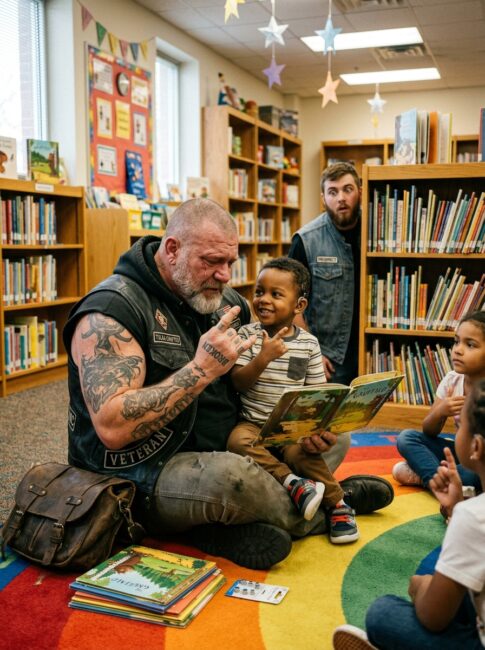
Then the hardest man in the Tulsa Iron Saints lowered himself onto the rainbow rug, pulled Goodnight Moon from his saddlebag, and began to read with his hands.
No voice.
Just hands.
Scarred hands.
BROKEN across the knuckles.
Moving gently through the air.
The kids watched like his fingers were firelight.
I stood behind a shelf, ashamed and unable to leave.
Then a little boy crawled into Graves’s lap.
Brown skin, maybe five, Black American, tiny hearing aids behind both ears. He pressed his head against Graves’s chest and signed one word.
Daddy.
Graves froze.
His eyes went wet.
He signed something back with trembling fingers.
The boy smiled.
I thought I had found the secret.
I still hadn’t found the truth.
The librarian found me before Graves did.
She was white American, mid-50s, silver hair, cat-eye glasses, and the kind of smile that could cut paper.
“You must be from the club,” she said quietly.
I opened my mouth.
Nothing came out.
She looked past me to Graves.
“He doesn’t like being followed.”
“I wasn’t—”
She raised an eyebrow.
I shut up.
Her name was Marlene Foster. She ran the Wednesday Silent Story Hour, a reading program for deaf and hard-of-hearing children and their siblings. Graves had volunteered there for almost seven years.
Seven.
Every Wednesday.
Rain, heat, ice, funeral week, flu week, court week, all of it.
“He told us he was retired,” I said.
Marlene watched him sign stars and moon and quiet house to the children.
“He is,” she said. “From lying about who he loves.”
That was a strange sentence.
Before I could ask, the little boy in Graves’s lap looked toward me.
He signed something.
Graves turned.
Saw me.
The room temperature dropped.
He did not get up. Did not shout. Did not expose me in front of the kids.
He signed to the boy, eased him gently off his knee, and finished the book.
Only after every child had picked a sticker and hugged or fist-bumped him did Graves walk toward me.
His boots made almost no sound on the carpet.
That scared me more than concrete.
Outside, behind the library, he lit a cigarette and did not smoke it.
Just held it.
“You tell Cutter,” he said, “I’ll break your teeth out of habit, then apologize.”
“I won’t.”
He looked at me.
“You followed me.”
“Yes.”
“Why?”
“I thought maybe you were hurting the club.”
He laughed once.
No humor.
“I am the club, kid. The parts it don’t brag about.”
Marlene came out then with the little boy in blinking sneakers.
The boy ran to Graves and signed fast.
Graves answered.
The boy ran back inside.
I stared.
Graves saw me staring.
“That’s Jonah,” he said.
“Is he yours?”
The question came out before I could stop it.
Graves’s face went flat.
“No.”
Then Marlene said, “Not legally.”
That was the twist.
Jonah was Graves’s grandson.
Nobody in the club knew Graves had ever had a child.
His daughter’s name was Emily. She was born when Graves was twenty-two and mean as a kicked dog. He was not around much. Army. Bars. Jail. Anger. Excuses. By the time he wanted to be a father, Emily was already old enough to know better than to trust him.
She was deaf.
Graves had not learned sign language when she was little.
That was the wound.
Not prison.
Not war.
Not scars.
His own daughter had lived in his house for eight years with a father who made her read lips because he was too proud, too drunk, too ashamed, or too stupid to learn how to speak with her hands.
When Emily grew up, she left Oklahoma and did not call him.
Years later, she came back with Jonah.
A little boy who was deaf like her.
She asked Graves for one thing.
“Learn before he knows you didn’t.”
So he did.
Secretly at first.
Badly.
At night.
From library classes, videos, Marlene, children patient enough to laugh at him kindly.
Then Emily got sick.
Kidney failure. Complications. Not dramatic. Just brutal and slow and expensive and unfair.
She died on a Wednesday morning.
The first Wednesday Story Hour Graves ever missed.
Before she passed, she made him promise Jonah would never have to beg a man to understand him.
So every Wednesday since, Graves had come to the library.
Not because he loved books.
Because once, his daughter spoke with her hands and he chose not to listen.
Now he listened to every child.
I did not tell Cutter.
I told Bishop.
Not the whole thing. Not at first. Just enough.
“Graves is at the library,” I said.
Bishop closed his eyes like a man hearing a verdict he had expected.
“I know.”
That was twist number two.
“You know?”
“I know where he goes. Not why.”
“You never asked?”
Bishop looked at me from behind his desk. The office smelled like coffee, old leather, and the rain coming in through a bad window seal.
“Some men keep secrets because they’re dirty. Some keep them because they’re sacred. You learn the difference, prospect, or you don’t belong here.”
I thought about Graves’s hands moving through the air.
BROKEN.
Moon.
Stars.
Quiet.
Daddy.
“What about Deacon?”
Bishop leaned back.
“Deacon got handled.”
“By who?”
“Rosie.”
That was twist number three.
Rosie was the club’s treasurer, white American, sixty-one, grandmother of five, rode a red Harley trike, and terrified men twice her size by using full sentences. She had gone to court with Deacon’s ex-wife, sat beside her, calmed both parents down, and arranged supervised exchanges through the community center.
No engines.
No intimidation.
No men posturing in a parking lot.
Actual help.
Bishop tapped his pen once.
“We did not need Graves. We needed to stop thinking only Graves could do hard things.”
That sat with me.
Brotherhood tested.
Not by a fight.
By whether a club could honor one man’s promise without making him explain his pain for permission.
Cutter did not learn as fast.
The next Tuesday, he brought it up again in church.
Church is what we called formal club meeting. Long table. Locked door. Phones off. Cuts on. Everyone pretending democracy was not just old men arguing with rules.
Cutter wanted a vote.
“No more personal days,” he said. “Club business comes first.”
Bishop looked tired.
Graves sat at the end of the table, silent.
I could feel the secret burning in my mouth. But it was not mine.
Cutter kept pushing.
“What’s so special about Wednesday?”
Graves stared at the table.
His right hand twitched once.
Not a fist.
A sign.
I recognized it from the library.
Pain.
Then the clubhouse door opened.
Marlene stepped in.
Behind her came Jonah.
Tiny. Serious. Blinking sneakers. Backpack with dinosaur patches.
Every man in that room went still.
Jonah walked straight to Graves.
He did not speak.
He signed.
Fast.
Graves answered.
His whole face changed.
The monster softened.
The room saw it.
Cutter looked confused. Then embarrassed. Then annoyed because embarrassment in men like him often curdles into anger.
“What is this?” he asked.
Jonah looked at him.
Then at Graves.
He signed something.
Graves’s mouth tightened.
Marlene translated because the room deserved to hear it.
“He asked why the loud man is mad.”
Nobody laughed.
Graves stood slowly.
For once, he spoke more than one sentence.
“My daughter was deaf,” he said. “I didn’t learn for her. She died anyway. Her boy is deaf. I learned for him. Wednesdays are his. Any man here got a problem with that can take it outside and be disappointed.”
The room did not move.
Cutter’s face went red.
But it was Deacon who spoke first.
The same brother who had needed Graves and been hurt by his refusal.
He looked at Jonah.
Then at Graves.
“My boy asked me to stop yelling,” Deacon said quietly. “I didn’t hear him either.”
He stood.
Not to challenge.
To remove his cut.
For a second, I thought something terrible was happening.
But Deacon turned the cut inside out and placed it over the chair beside Jonah, making a little leather cushion.
“Sit, kid,” he said awkwardly.
Jonah looked at Graves.
Graves signed.
Jonah climbed onto the chair.
That broke the room open.
Not tears. Not hugs. Bikers don’t usually know what to do with those in a clubhouse. It broke open in movement.
Pike poured the kid lemonade.
Rosie found cookies.
Bishop gave Marlene his chair.
And Cutter sat down without another word.
Later, I saw him outside by the bikes.
He was crying angry, wiping his face hard like the tears had insulted him.
Graves stood beside him.
No comfort.
Just presence.
Cutter said, “My brother was deaf.”
Graves looked at him.
“When?”
“Born that way.”
“You sign?”
Cutter shook his head.
“No.”
Graves took the cigarette from behind his own ear, handed it to Cutter unlit, and said, “Library. Wednesday. Three o’clock.”
That was Graves.
Not forgiving.
Not condemning.
Opening a door and walking away.
After that, Wednesdays changed.
Not for Graves.
For us.
He still left at 2:40.
Still rode east through Tulsa.
Still parked behind the library.
Still carried the same beat-up saddlebag full of books, stickers, batteries, snacks, and crayons.
But now, sometimes, he did not ride alone.
The first to join him was Deacon. He sat in the back of the children’s room with his knees up around his ears, trying to learn the alphabet on a laminated card while Jonah corrected him with the cold patience of a five-year-old.
Then Rosie came.
She learned faster than all of us and pretended not to enjoy being better.
Then Bishop.
He signed slowly, carefully, like every movement had weight. The kids loved him because he made mistakes and laughed without sound.
Even Cutter came.
Late.
He stood in the hallway the first week.
Inside the door the second.
On the rug the third.
A little girl with pink hearing aids handed him a book about a bear. Cutter looked at Graves like he had been asked to defuse a bomb.
Graves signed one thing.
Slow.
Try.
So Cutter tried.
His hands were clumsy. His face went red. The girl corrected him four times. He stayed.
The club did not become holy.
Don’t make it pretty.
Men still argued. Bikes still broke. Bills still came. Some brothers still drank too much. Some still carried old violence in their shoulders. Graves was still Graves. He could still scare a man quiet with one look. He still had BROKEN across his knuckles and a past that did not wash off because children liked him.
But every Wednesday, something different happened at the Tulsa City-County Library.
Heavy boots lined up by a rainbow rug.
Leather cuts hung over tiny chairs.
Scarred hands practiced signs for rabbit, truck, moon, again, friend, sorry.
The kids gave road names.
Jonah called Bishop “Big Quiet.”
Rosie became “Cookie Boss.”
Cutter became “Red Loud,” which stuck and nearly caused a fight until he admitted it was accurate.
Graves stayed Graves.
Except to Jonah.
Jonah called him Grandpa in sign.
The first time I saw it, Graves looked away toward the window.
Outside, his Harley sat under a honey locust tree, dust on the tank, chrome catching afternoon light.
The blue star patch made sense eventually.
Emily had sewn it when she was nine. Her school for deaf children had a craft fair. She made a star from blue felt and gave it to Graves during one of his brief sober stretches.
He lost it twice.
Found it both times.
After she died, he stitched it inside his cut where nobody could see it unless the wind wanted them to.
I asked him once why no name.
He looked at the patch.
“She knew who she was,” he said.
That was all.
I earned my patch the next spring.
Bishop handed it to me in the clubhouse while the brothers watched and pretended the dust in the room was making their eyes wet. Graves stood in the back, arms crossed, face unreadable.
Afterward, he walked up and gave me a small book.
Worn corners. Green cover. A rabbit on the front.
Goodnight Moon.
Inside the cover, in blocky handwriting, Jonah had written my new road name.
Scout.
Because I followed Graves and found something I wasn’t supposed to, then learned not to steal it.
Fair.
Every Wednesday now, I ride behind him.
We leave the clubhouse at 2:40. The engines wake under the awning one by one, low and rough, bouncing off the old Route 66 brick. We pass the diner, the tire shop, the faded motel sign, the places where people still look twice when they see us.
Then we park behind the library.
The engines cut off.
That silence always gets me.
One by one, hard men and hard women walk inside carrying picture books.
Children look up.
Hands start moving.
Graves lowers himself onto the rug with a groan, his leather creaking, his big tattooed hands opening like doors.
Jonah climbs into his lap.
The story begins without a sound.
Outside, the Harleys cool in the sun.
Tick.
Tick.
Tick.
Like hearts learning patience.
Follow the page for more emotional biker stories about the heart behind the leather.