Part 2: Two Harleys Missed One Morning — Then Fifteen Came From the Wrong Direction
I was Lily’s kindergarten teacher, which means I learned to read fear before I learned to read her handwriting.
Fear had a sound.
It was the scrape of a chair when a child moved too fast away from a man’s voice in the hallway. It was the silence after a door clicked shut. It was the way Lily’s crayons stayed inside the lines too carefully, like making a mistake might cost her something.
Her grandmother, Ruth, enrolled her two weeks after Labor Day. Ruth was sixty-eight, thin as a broom handle, with blue veins on the backs of her hands and a purse full of folded paperwork from court. She smelled like laundry soap and hospital coffee.
“She’s a good girl,” Ruth told me that first morning. “She just gets scared.”
Lily stood behind her leg and stared at the tile floor.
Three days later, Ruth asked the principal if we had extra security.
The answer was no. We had a buzzer, two cameras, one part-time resource officer, and a front office secretary named Gloria who could stop a parent faster than any locked door if she had to. But school was school. Not a fortress.
Then BACA showed up.
They did not arrive like heroes.
They arrived like trouble.
Four Harleys rolled into the visitor lot on a rainy Thursday, engines cracking against the brick walls. Parents turned. A dad in a suit muttered something about “gangs.” Gloria reached for the phone until the principal put a hand on her wrist.
Reaper came in first.
Six foot three. Maybe two-eighty. Black-gray beard, scar on his chin, hands like cinder blocks. His leather cut creaked when he walked. You could smell rain, gas, tobacco, and old road on him. Behind him came Mouse, Preacher, and a woman called Steel, who looked like she could lift a refrigerator and apologize to it afterward.
They sat in the conference room with Ruth, our principal, and a victim advocate from the county.
Reaper barely spoke.
When he did, he kept his hands flat on the table.
“We don’t confront,” he said. “We don’t chase. We don’t start anything. We show up. Kid needs to see she’s not alone.”
That was it.
No chest-pounding.
No dramatic promise.
Just show up.
Later, I found out Reaper had been with BACA for nine years. Before that, he had been a welder. Before that, he had done eighteen months in county for putting a man in the hospital outside a bar in Steelton. He never hid it. Never polished it.
“I was mean before I was useful,” he told me once, while fixing a broken playground latch with a multitool from his saddlebag.
I did not know what to say to that.
So I said, “And now?”
He tightened the screw, tested the gate, and looked across the blacktop where Lily was showing Mouse a ladybug on her sleeve.
“Now I try not to waste what’s left.”
That was Reaper. Short sentences. Heavy ones.
The chapter took Lily’s case seriously. They did not call it babysitting. They called it keeping a promise.
Two bikers in the morning. Two in the afternoon. Never the same pair for too many days, except Reaper was there almost always. Even when it rained sideways off the Susquehanna. Even when snow crusted the curbs and salt turned his boots white. Even when his beard had ice in it and his knuckles looked raw from the cold.
Lily changed slowly.
First she stopped crying at drop-off.
Then she started waving at the crossing guard.
Then she began bringing Reaper drawings. Mostly purple butterflies. Sometimes stick figures with giant motorcycles and tiny girls with yellow backpacks.
Reaper folded every drawing into the inside pocket of his cut.
That same pocket, I noticed, sat just below the hidden purple butterfly patch.
Maggie.
I never asked.
Teachers learn not to force locked doors open. Not with children. Not with men like Reaper.
But one afternoon, while Lily was playing with blocks, Mouse came into my classroom carrying a box of donated winter coats. He saw me looking at the little patch inside Reaper’s vest hanging on the back of a chair.
“That was his daughter,” Mouse said quietly.
I looked at him.
He did not give me the whole story. Just enough to make the air feel different.
“Ten years old,” he said. “Wrong house. Wrong man. System missed it.”
Then he picked up the empty box and left.
After that, when Reaper stood at Lily’s door every morning, I understood the way he watched the street.
Not angry.
Not hungry for a fight.
Worse.
Prepared.
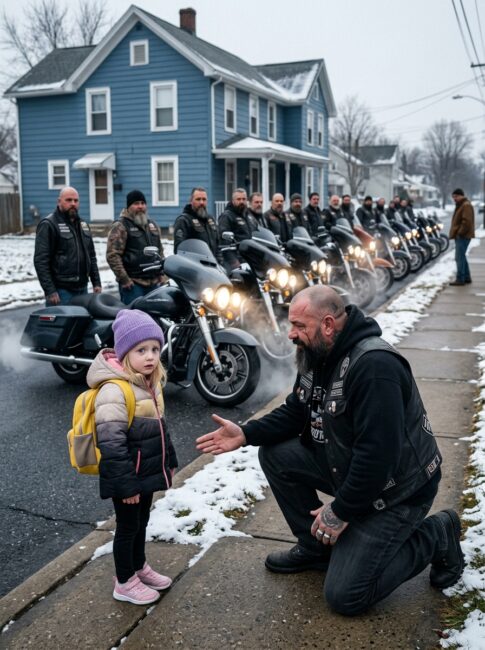
The morning it happened was a Tuesday in February, cold enough that the puddles at the edge of the curb had frozen into cloudy glass.
I remember the date because it was pajama day at school.
Half my class came in wearing cartoon fleece and snow boots. The hallway smelled like wet mittens, cereal breath, and disinfectant. I was taping paper hearts to the classroom door when Gloria’s voice came over the intercom, tight and low.
“Ms. Walker, can you come to the office?”
That voice made my stomach drop.
When I reached the front office, Ruth was on the phone, crying without making noise. Her lips were moving. No sound came out. The principal stood beside her, one hand pressed against the desk.
“What happened?” I asked.
Gloria covered the receiver.
“Bikers aren’t there.”
I looked through the front window toward Maple Street.
Nothing.
No black Harley. No Mouse. No Reaper.
Just a gray road, a crossing guard, and the morning line of minivans.
Ruth kept saying, “She won’t come out. She won’t come out without them.”
Then she froze.
Someone on the other end had spoken.
Ruth closed her eyes.
“She’s outside now,” Gloria whispered. “By the gate.”
I grabbed my coat and ran.
Maple Street Elementary sat three blocks from Ruth’s little blue house, close enough that on quiet mornings you could hear the school bell from her porch. The fastest way was past a vacant lot, a laundromat, and the old brick duplex where Lily’s father was staying with his cousin.
That detail mattered.
Everybody knew it.
The court knew it. The school knew it. Ruth knew it. Lily knew it most of all.
I reached the sidewalk halfway between the house and school and saw her.
Tiny body. Yellow backpack. Pink sneakers. Purple hat sliding over one eye.
She was standing still at the corner of Fulton and Maple, both hands wrapped around the straps of her backpack, staring down the road where the Harleys usually came from.
No one touched her.
Ruth stood in the doorway of the blue house, unable to leave because the court order said Lily could walk with escorts but Ruth was not supposed to approach the father’s block alone. The crossing guard was at the next corner, holding her stop sign uselessly. I was still too far away.
Five minutes passed.
Then ten.
I saw Lily’s shoulders start to shake.
Not crying.
Trying not to.
That is worse in a child.
I looked down Maple Street.
At the far end, near the laundromat, a man stood beside a telephone pole.
Brown jacket. Baseball cap. Hands in pockets.
He was not on school property. He was not speaking. He was not violating the letter of anything.
But Lily saw him.
Her whole body changed.
She went from small to smaller.
I started toward her, but a white delivery truck pulled between us, blocking the street. The crossing guard blew her whistle. A car horn barked. Somewhere a dog started barking behind a fence.
Then Ruth screamed Lily’s name.
The man in the brown jacket had taken one step off the curb.
Just one.
And that was when we heard it.
Not from the west, where Reaper always came from.
From the east.
From the wrong direction.
At first it sounded like thunder caught between buildings. A low shaking in the pavement. Then another engine joined it. Then another. Then so many that the windows of the laundromat rattled in their frames.
The man in the brown jacket turned his head.
So did every parent in the drop-off line.
Fifteen Harleys came around the corner in a tight, slow formation, headlights burning white in the cold morning air. Not rushing. Not roaring like a threat. Just steady. Heavy. Unmistakable.
Reaper was in front.
Mouse beside him.
Steel behind them.
Preacher. Tank. Lobo. Cricket. Men and women I had only seen once or twice at school events, all wearing the same patch, all turning onto Maple Street like the road belonged to the promise they had made.
They did not go near Lily’s father.
They did not yell.
They did not point.
They rode right past him and lined up in front of Ruth’s house, one bike after another, chrome ticking, exhaust breathing steam into the frozen air.
Reaper cut his engine.
The sudden silence hit harder than the noise.
He swung one boot over, stood, and walked to Lily.
His hands were shaking.
I saw it.
He tucked them into fists, then opened them again.
Lily looked up at the line of bikes, eyes huge.
Then she smiled.
“Hôm nay đông quá,” she said first in the little Vietnamese phrase Ruth had taught her from a neighbor, then corrected herself in English, laughing through the fear.
“There’s a lot today.”
Reaper crouched down.
His leather creaked.
His voice came out rough.
“Never short a ride for you, kid. Hear me?”
She nodded.
He lifted her onto the Harley like she weighed nothing.
The man in the brown jacket stood two blocks away.
Then he turned around and walked back the way he came.
We thought that was the climax.
We thought the bikers had saved the morning.
We were wrong.
The real story was why they were late.
By lunch, everybody at school had a version of what happened.
Some said Reaper’s bike broke down.
Some said the police had called him away.
Some said the whole chapter staged it to scare Lily’s father.
They were all wrong.
I got the truth at 3:15, when Reaper came to pick Lily up and did not take off his gloves.
That was the first thing I noticed.
Reaper always removed his gloves before helping Lily with her helmet. “Kids need skin, not leather,” he once told Mouse. But that afternoon, his black gloves stayed on. His right shoulder sat wrong. His jaw was clenched so hard the muscle jumped.
Lily ran to him like nothing in the world was broken.
“Mr. Bear!”
He caught her with his left arm only.
Mouse took the helmet and fastened it under her chin.
That was not normal.
After Lily climbed onto Steel’s bike for the ride home, I stepped beside Reaper.
“What happened this morning?”
He looked at the buses.
“Traffic.”
“Don’t do that.”
He glanced at me then. Not angry. Tired.
Mouse was the one who told me.
At 7:10 that morning, Reaper and Mouse were two blocks from Ruth’s house when a pickup truck slid on black ice near Paxton Street and clipped a bicyclist. The cyclist was an older man carrying groceries in a milk crate. He went down hard. Cars swerved around him.
Reaper stopped.
Of course he did.
Mouse called 911. Reaper knelt in the street, took off his cut, and put it under the man’s head. When the man started choking on blood, Reaper rolled him carefully and kept him breathing until the ambulance came.
That cost them minutes.
Then Reaper got the call from Ruth.
Lily was at the door asking where they were.
Reaper stood up too fast, slipped on the ice, and tore something in his shoulder catching himself against the curb. He still tried to ride. Mouse told him he was bleeding through his sleeve.
Reaper said, “Kid’s waiting.”
Mouse said, “Then we call the club.”
That was the twist nobody saw.
Those fifteen bikers did not come because they were already nearby. They came because Mouse hit one group text with two words:
Lily alone.
One brother was at a dentist appointment in Camp Hill.
One sister was halfway to a roofing job in Hershey.
Preacher was at a diner on Route 22 with his eggs still steaming.
Tank was at a gas pump, nozzle in hand.
Steel was on her way to court for another kid.
They all turned around.
Not because Reaper ordered it.
Because the promise was never his alone.
And there was more.
When Reaper took off his cut that morning to help the injured cyclist, the inside pocket tore open. All the folded drawings Lily had given him spilled onto the wet street.
Purple butterflies.
Yellow backpacks.
Stick-figure motorcycles.
And underneath them, wrapped in plastic, was an old photograph of a girl about Lily’s age.
Brown hair. Missing front tooth. Purple butterfly barrette.
Maggie.
The child whose patch lived inside his vest.
The reason he never missed a morning until the morning he stopped for somebody else’s father.
I looked at Reaper.
He looked away first.
“Don’t make it pretty,” he said.
So I won’t.
He was in pain. He was scared. He was angry at himself for being five minutes late to a promise he had treated like oxygen.
And he had still saved a stranger.
That is the part people like to sand down until it shines.
But real men like Reaper do not shine.
They hold together.
The next day, Lily came to school with a drawing.
It showed fifteen motorcycles, all bigger than the houses, and one tiny girl in the middle with a yellow backpack. Above them, in crooked kindergarten letters, she had written:
MY ROAD.
She gave it to Reaper at drop-off.
He stared at it for a long time.
Then he folded it once, carefully, and put it inside his cut.
Not in the regular pocket.
In the torn pocket.
The one with Maggie’s photo.
That was when I understood the purple butterfly patch.
Not fully. Nobody fully understands another person’s grief. But enough.
Maggie had been Reaper’s niece, not his daughter. That was the second small twist. Mouse had said “his daughter” because Reaper raised her more than her own father ever did.
Her mother was Reaper’s younger sister, a woman who loved Maggie but could not stay sober long enough to protect her. Reaper was younger then, rougher, proud in the worst way. He had a temper and a record and a belief that fear could solve what love could not.
When Maggie told him she did not want to go back to her mother’s boyfriend’s house, he drove over there ready to hurt somebody.
Police came.
Reaper went to jail.
Maggie went back into the same system that had already failed her.
Three months later, she was gone.
Not in some dramatic way I need to describe. Gone is enough.
After he got out, Reaper did not join BACA right away. First he drank. Then he fought. Then he sat in his garage for almost a year, starting his Harley and shutting it off, starting it and shutting it off, like a man trying to decide whether the next sound should be an engine or silence.
One night, an old biker named Solomon knocked on his garage door.
Solomon had been BACA before Reaper knew what the letters meant.
He did not give Reaper a speech.
He just handed him a child’s drawing from another case.
A house. A motorcycle. A sun.
“Use your size for something,” Solomon said.
That was all.
Reaper showed up at the next meeting.
He did not become gentle overnight. Men like him do not transform like movie characters. They grind down. They learn where to put their hands. They learn when not to raise their voice. They learn that protection is not standing in front of a monster with your fists up.
Sometimes protection is showing up at 7:32 every morning with a spare granola bar, a clean helmet, and enough patience to wait until a child decides the porch is safe.
That explained his clean fingernails, too.
I had noticed them months before. Big hands, scarred knuckles, oil stains at the wrists, but nails always clipped, always clean.
“Court habit,” Steel told me. “Kids notice hands. Dirty hands scare some of them.”
So he cleaned them.
Every morning.
For Lily.
The father never came near Maple Street Elementary again.
Not because someone threatened him. Not because fifteen bikers broke the law. They did not.
He stayed away because one morning he saw exactly what Lily had behind her.
Not violence.
Witnesses.
Engines.
A wall of adults who had decided one child’s fear mattered more than their schedules, their jobs, their breakfast, their pain, their pride.
The chapter changed after that morning, too.
Before, some members had complained quietly about the strain. Six months is a long time to escort one child twice a day. People had work. Families. Doctors. Bills. Winter made it harder. Gas cost money. Court dates dragged. Cases like Lily’s do not wrap up clean.
That Tuesday burned the complaining out.
A promise got tested.
The promise held.
After school, Reaper walked Lily to Steel’s Harley while Mouse stood guard by the curb. Lily paused and touched the purple butterfly patch inside Reaper’s vest.
“Who’s that?” she asked.
Reaper went still.
Nobody moved.
Not Mouse. Not Steel. Not me.
Reaper looked down at that little finger on the butterfly.
Then he said, “Someone who should’ve had more bikes.”
Lily thought about that.
Then she patted the patch twice.
“She can share mine.”
Reaper nodded once.
His eyes went wet.
He did not cry.
He just lifted Lily’s helmet and buckled it under her chin with those clean, shaking hands.
Spring came late that year.
Pennsylvania did what Pennsylvania does. Gave us one warm day, then punished us with sleet. The snow piles shrank into gray lumps by the curbs. The Susquehanna ran brown and high. Maple Street smelled like thawing mud, old leaves, and bus exhaust.
Still, every morning, engines came.
Sometimes two.
Sometimes three.
On Fridays, if the weather was good, more.
Lily started waiting on the porch instead of behind the door. Then on the steps. Then at the sidewalk gate.
By April, she was talking so much the bikers had to build extra time into the route.
She told Mouse about worms after rain.
She told Steel that boys were too loud at snack time.
She told Reaper his beard looked “like a tired squirrel,” which made Preacher laugh so hard coffee came out of his nose.
Reaper took it.
“Fair,” he said.
The ritual became part of our school’s weather.
Morning bell. Bus brakes. Kids yelling. Then that low V-twin rumble rolling in from Fulton Street.
Parents stopped whispering after a while.
Some still stared. You cannot change everybody.
But the staring changed shape.
One father who had once complained about “those motorcycle people” began bringing coffee in a cardboard tray when it was cold. Gloria kept spare hand warmers in her desk for them. The crossing guard, Mrs. Alvarez, started tapping her stop sign twice on the pavement when Lily passed, like a little salute.
Ruth got stronger.
Not quickly. There are no quick fixes in houses where fear lived too long. But her shoulders lifted. Her voice came back. She started walking to the porch before Lily did.
At the end of the school year, we held kindergarten promotion in the cafeteria. Paper stars on the wall. Folding chairs. Juice boxes. Parents fanning themselves with programs because the air conditioning was broken again.
Lily wore a yellow dress.
Reaper stood in the back by the exit because he never liked blocking anyone’s view. His cut was clean. His boots were polished. The purple butterfly patch was still hidden inside, but Lily’s “MY ROAD” drawing was laminated now and tucked beside it.
When Lily’s name was called, she walked across the little stage and took her certificate from the principal.
Then she looked to the back of the room.
Reaper did not wave big.
Just two fingers off his folded arms.
Lily grinned like the whole cafeteria belonged to her.
That summer, the escorts stopped being daily.
The court case moved. The father took a plea. Ruth and Lily moved to a different neighborhood on the other side of Harrisburg, closer to Ruth’s sister and farther from the old block.
On their last morning on Maple Street, fifteen bikes showed up again.
No emergency this time.
No fear.
Just a sendoff.
Lily stood on the porch, hands on hips, and said, “You’re all too loud.”
Reaper nodded.
“Been told.”
Then he handed her a small patch.
Not a club patch. Not something official.
A purple butterfly stitched on black cloth.
Under it, one word:
BRAVE.
She pressed it to her chest and smiled.
I still teach at Maple Street.
Kids come and go. Backpacks change. Shoes light up. Parents cry on the first day and pretend they have allergies. The buses still run late when it rains. Gloria still knows everything before anyone tells her.
And sometimes, on cold mornings, I hear a Harley before sunrise.
Not fifteen.
Usually one.
It comes down Fulton Street, slows near the corner where Lily once froze, then rolls past the school without stopping. Same black touring bike. Same low engine. Same man with a gray beard and a leather cut that looks too heavy for anyone who has not earned its weight.
Reaper never honks.
Never waves.
He just rides the block once.
A ritual.
Maybe for Maggie.
Maybe for Lily.
Maybe for the version of himself who was five minutes late and never forgave himself, even though a whole chapter proved the promise was bigger than one man.
Last October, I got a postcard from Ruth.
No return address, just a photo tucked inside.
Lily, two years older, missing another tooth, standing beside a school bus with a purple butterfly patch sewn onto her backpack. On the back, in Ruth’s careful handwriting, it said:
“She still listens for engines.”
I showed it to Reaper the next morning when he stopped by with donated coats.
He held the photo for a long time.
Then he handed it back.
“Good,” he said.
Outside, his Harley ticked in the cold.
He zipped his cut, pulled on his gloves, and stepped off the curb.
The engine turned over once.
Then the sound rolled down Maple Street.
Not loud.
Just there.
Like a promise.
Follow the page for more true-feeling biker stories that show the heart behind the leather.