Part 2: She Drew a Biker as Her Dad — Then He Saw the Name in the Corner
My name is Nora Bell, and I worked nights at St. Agnes before I ever worked days.
Nights teach you things about children that daylight hides.
You learn which kids talk in their sleep. Which ones wake up swinging. Which ones keep their shoes beside the bed because some part of them still believes they might need to run before morning.
Ellie slept with her shoes on for the first month.
She came to us after a county worker found her in a motel room outside Old Fort, wrapped in a blanket that smelled like smoke and vending machine chips. Her mother had died two weeks earlier. Overdose, the paperwork said. Father unknown. No relatives located.
That was what the file said.
Files are cold things.
They do not tell you how a child flinches when a door shuts. They do not tell you how small fingers count crackers before eating them. They do not tell you why a six-year-old girl stares at every man who walks past like she is trying to remember a face from a dream.
St. Agnes sat on a hill above a two-lane road that curled toward the Blue Ridge Parkway. It used to be a convent. Red brick. White trim. Wide porch. A playground out back with one good swing and one swing that squeaked no matter how much oil we poured into it.
On Saturdays, the bikers came.
Not a gang. Not a club looking for attention. Just a loose circle of veterans, mechanics, recovering men and women, widowers, grandmothers with tattoos, people who had lived hard enough to know children could smell fake kindness from across a room.
They brought diapers. Fixed broken furniture. Put training wheels on donated bikes. Carved pumpkins. Hung Christmas lights. Sat through bad puppet shows with straight faces.
Dutch was their anchor.
He did not talk much. He did not smile on command. He scared donors the first time they saw him. The board chair once asked if he could “dress softer.” Dutch looked down at his cut, then at her pearl necklace, and said, “This is me soft.”
But the kids trusted him.
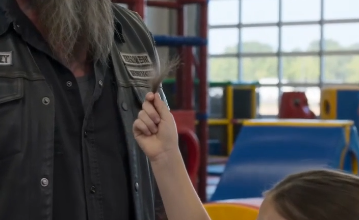
Because he never grabbed. Never rushed. Never forced hugs. If a child handed him a toy phone, he answered it. If a child gave him pretend coffee, he drank it. If a child cried, he sat nearby and let them decide the distance.
He had rules.
No surprises from behind.
No picking kids up unless they asked.
No calling a child “good” for not crying.
“Crying ain’t bad behavior,” he told me once while fixing the broken swing. “It’s weather. Let it pass.”
That line stuck with me because men who look like Dutch are not supposed to speak softly about weather inside children.
The other bikers treated him like road-worn royalty.
There was Pike, a Black American man in his early 60s with a white beard, Vietnam vet patches, and hands gentle enough to repair dollhouses. There was Rosie, a white American woman in her 50s with silver hair, tattooed knuckles, and a laugh that shook picture frames. There was Little John, who was not little, a broad Mexican American biker in his 40s who cooked pancakes on a griddle in the parking lot and cried every time a kid got adopted.
They called each other brother and sister, but they fought like family too.
About money.
About time.
About who had missed a Saturday.
About whether Dutch gave too much of himself to children who would keep leaving.
“Brother,” Pike told him one afternoon, “you can’t make every kid yours.”
Dutch was tightening a loose bolt on the porch rail. He did not look up.
“Wasn’t asking permission.”
That was him.
Short. Flat. Final.
Ellie watched all of this from corners.
She did not run to the bikers like some kids did. She studied them. Especially Dutch. When he sat on the carpet, she sat ten feet away. Then six. Then three. By November, she sat beside his boot and leaned against his knee like she had arrived there by accident.
He never mentioned it.
He just lowered his hand near her, palm open, and waited.
One Saturday, she put two fingers into his palm.
His face changed so slightly most people missed it.
I didn’t.
His eyes went wet.
He looked away toward the window where his Harley sat under bare maple branches, black and still, engine ticking as it cooled.
Inside his leather vest, just below the left breast, I noticed a patch I had never seen before. Not on the outside. Hidden on the lining.
A tiny yellow house.
Under it, one stitched name:
Mara.
I did not ask.
At St. Agnes, secrets often walked in wearing boots.
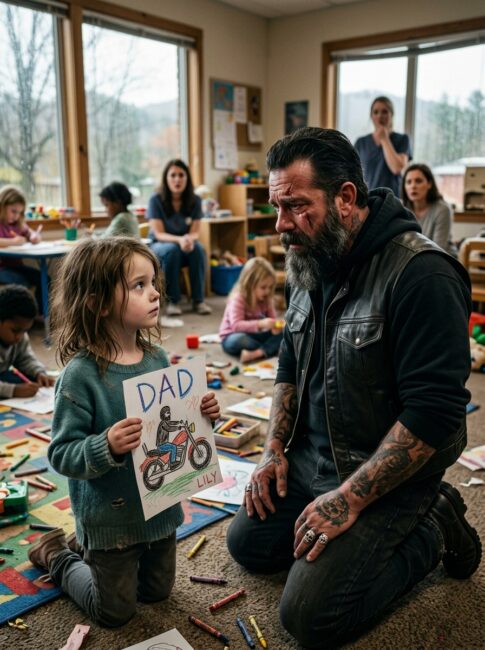
Family art day was supposed to be harmless.
That was my mistake.
I should have known better. Nothing with the word “family” is harmless in a children’s home.
It was early March. Rain had been falling all morning, tapping the old windows and turning the parking lot to a gray mirror. The bikers had come anyway. Engines rolled up the hill one by one, wet and low, headlights glowing through fog.
The kids were restless from being trapped inside.
So I spread butcher paper across the activity room tables and put out crayons, markers, glue sticks, yarn, buttons, stickers, and old magazines.
“Draw your family,” I said.
Some children started right away.
Some froze.
Ellie froze.
She sat at the end of the table with a purple crayon in her hand, staring at the blank paper like it had teeth.
Dutch was across the room repairing a bookshelf that had collapsed under too many donated picture books. He wore his usual cut, jeans, heavy boots, and that same unreadable face. Two toddlers had stuck dinosaur stickers on his sleeves. He had not noticed.
“Draw anything you want,” I told Ellie.
She whispered, “What if I don’t have one?”
I knelt beside her.
“You can draw who feels safe.”
Her eyes moved across the room to Dutch.
I felt my chest tighten.
There are rules in places like ours. Good rules. Needed rules. Boundaries keep children from getting hurt twice. Volunteers are not parents. Staff are not parents. Attachment is precious, and dangerous, and never simple.
Ellie picked up the black marker.
She drew a motorcycle first.
Huge wheels. Smoke coming out of the back. A handlebar shaped like antlers. Then she drew Dutch on it. She gave him angry eyebrows, a long beard, and arms as wide as tree trunks.
Then she drew herself behind him.
Tiny.
Smiling.
Holding on.
Above him, she wrote DAD.
I heard the room go softer.
Not quiet exactly. Children kept coloring. Rain kept tapping the glass. A little boy laughed because Rosie had glue on her elbow.
But every adult within seeing distance stopped moving.
Dutch looked up.
He saw the drawing.
The screwdriver slipped from his hand and hit the floor with a sharp metal clack.
Ellie flinched.
He noticed and immediately lowered himself to one knee.
“Sorry, peanut,” he said. “Dropped it.”
She lifted the paper.
“I made family.”
His throat worked.
“I see that.”
“You’re on the big bike.”
“Looks like me.”
“You’re the dad.”
The rain seemed louder then.
Dutch did not correct her.
That scared me more than if he had.
Before I could step in gently, before I could guide the moment into something safe and professional and approved by policy, our director, Mrs. Harlan, appeared in the doorway with a county social worker.
Her face had that careful brightness adults use when they are about to break a child’s world and call it good news.
“Ellie,” she said, “someone is here to meet you.”
Behind her stood a couple from Charlotte.
White American. Late 30s. Clean coats. Soft smiles. Nervous hands. They had been approved for adoption and matched through the agency. I knew the process had been moving, but not that fast. Not that day.
The woman held a stuffed rabbit.
The man held a folder.
Ellie looked from them to Dutch.
Then back to them.
Her fingers crushed the edge of the drawing.
The woman smiled. “Hi, sweetheart.”
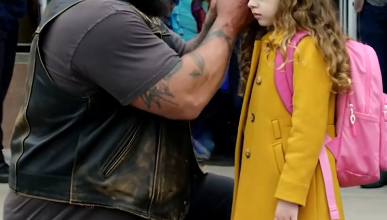
Ellie slid off the chair, walked to Dutch, and hid behind his leather vest.
The room stopped pretending.
Mrs. Harlan’s smile faltered.
The social worker cleared her throat.
Dutch stayed kneeling, one hand on his thigh, the other open but not touching Ellie.
“Peanut,” he said quietly, “you’re safe.”
She whispered something into his vest.
He bent his head.
“What?”
She said it louder.
“I already drew my family.”
The adoptive woman’s face changed.
Not offended.
Wounded.
The man looked at the floor.
Mrs. Harlan asked me to take Ellie to the quiet room. Ellie refused to let go. Her fingers were hooked into the seam of Dutch’s cut so tightly her knuckles whitened.
That was when Dutch saw the lower right corner of the picture.
The tiny name Ellie had written there in crooked letters.
Not Ellie.
Not Dutch.
Not Dad.
Mara.
The color left his face.
He touched the hidden patch inside his vest through the leather, like checking for a wound.
Then he whispered, “No. Not again.”
We thought he meant he had lost another child before.
We were right.
We were also wrong.
The first twist came from Ellie.
Nobody had taught her the name Mara.
Not us. Not the file. Not the county worker. Not the adoptive couple. We checked later.
Mara was not in Ellie’s paperwork.
Mara was the name stitched inside Dutch’s vest.
The second twist came from the drawing.
When Mrs. Harlan gently asked Ellie why she wrote that name, Ellie looked confused, almost annoyed, the way children do when adults fail to understand something obvious.
“That’s what Mommy called me when she was sleepy,” Ellie said.
My mouth went dry.
“What did she call you?”
“Mara-bug.”
Dutch closed his eyes.
His hand went to the chair beside him.
He missed it.
Pike caught his elbow before he fell.
The big man everyone feared stood there with his knees almost gone, rainwater dripping from his beard, leather creaking as his chest moved too fast.
Mrs. Harlan sent the children to the playroom.
The adoptive couple stepped back, holding their rabbit and folder like people who had wandered into the wrong chapter of someone else’s life.
Dutch asked for Ellie’s file.
He did not yell. Did not demand. Did not throw his size around.
He just said, “Please.”
That word from him sounded heavier than any threat.
Mrs. Harlan hesitated. Confidentiality. Procedure. Rules. All real. All important.
Then Ellie, still clutching the drawing, reached into the front pocket of her little sweater and pulled out a broken plastic bracelet.
Pink beads. Cheap string. One metal charm shaped like a yellow house.
She handed it to Dutch.
“Mommy said this was from before.”
Dutch took it like it might burn him.
Inside the charm was a scratched initial.
M.
He sat down hard on one of the child-sized chairs. It groaned under him.
“My daughter’s name was Mara,” he said.
Nobody breathed.
Dutch had not lost a daughter to death like we assumed.
He had lost her to his own life.
Twenty-four years earlier, Mara Mercer had been three years old when Dutch went to prison. Not for something noble. Not defending anyone. He beat a man nearly to death outside a bar after a card game went bad. Alcohol. Pride. Rage. The usual ugly ingredients.
While he was locked up, Mara’s mother moved east.
Changed her number.
Changed the child’s last name.
Told Dutch through a lawyer that if he loved them, he would stay gone.
So he did.
That was the wound under the leather.
He got out. Got sober. Joined veteran rides. Found the Saturday volunteer program after a chaplain told him children needed adults who could sit still with pain.
He never found Mara.
He carried her name inside his vest because it was the only place left to keep being her father.
But Ellie’s mother, the woman who died in that motel, had another name once.
Mara Mercer.
Dutch had been visiting St. Agnes every Saturday for five years.
His granddaughter had been sitting beside his boot for four months.
And nobody knew.
Not even him.
After that, there was no clean scene.
Real life does not give you perfect music and tidy timing. It gives you county offices, birth records, hold music, wet jackets, crying children, and one huge biker sitting alone in a hallway built for nuns, staring at a pink-bead bracelet like it was a map home.
The adoptive couple waited in the conference room.
That is the part people miss when they hear this story. They were not villains. They had driven three hours with hope in their car. They had painted a bedroom yellow. They had a stuffed rabbit named Clover. They wanted to love a child who needed love.
But love is not first come, first served.
And blood alone is not enough either.
Dutch knew that better than anyone.
“I don’t get to claim her because I got old and sorry,” he told Mrs. Harlan.
His voice was rough, like gravel under a boot.
Pike stood beside him, arms crossed.
Rosie cried openly, which made Little John cry, which made him angry, which made him cook pancakes nobody asked for.
The county worker made calls.
Records came back slow.
Mara Mercer had changed her last name to Lane. Ellie’s birth certificate listed no father. Emergency contacts blank. No known relatives.
But in an old hospital intake form, buried in scanned records from years before, Mara had written one name under “family history.”
Caleb Mercer.
Father.
No phone number.
No address.
Just a name.
Dutch stared at the printout.
I watched his tattooed thumb brush over the letters once.
Then he folded it carefully and gave it back.
“Don’t lose that,” he said.
That was his big emotional speech.
The revelation did not turn Dutch into a soft man.
It made him quieter.
He did not rush Ellie. He did not tell her “I’m your grandpa” in the hallway like a man desperate for a title. He asked permission to sit with her in the quiet room.
Ellie was on the rug, hugging her knees, the drawing beside her.
She looked up when he came in.
“You leaving?”
Dutch lowered himself to the floor with a grunt. His boots squeaked on the old linoleum. His vest creaked. Outside the rain kept hitting the window.
“No.”
“Are they taking me?”
“Not today.”
“Are you mad I wrote Dad?”
He swallowed.
“No, peanut.”
“Then why did your face break?”
That one got him.
His eyes went wet.
Bikers like Dutch do not cry easily. Maybe because the world punished them for it early. Maybe because tears feel too close to weakness when you have survived by being hard. But his eyes filled, and he let them.
“My little girl used to have your bracelet,” he said.
Ellie looked at the pink beads around his fist.
“My mommy?”
He nodded once.
“She was my daughter.”
Ellie stared at him.
Not understanding all of it. Children don’t need all the genealogy at once. They need one piece they can hold.
“So you’re her dad?”
“Yeah.”
She looked at the drawing.
Then at him.
“So you’re my…”
She did not finish.
Dutch did not help her.
He waited.
That was the kindest thing he did.
Ellie crawled across the rug and sat beside him, not touching at first. Then she leaned into his leather vest. Her ear pressed against the patch outside. Her fingers found the chain near his shoulder.
“You smell like outside,” she whispered.
His face twisted.
“Sorry.”
“I like it.”
He looked at the ceiling.
I looked away.
Later, we learned more about Mara.
Not enough. Never enough. She had grown up hard. Moved too much. Loved the wrong men. Got clean twice. Relapsed three times. Kept Ellie fed more often than she kept herself fed. Told Ellie stories about a big man on a motorcycle who could make thunder stop at the door.
She had not known how to find Dutch.
Or maybe she had been ashamed.
Or maybe she planned to someday.
Someday is a dangerous country. People die there.
The yellow house patch inside Dutch’s vest had been copied from a drawing Mara made at age four during prison visitation. A house with a crooked roof and smoke from the chimney. He had kept that drawing until it fell apart, then had the patch stitched from memory.
The charm on Ellie’s bracelet was the same house.
Mara had kept her piece too.
That was the real “aha” of it.
Not that Dutch suddenly became family.
He had been family the whole time, separated by rage, prison, shame, bad addresses, and a world that misfiles broken people until they disappear.
Ellie’s drawing did what courts and caseworkers and years of regret had failed to do.
It put everyone back in the same room.
The adoption did not happen overnight.
Nothing good does.
Dutch had to be checked, questioned, inspected, fingerprinted, evaluated, and humbled in rooms where people called him Mr. Mercer and looked over his record with careful eyes.
He answered everything.
Yes, prison.
Yes, anger.
Yes, sober sixteen years.
Yes, nightmares.
Yes, support system.
Yes, stable home.
Yes, motorcycle club.
No, not that kind.
Pike wrote a letter. Rosie wrote six pages. Earl from the diner on Tunnel Road wrote that Dutch had paid for meals for strangers for ten years and never once asked for credit. The VA counselor wrote carefully. The pastor who ran the Saturday program wrote one sentence that stayed with me:
“Mr. Mercer does not perform kindness. He practices it.”
Ellie stayed at St. Agnes while the process moved.
But Saturdays changed.
Before, Dutch arrived with the bikers.
After, he arrived early.
Sometimes before breakfast.
The Harley would rumble up the hill while the fog still sat low on the grass. He would cut the engine and sit there a moment, both hands on the handlebars, like he was asking permission from the morning.
Then Ellie would appear on the porch in pajamas and sneakers, hair wild, waving like she had been waiting since yesterday.
He never ran to her.
He walked.
Big boots on old steps.
Slow enough not to scare the ghosts still living in her body.
She started calling him Dutch-Dad by accident.
Then Grandpa Dutch.
Then sometimes just Dutch.
He accepted all of them.
One Saturday in June, the club built Ellie a small wooden playhouse behind St. Agnes. Yellow paint. Crooked roof on purpose. Painted smoke curling from the chimney.
A copy of Mara’s house.
Pike measured. Rosie bossed. Little John grilled burgers. Dutch hammered nails with a focus so fierce nobody teased him.
Ellie pressed her handprints in purple paint beside the door.
Dutch added one handprint above hers.
Huge. Tattooed. Scarred.
Then he added Mara’s name in tiny black letters under the window.
Not a shrine.
A doorway.
By September, Ellie moved into Dutch’s small house outside Asheville, not far from the road that climbed toward the Blue Ridge Parkway. It had a porch, a garage, and a spare room he had painted yellow without telling anyone. There was a shelf for snacks she did not have to hide. A nightlight shaped like a moon. A hook by the door for her little backpack.
And in the garage, beside his black helmet, hung a child’s purple helmet with butterfly stickers.
He did not take her on the Harley right away.
“Trust first,” he said.
So they sat on it in the garage with the engine off.
Then with the engine on.
Then around the driveway.
Then down the road to the mailbox.
The first real ride was to St. Agnes on a Saturday.
Ellie rode behind him, arms wrapped tight around his waist, chin tucked against his vest.
When they arrived, every child ran to the windows.
The engine cut off.
For a second, the old home went silent.
Then Ellie pulled off her helmet and yelled, “I brought my family!”
Dutch looked down at the pavement.
His beard hid most of his face.
Not all of it.
Years have passed since family art day.
St. Agnes still sits on that hill. The porch still creaks. The back swing still squeaks no matter what we do. Children still arrive with trash bags and leave with suitcases, or families, or scars, or hope, depending on what the world manages to give them.
And every Saturday, engines still roll up the road.
Sometimes five bikes.
Sometimes twelve.
Sometimes only one.
Dutch is older now. His beard is more white than gray. His knees complain when he gets down on the floor, but he does it anyway. He still smells like leather, gas, rain, and mountain air. He still lets children braid his beard. He still answers toy phones.
Ellie is taller.
Ten now.
She has serious gray eyes, her mother’s mouth, and Dutch’s habit of saying little when a lot is happening inside.
Every family art day, she draws the same thing.
A yellow house.
A black Harley.
A big man with angry eyebrows.
A little girl behind him.
But last year, she added one more figure in the sky above the house.
A woman with brown hair, holding a pink-bead bracelet.
Underneath, Ellie wrote three names.
Mara.
Dutch.
Me.
She handed the picture to Dutch.
He studied it for a long time.
Then he folded it once, opened his leather vest, and tucked it inside beside the yellow house patch.
Outside, his Harley waited in the sun.
Children pressed their faces to the glass.
Dutch put on his helmet.
Ellie climbed on behind him.
Her small arms wrapped around his waist.
The engine woke the hill.
And thunder sounded like home.
Follow the page for more emotional biker stories about the heart behind the leather.