Part 2: The Biker Gave Kids Helmets — Until One Birthday Revealed Why
My name is Claire Bennett, and at the time, I was the assistant principal at Kingman Elementary, a low brick school not far from old Route 66, where desert dust found its way into every hallway no matter how often the custodians mopped.
I knew Ray Maddox before I knew his name.
Everybody in town did.
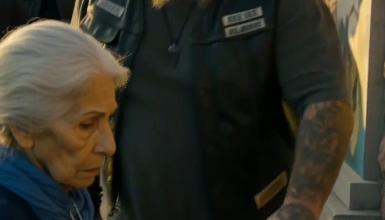
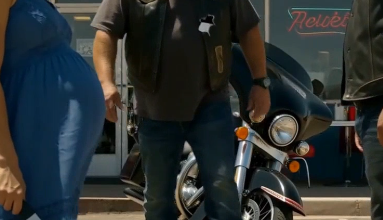
He owned a small repair garage off Stockton Hill Road, the kind of place with sun-faded signs, old tires stacked like black walls, and a coffee pot that looked older than some teachers. Men with Harleys came and went from that garage. Sometimes women too. Leather cuts. Tattooed arms. Cigarette voices. The smell of gasoline, hot metal, sweat, and cheap coffee hung around the place like weather.
People talked.
They said Ray had been in prison when he was young. They said he used to drink hard. They said he had once put a man through a bar window in Laughlin and did not speak for three days after. Some stories were probably true. Some were desert gossip, dried out and sharpened by time.
Ray never corrected anyone.
That made people believe the worst.
The first birthday visit made the school uncomfortable. The second made it curious. By the third, teachers started checking the calendar.
March 18.
Every year.
Same hour. Same rumble. Same black Harley at the front, Ray riding with his club behind him.
They didn’t come onto campus loud. That surprised me. The engines cut off at the curb. After that, all you heard was cooling pipes ticking, leather shifting, boots scraping gravel, and the school flag snapping in the morning wind.
Ray always brought one helmet.
Not a box. Not a donation ceremony. Not a photo op.
One helmet.
He would stand near the bike rack until he saw a child riding without one. Then he would kneel, ask permission from the parent or staff member nearby, adjust the fit, and leave before anyone could thank him too much.
He hated thanks.
“Kid wears it,” he’d say. “That’s enough.”
The club called him Brick. Not because he was dumb. Because once he planted himself somewhere, nothing moved him.
His brothers tested that every year.
Some thought he should stop.
Not cruelly. Just tiredly.
“Brother,” a rider named Dutch told him one March morning, “you keep tearing the scab open.”
Ray was tightening a helmet strap on a boy named Miguel, who had ridden in from the trailer park with one pedal missing a reflector.
Ray didn’t look up.
“Scab’s not the problem.”
“What is?”
Ray clicked the buckle under Miguel’s chin.
“Pretending it healed.”
That was Ray. Five words where other people needed fifty.
There were small things about him that never fit the shape of the rumor.
His nails were always clean, though his hands were cracked black at the creases from grease. He never stepped on school grass. He stood outside the fence unless invited in. He carried stickers in his saddlebag — dinosaurs, stars, little lightning bolts — so kids could decorate the helmets if they thought plain colors were boring.
And every helmet, no matter the color, had Maddie written on the back in silver marker.
I noticed something else the fourth year.
Inside Ray’s leather cut, stitched near the heart, was a tiny yellow button.
Plastic.
Child-sized.
It was shaped like a sunflower.
I saw it when the wind lifted his vest.
It didn’t belong there.
Nothing about Ray looked like sunflowers.
When I asked one of the women riders about it, she went quiet.
Her road name was Sparrow. She had white hair in a braid, tattoos down both arms, and eyes that did not waste kindness.
“That’s not my story,” she said.
Then she looked toward Ray, standing by the curb with a purple helmet under one arm.
“But it’s why he’s still here.”
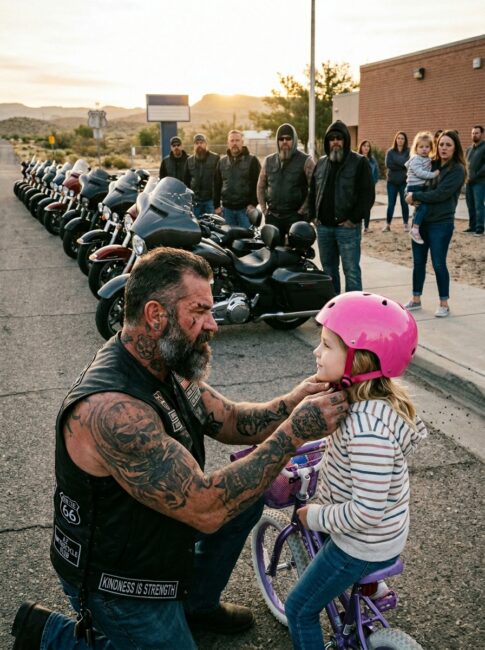
The year everything changed, Ray almost didn’t come.
March 18 fell on a Wednesday.
The desert sky was pale and hard. Wind pushed dust along the curb in little brown ghosts. I was outside before the first bell, holding the same clipboard, watching kids roll up on bikes, scooters, and skateboards.
At 7:36, I heard the engines.
Only three this time.
Not eleven.
Ray’s Harley led them, but the sound was wrong. Slower. Uneven. Like the whole line had lost teeth.
He parked across from the bike rack and sat there longer than usual. His gloves stayed on the bars. His head dipped. The other two riders, Sparrow and Dutch, waited without speaking.
I walked over.
“Ray?”
He did not answer right away.
Up close, he looked older than the year before. His beard had more white. His eyes were red-rimmed but dry. Bikers like Ray don’t cry where people can see it. They hold grief in the jaw, the fists, the neck.
He swung one leg off the bike. The leather of his vest made that old creak. His right hand shook when he reached for the saddlebag.
“You all right?” I asked.
“No.”
That was all.
Inside the saddlebag was a helmet.
White.
Small.
On the back, in silver marker, was MADDIE.
But beneath the name, taped carefully under clear plastic, was a faded photograph of a girl with missing front teeth and dark hair in pigtails. She was sitting on a red bicycle, one hand on the handlebar, one hand lifted like she was telling the camera to hurry up.
I had never seen the photo before.
Ray caught me looking.
“Last one,” he said.
“What do you mean?”
He shut the saddlebag.
“Last helmet.”
Before I could ask more, a boy came around the corner too fast.
His name was Tyler McKee. Ten years old. Skinny. Freckled. Always in trouble for talking, never mean about it. He rode an old blue bike with one brake squealing like a trapped bird. No helmet.
Behind him, another boy shouted, “Race you!”
Tyler looked back.
The sound of tires on asphalt changed.
There are sounds you remember forever because they split time in half.
The skid.
The gasp.
The sharp clap of a bike hitting the curb.
Tyler went down hard near the crosswalk, backpack rolling, front wheel spinning.
For one second, nobody moved.
Then Ray did.
He was off the curb and across the lane before my brain caught up. A pickup braked twenty feet away. A mother screamed. Sparrow threw one arm out to stop traffic. Dutch ran toward the bike rack.
Ray dropped to his knees beside Tyler.
“Don’t move,” he said.
His voice was hard enough to cut through panic.
Tyler’s eyes were open. His cheek was scraped. Blood ran from his eyebrow. His hands fluttered at his sides like he wanted to get up and couldn’t remember how.
“I’m okay,” Tyler said, but his voice shook.
Ray’s hands hovered over him.
Not touching. Not yet.
I saw those hands tremble.
Huge hands. Scarred hands. Hands that could hold a motorcycle steady in desert wind. They trembled over a child on pavement.
For a second, Ray wasn’t outside Kingman Elementary anymore.
He was somewhere else.
Some other road.
Some other child.
I called 911. A teacher brought the nurse. Parents gathered. Kids cried. Tyler’s friend stood white-faced beside the curb.
Ray leaned close.
“Look at me, kid.”
Tyler blinked.
“Breathe slow.”
“My mom’s gonna kill me.”
“No,” Ray said. “Not today.”
The ambulance came fast. Tyler was lucky. Concussion. Stitches. A broken wrist. No skull fracture.
The town treated it like a warning with a clean ending.
The boy survived. The biker had helped. The helmet program mattered. People clapped Ray on the shoulder. The local paper called me for a quote. Parents posted nice things online.
Everyone thought the crisis was Tyler hitting the curb.
It wasn’t.
The crisis came three hours later, when Ray walked into my office, set the white helmet on my desk, and said, “I can’t do this anymore.”
I closed my office door.
Ray remained standing.
He never liked chairs in schools. I think they made him feel too large, too trapped, too aware of the small desks and bright posters and children’s drawings taped to painted cinderblock walls.
The white helmet sat between us.
Maddie’s name faced me.
The photograph beneath it had started to curl at one corner.
“Ray,” I said, “what happened today wasn’t your fault.”
His laugh had no humor in it.
“People say that when they don’t know what else to say.”
I deserved that.
He looked toward the playground through the blinds. Kids were at lunch recess, the younger ones chasing each other under a sky too blue for anyone’s grief.
“I was late once,” he said.
I didn’t move.
He had never told me anything real before. Not directly.
“Maddie’s birthday,” he said. “She turned eight. I was supposed to pick her up right here. Same school. Same curb. I was working on a man’s transmission and told myself ten more minutes.”
His jaw tightened.
“Ten turned into twenty.”
The hallway outside my office went quiet.
He kept looking out the blinds.
“She got tired of waiting. Rode her bike home.”
I already knew how the sentence ended. Still, my stomach dropped.
“Driver never saw her.”
He tapped the helmet with one finger.
“She wasn’t wearing one.”
I looked at the sunflower button inside his vest, barely visible where the leather opened.
“She was your daughter.”
Ray nodded once.
But that was not the twist.
The twist was what he said next.
“Tyler’s father was driving the truck.”
I stared at him.
Ray’s face did not change.
“Today?” I asked.
“No. Back then.”
The room seemed to lose air.
Tyler McKee, the boy who had crashed that morning, was the son of the man who had hit Maddie fourteen years earlier.
I knew Tyler’s father. Aaron McKee. He worked nights at the bottling plant. Quiet man. Always looked tired. He came to parent conferences smelling like machine oil and mint gum, cap twisted in both hands. I had seen guilt on him before, but I thought it was poverty, exhaustion, divorce.
I was wrong.
Ray kept speaking.
“Aaron wasn’t drunk. Wasn’t speeding. Sun was low. Maddie cut across from between two parked cars. He braked. He lived. She didn’t.”
His voice got rougher.
“I hated him anyway.”
Of course he did.
Grief needs somewhere to put its teeth.
“For two years,” Ray said, “I wanted him gone from this town. Wanted him to hurt. Wanted him to wake up choking on her name.”
“And then?”
Ray looked at the helmet.
“Then I saw his boy ride past without a lid.”
He didn’t have to say the rest.
The first child Ray ever gave a helmet to had been Tyler.
Not because Tyler was random.
Because Tyler was the child of the man Ray had almost let himself hate forever.
That was the beginning.
Not charity.
Not a school safety habit.
Not a biker doing one good thing because he missed his little girl.
It was harder than that.
Ray had been choosing mercy every year with his teeth clenched.
And now Tyler had gone down in front of him, on Maddie’s birthday, at the same curb, with no helmet.
That was why his hands shook.
That was why he said he was done.
He wasn’t tired of giving helmets.
He was tired of surviving the same morning.
After Ray left my office, I found Aaron McKee sitting on the curb near the bike rack.
His son was at the hospital. His ex-wife had ridden in the ambulance. Aaron had followed in his truck, then come back because he said he needed Tyler’s bike. But he hadn’t touched it.
He just sat there, cap in both hands, staring at the black skid mark on the pavement.
Ray stood twenty feet away near his Harley.
Neither man spoke.
Sparrow and Dutch stood by the fence, not interfering. That was brotherhood too. Knowing when to step close and when to stay back.
I learned later that the club had nearly split over Ray’s birthday ritual years before.
Some of the brothers thought riding to the school every March kept him chained to the worst day of his life. One prospect said the wrong thing — called it “attention” — and Dutch put him outside so fast the clubhouse door cracked its frame. Sparrow argued that if Ray stopped, he might not make it through the next birthday at all.
So they rode with him.
Every year.
Not because they understood.
Because he asked without asking.
That morning, after Tyler’s crash, they thought they had lost him back to the dark place.
Then Aaron stood.
He crossed the pavement slowly, like he was walking toward a judge.
Ray watched him come.
Aaron stopped with six feet between them.
“I’m sorry,” Aaron said.
Ray’s mouth tightened.
Aaron had said those words before, I’m sure. At the funeral. Through lawyers. In letters Ray may or may not have opened.
But this time he said them with Tyler’s blood still drying on the curb.
“I should’ve made him wear one,” Aaron whispered.
Ray looked at him for a long time.
Then he reached into the saddlebag and took out the white helmet.
The last one.
Maddie’s photograph glinted under the plastic.
I thought he was going to hand it to Aaron.
He didn’t.
He walked past him.
To me.
“Hospital,” he said.
So we went.
Not in a parade. No cameras. No post. Just three Harleys, my dusty Subaru, and a white helmet riding in Ray’s saddlebag down Route 66 toward Kingman Regional.
Tyler was sitting up in the emergency room with a splint on his wrist and stitches over one eyebrow. His mother looked like she had aged five years. Aaron stood in the corner, arms folded tight, trying not to take up space.
Ray filled the doorway.
Everyone went still.
Tyler’s eyes widened.
“Am I in trouble?”
Ray grunted.
“Already handled that yourself.”
The boy looked at the floor.
Ray stepped closer and set the white helmet on the bed.
Tyler read the name.
“Maddie?”
“My daughter.”
Tyler touched the photograph carefully.
“She died?”
“Yeah.”
“On a bike?”
Ray nodded.
“Like me?”
“Almost.”
The room got very quiet.
Tyler swallowed.
“My dad told me.”
Aaron closed his eyes.
Ray’s scarred hands flexed once.
“He should have.”
Tyler looked up.
“Do you hate us?”
That question went through the room like a blade.
Ray did not answer fast.
Bikers like Ray don’t lie to make children comfortable.
Finally, he said, “I used to.”
Tyler’s chin trembled.
Ray sat down beside the bed. The chair looked too small under him.
“Then you rode by my shop one day with no helmet,” Ray said. “Skinny kid. Loud bike chain. Thought you owned the road.”
Tyler gave a weak half-smile.
Ray tapped the helmet.
“I had two choices. Hate your father through you. Or keep your head in one piece.”
He looked at Aaron then.
Not soft.
Not friendly.
But no longer loaded.
“I picked the kid.”
Aaron covered his mouth with one hand.
The sunflower button inside Ray’s vest caught the hospital light.
I finally understood that too.
Maddie had worn sunflower buttons on her backpack. Ray had cut one off after the funeral and sewn it inside his cut where a man like him could carry a little girl without explaining her to strangers.
The silver marker. The one helmet. The exact birthday. The clean nails. The stickers. The way he always checked the strap twice.
None of it was random.
It was a father trying to arrive on time for someone.
Even if it was fourteen years too late for his own child.
Tyler picked up the helmet with his good hand.
“It’s yours,” Ray said.
“I can’t take her helmet.”
“It was never hers.”
Ray’s voice dropped.
“It was what I should’ve bought.”
Tyler held it against his chest.
Aaron stepped forward, but stopped.
Ray saw him.
Then, slowly, he held out one hand.
Aaron looked at it like it might burn him.
He took it anyway.
No hug.
No speech.
Just two men holding the weight of the same day from opposite sides of the road.
Ray didn’t stop coming.
That surprised me.
I thought the hospital room had closed something. I thought giving Tyler the last helmet meant March 18 would finally become just a date.
I was wrong.
The next year, Ray rode up with the club again.
Eleven Harleys this time.
Engines low. Pipes ticking. Boots on gravel. Leather creaking in the dry morning.
But there was no helmet in his saddlebag.
Instead, Tyler walked beside him.
He had grown taller. Still skinny. Still freckled. A faint scar cut through one eyebrow. On his head was the white helmet with Maddie’s name on the back and her photograph under the plastic.
In his arms, Tyler carried a cardboard box.
Inside were twenty helmets.
Red, blue, green, yellow, black, purple, pink.
Every one had a small silver sunflower sticker on the back.
No cameras. No banner. No assembly.
Just Ray, Tyler, Sparrow, Dutch, and a box set on the sidewalk near the bike rack.
Ray didn’t kneel that year.
His knees were bad.
Tyler did.
A first-grade boy rolled up on a bike too big for him, no helmet, shoelace dragging near the chain. Tyler crouched, held up a blue helmet, and said, “Your skull important to you?”
The boy blinked.
Ray snorted.
“Work on your sales pitch.”
Tyler smiled.
“Wear it,” he said. “Please.”
That worked better.
After that, March 18 changed.
Not easier. Never easy.
But wider.
Parents started dropping off helmets in Ray’s garage. The club built shelves for them. Sparrow made a sign that said Maddie’s Lids in careful block letters, then pretended dust got in her eye when Ray hung it on the wall.
Aaron McKee came every year too.
He never stood beside Ray. Not at first. He stayed near the curb, carrying boxes, checking brakes, tightening loose handlebars. Grease under his nails. Cap low.
One morning, I saw Ray hand him a silver marker.
Aaron hesitated.
Then he wrote MADDIE on the back of a red helmet.
His hand shook.
Ray watched.
“Crooked,” Ray said.
Aaron looked ashamed.
Ray capped the marker.
“She’d like crooked.”
Then he walked away before either man had to say more.
That was how Ray forgave.
Not with words.
With work.
Ray Maddox died on a Monday in late October.
Heart gave out in his garage while he was changing oil on Sparrow’s bike. She found him on the concrete floor, one hand still wrapped around a wrench, the radio playing an old country song full of static.
At his memorial, the whole town showed up.
Not because Ray had become harmless.
He never did.
Even in the casket, with his beard combed and his cut folded across his chest, he looked like a man you should not test.
But on the table beside him were fifty-three bicycle helmets.
Each one worn.
Each one scuffed.
Each one with MADDIE written on the back.
Tyler came wearing the white one.
He was sixteen then. Tall. Nervous. Holding his father’s car keys. Aaron stood beside him, one hand on his shoulder.
After the service, the club rode to Kingman Elementary.
The engines rolled down old Route 66 in a line so long traffic stopped without anyone asking. Nobody revved. Nobody showed off. Just that low V-twin sound moving through town like a heartbeat that refused to quit.
At the school curb, Sparrow opened Ray’s saddlebag.
Inside was one last helmet.
Pink.
Still tagged.
On the back, in silver marker, Ray had written two names.
MADDIE.
And under it:
NEXT.
Tyler took it from her.
A little girl rolled up on a bicycle with no helmet, backpack bouncing, hair in messy braids.
Tyler knelt.
The club stood behind him.
Leather creaked. Boots shifted. Pipes ticked hot in the morning air.
The girl looked scared of all those bikers.
Tyler smiled gently and held up the helmet.
“Your head matters,” he said.
She let him buckle it.
Far down Route 66, the last motorcycle engine faded into the desert.
The pink helmet stayed.
Follow the page for more biker stories about the rough-looking people who show up when the world looks away.