Part 2: The Boy Who Asked for 200 Harleys — But Never Wanted to Ride
I was Mason’s night nurse at St. Agnes Children’s Hospital.
People think night nurses see less.
They’re wrong.
We see what families hide in daylight.
We see mothers crying into vending machine coffee. Fathers sleeping in chairs too small for grown men. Grandmothers praying with one hand on a child’s ankle because they are afraid that if they stop touching him, God might forget where he is.
Mason Reed came to us in late September.
He had the polite manners of a boy raised by somebody who believed “yes, ma’am” still mattered. He thanked us after blood draws. Apologized after vomiting. Tried to smile when his mother, Carla, walked in with red eyes and a brave face.
His chart said osteosarcoma.
His body said war.
But his room said motorcycle.
Not posters of race bikes or shiny showroom machines. Real things. A cracked leather glove on the windowsill. A faded photo taped beside his bed. A tiny metal keychain shaped like a motorcycle tank.
In the photo, Mason was six or seven, sitting on a gas station curb along Route 66 with a man in a denim vest kneeling in front of him.
The man was laughing.
Mason was covering his ears.
Behind them sat a black Harley, dusty from road miles.
“That’s his dad?” I asked Carla one night.
She nodded.
“Tommy.”
Her voice changed when she said his name. Not softer. Just thinner.
“Was he a biker?”
“Not club,” she said. “Just a man with a bike and more heart than schedule.”
Tommy Reed had died two years earlier when a drunk driver crossed the center line outside Lebanon, Missouri. Mason had not been with him. Carla told me that like it was a mercy she had to remind herself of.
After Tommy died, Mason stopped asking for rides.
But he kept asking for sounds.
A truck downshifting outside the hospital.
A motorcycle passing on the road.
The deep thump of an engine idling at a stoplight.
Every time, Mason would turn his head toward the window.
Like a dog hearing his owner’s keys.
That was how Duke Harlan entered the story.
Not as a hero.
As a problem.
Duke had been admitted to St. Agnes after a bar fight outside a diner near Halltown. That was the official story. The unofficial story was that a drunk twenty-five-year-old had shoved an old waitress, and Duke had ended the conversation with one hand and poor judgment.
He came in with three broken ribs, a split eyebrow, and a refusal to stay in bed.
Hospital security hated him.
Nurses avoided him.
He had a voice like gravel under tires and a stare that made young doctors check their notes twice.
His club brothers filled the waiting room in leather cuts and boots. The smell of rain, road dust, tobacco, and gas came in with them.
But Duke was not what people thought.
On his second night, I found him in the pediatric hallway at 2:14 a.m., standing outside Mason’s room.
I reached for the phone to call security.
Then I heard him.
He was humming.
Low and off-key.
Mason was awake inside, eyes closed, listening.
Duke saw me and lifted both hands.
“Kid asked what a Harley sounded like up close,” he said. “Couldn’t bring mine upstairs.”
Mason opened one eye.
“He sounds like Dad’s bike,” he whispered.
Duke looked at the boy.
Something moved behind his hard face.
Not sadness exactly.
Recognition.
From then on, Duke stopped by Mason’s room every night before lights out.
He never brought balloons.
Never said fake cheerful things.
He brought simple stuff. A diner milkshake Mason could barely drink. A Route 66 postcard. A patch from his club that Carla wouldn’t let Mason keep until she washed it twice.
And one small silver bell.
“Guardian bell,” Duke said, placing it on Mason’s blanket. “Keeps bad road off a bike.”
Mason held it carefully.
“I don’t have a bike.”
Duke nodded.
“Then it keeps bad road off you.”
That was the first seed.
A bell.
A biker who looked like a threat.
And a boy who listened for engines like they were footsteps on a porch.
By November, Mason stopped talking about next summer.
That is how you know.
Kids don’t understand death the way adults do, but they understand when people stop making promises.
He stopped asking when he could go home.
Stopped asking if his hair would grow back.
One Thursday morning, after a long night of pain and morphine and Carla whispering songs she no longer had the voice for, Mason asked for Duke.
Duke came fast.
Not alone.
He arrived with Preacher, a red-bearded club officer with one cloudy eye, and Nina, a Black American woman in her forties who rode a blue Harley and wore a vest covered in memorial patches. She had lost a son in Afghanistan. She did not smile often, but when she did, it meant something.
Duke walked into Mason’s room and removed his cap.
“You rang, soldier?”
Mason swallowed.
His lips were cracked.
“I want to ride a Harley.”
Carla closed her eyes.
Duke didn’t move.
For once, the big man had no answer.
The doctors said no before anyone asked them.
Too fragile.
Too much pain.
Too much risk.
Outside air could hurt him. Vibration could hurt him. A simple transfer from bed to wheelchair took three adults and a prayer.
Carla cried in the hallway where Mason couldn’t see.
Duke stood with his back against the vending machine, arms folded, jaw working.
“He asked for one thing,” Carla said.
Duke stared at the tile.
His hands were shaking.
Not from fear.
From helplessness.
That is a hard thing for men like Duke. They can lift engines. Fix broken frames. Ride through storms. Stand between danger and a door.
But they cannot punch cancer.
They cannot threaten time.
Preacher finally said, “We bring the ride to him.”
Duke looked up.
By midnight, the phones started ringing.
Club to club.
Veterans to firefighters.
Old riders to young riders.
People who owed Duke favors.
People who hated Duke but loved kids.
People who had never met Mason Reed but knew what a last wish cost.
The plan was simple.
Sunday morning, sunrise, St. Agnes Children’s Hospital.
No revving near the building without permission.
No blocking ambulances.
No club politics.
No colors drama.
No ego.
Just engines.
Springfield police agreed to close one lane along the hospital road for twenty minutes. The hospital administrator nearly refused until Duke put both hands flat on her desk and said, “Ma’am, I am not asking for noise. I am asking for mercy.”
She signed the paper.
Sunday came cold.
Frost on the bikes.
Coffee steam rising from paper cups.
At 6:45 a.m., the first Harley rolled in.
Then another.
Then ten.
Then fifty.
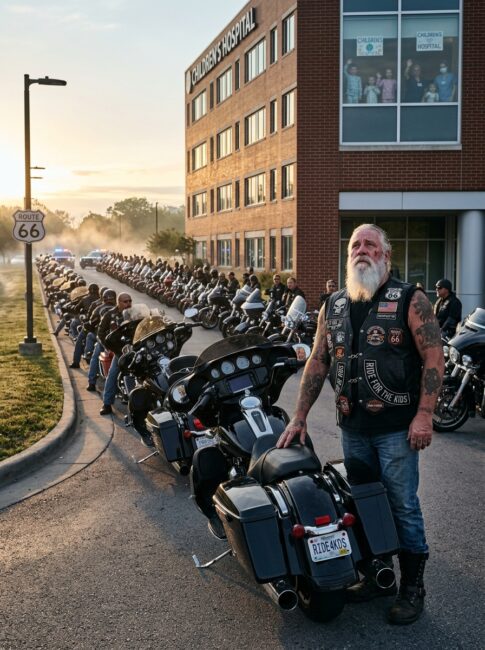
By 7:10, the line stretched past the hospital entrance, around the bend, and down toward Route 66. Touring bikes. Cruisers. Old choppers with paint faded by years. American flags. Cancer ribbons. Memorial patches. Men with white beards. Women with braided hair. Veterans. Mechanics. Truckers. Widows.
Two hundred engines idling low.
The sound moved through the hospital walls.
Not noise.
A heartbeat made of metal.
Mason was already at the window in his wheelchair.
He wore a knit cap and a hoodie three sizes too big. The guardian bell hung from a string around his wrist.
Carla knelt beside him.
Duke stood behind the chair with both hands on the handles, dressed in his black cut, gray beard brushed, eyes dry and red at the edges.
A local reporter whispered to her camera.
“Ten-year-old cancer patient gets final Harley ride.”
Everybody believed that.
We all did.
Duke leaned down.
“Your chariot’s waiting, soldier.”
Mason stared at the bikes.
His face did not light up the way we expected.
Instead, it folded inward.
His small fingers tightened around the bell.
“No,” he said.
Carla blinked.
Duke bent closer.
“You hurting?”
Mason shook his head.
“I don’t want to go down.”
The room froze.
Outside, two hundred Harleys idled in the morning cold.
Duke’s throat moved.
“Then what do you need, son?”
Mason looked at the window.
Then at Duke.
Then at his mother.
“I just wanted to hear my dad come home.”
That was the false ending.
The wish had been granted.
But it was the wrong wish.
Nobody moved for a second.
Even the reporter lowered her microphone.
Carla covered her mouth with both hands, but no sound came out.
Duke stepped back like he had been hit.
The big man who had walked into bars, prisons, courtrooms, and storms without flinching suddenly looked old.
Very old.
“You said ride,” he whispered.
Mason nodded.
“I didn’t know how to say it.”
That is the thing about children near the end.
Adults keep trying to translate them into plans.
Sometimes they only mean a feeling.
Duke turned toward the window.
The engines below were uneven. Each Harley had its own rhythm. Some deep and slow. Some rough. Some clean. Some coughing cold air through old pipes.
Mason closed his eyes.
He listened.
Then he shook his head.
“Not yet.”
Duke looked at Carla.
She looked lost.
“Mason?” she said.
He lifted one thin finger toward the photo beside his bed.
The one of his father at the gas station.
“Dad’s didn’t sound like all of them,” he said. “It went… three slow, then one hard.”
Duke’s face changed.
Preacher stepped closer.
“What did Tommy ride?” he asked Carla.
She wiped her cheeks.
“Black Road King. Older one. He bought it used. It had this bad idle. I kept telling him to fix it.”
Mason smiled a little.
“He said it wasn’t broken. It was talking.”
Duke shut his eyes.
Then he reached inside his leather vest.
The room held its breath.
From an inner pocket, he pulled a folded photograph.
The edges were worn soft.
He opened it and handed it to Carla.
Her knees nearly gave.
It was Tommy Reed.
Younger. Leaner. Standing outside Millie’s Diner beside a black Harley.
Next to him stood Duke.
Same beard, darker then.
Same hard eyes.
One arm around Tommy’s shoulder.
On the back of the photo, written in faded ink:
Tommy Reed — Prospect night, 2009. Almost made it.
Carla stared at Duke.
“You knew him?”
Duke’s jaw tightened.
“Yeah.”
“Why didn’t you say anything?”
Duke looked at Mason.
Then at the floor.
“Because I was the reason he left the club.”
Preacher whispered, “Duke.”
But Duke shook his head once.
No hiding now.
He told it in twelve words, because that was all he could stand.
“I chose pride. He chose family. He was right.”
Tommy had prospected for Iron Covenant years before Mason was born. Duke was harder then. Meaner. Fresh out of prison, full of rules and anger, treating brotherhood like obedience.
Tommy wanted the club.
Then Carla got pregnant.
Tommy stepped away.
Duke called him weak.
They did not speak for years.
And now Tommy’s son was dying in front of him, asking for the sound of the motorcycle Duke had never followed home.
That was the twist.
Mason had not called the bikers to ride.
He had called the last man who remembered exactly how his father’s engine sounded.
Duke left the room without a word.
For one terrible second, I thought he was running from it.
Then I saw him through the window.
He moved across the parking lot with Preacher at his side, boots striking the pavement, leather vest creaking in the cold. Every biker watched him.
Duke raised one hand.
Two hundred engines cut off.
The silence after that was worse than the sound.
Hospital windows held faces. Nurses. Doctors. Parents. Bald children with IV poles. Security guards who no longer looked afraid.
Duke walked down the line.
He stopped at every older black Harley.
Listened.
Shook his head.
Moved on.
Nina joined him. Then Preacher. Then three old mechanics who had ridden since before most of us were born.
They were not looking for a bike.
They were looking for a ghost.
Inside the room, Mason waited with his eyes closed.
Carla sat on the edge of his bed holding Tommy’s photograph.
“I didn’t know,” she whispered.
Mason barely opened his eyes.
“Dad said Duke was loud.”
Carla laughed once through tears.
“He was.”
Outside, Duke reached the far end of the line.
An old rider named Hank sat on a faded black Road King with chipped paint and a dented tank. Seventy if he was a day. White male, narrow shoulders, oxygen tube tucked into his vest pocket, hands swollen with arthritis.
Duke leaned down.
Hank said something.
Duke stepped back.
Hank started the bike.
The engine turned over slow.
Then came the sound.
Three low beats.
A stumble.
One hard cough through the pipes.
Mason’s eyes snapped open.
Carla stood.
The room changed.
Not with joy exactly.
With recognition.
“That’s it,” Mason whispered.
Down below, Duke put both hands on Hank’s handlebars and bowed his head.
Later, Preacher told me Hank had bought Tommy’s bike after the accident. He hadn’t known whose boy Mason was. He just came because a kid asked for Harleys.
The world can be cruel like that.
It can also hand you back a sound you thought was buried.
Duke returned upstairs.
He did not speak at first.
He stood beside Mason’s wheelchair and looked smaller than he had that morning.
Mason reached for him.
Duke bent down.
The boy touched the front of Duke’s vest.
Not the skull patch.
Not the club name.
The little silver guardian bell Duke had pinned near his heart.
“You can make it sound again?” Mason asked.
Duke nodded.
“As long as you want.”
Mason leaned back.
“Not loud.”
Duke looked at Preacher.
Preacher was already on the phone.
They made a new plan in under two minutes.
No parade.
No show.
No cameras.
One bike.
Tommy’s bike.
Hank riding it below the fifth-floor window, slow circles through the hospital drive. Three soft beats and one hard cough. Again and again.
The other 199 bikers stood beside their motorcycles in silence.
Helmets in hand.
Heads lowered.
The reporter never aired her original segment.
She filmed anyway, but she filmed the quiet.
Duke stood in Mason’s room with one hand on the wheelchair and one hand gripping Tommy’s photo so tight the paper bent.
Carla touched his arm.
“I wish he’d known you came.”
Duke’s face turned hard for a second, like pain had knocked and he refused to open.
Then Mason spoke.
“He hears it.”
No one corrected him.
Outside, Tommy’s old Harley circled once more.
Three slow.
One hard.
Talking.
Mason lived nine more days.
Not months.
Not the miracle people beg for under hospital lights.
Nine days.
But those nine days had a sound.
Every afternoon at 4:30, Hank rode Tommy’s old Road King into the hospital drive. If Hank’s hands hurt too badly, Duke rode it. If Duke could not trust himself, Nina did.
The bike never roared.
It idled.
Low. Uneven. Familiar.
Three slow.
One hard.
Mason would close his eyes, and the tight lines around his mouth would loosen. Carla would sit beside him and tell stories about Tommy. How he burned pancakes. How he sang off-key. How he once rode thirty miles back to a gas station because Mason had left a plastic dinosaur on the curb.
Duke listened to every story like punishment.
And maybe like grace.
On the seventh day, he brought Mason a new patch.
Small.
Black border.
White letters.
It said:
HOME SOUND
Carla sewed it onto Mason’s blanket while Duke held the cloth steady in his scarred hands.
His nails were clean.
I noticed that.
For a man who smelled like motor oil and road rain, he kept his hands clean around Mason.
Like he was entering a chapel.
On the ninth night, the hospital was quiet.
Snow tapped the window.
Mason’s breathing had changed. Nurses know that sound. Mothers know it before we do.
Carla climbed into the bed beside him.
Duke stood near the door, because he did not think he belonged closer.
Mason opened his eyes.
“Duke.”
The big man stepped forward.
“Yes, soldier.”
“Tell Dad…”
His voice faded.
Duke bent low.
Mason tried again.
“Tell Dad you came home.”
Duke pressed his lips together.
His eyes went wet.
Still, nothing fell.
“Yes,” he said. “I’ll tell him.”
Mason died at 2:17 a.m.
No engines.
No dramatic speech.
Just snow, a mother’s hand, and a biker standing at attention beside a hospital bed.
The funeral was three days later.
Cold morning.
Gray sky.
Small cemetery outside Springfield, not far from Route 66.
Carla asked for no long procession.
Duke nodded.
Then he gave one order to the club.
“Quiet ride.”
Two hundred bikers came anyway.
They parked half a mile down the road and walked the rest. Boots on gravel. Leather creaking. No engines. No shouting. No club pride.
Just people.
Hank brought Tommy’s old Road King on a trailer because the roads were icy. After the service, he rolled it carefully near the cemetery gate.
Duke stood beside it.
Carla handed him Mason’s blanket with the HOME SOUND patch sewn into the corner.
Duke folded it once.
Twice.
Then placed it across the seat.
Nobody said a word.
He started the Harley.
Three slow beats.
One hard cough.
Carla closed her eyes.
The sound moved over the stones, soft and uneven, like someone familiar pulling into the driveway after dark.
Duke let it idle for ten seconds.
Then he shut it off.
The silence stayed.
Every year now, on Mason’s birthday, Iron Covenant rides to St. Agnes before sunrise.
They don’t rev.
They don’t pose.
One old black Road King circles the hospital drive.
Three slow.
One hard.
And up on the fifth floor, sometimes, a sick child turns toward the window and listens.
The red taillight fades toward Route 66.
The sound stays behind.
Follow the page for more biker stories that reveal the heart beneath the leather.